
Explore the Cosmic Neutrino Background (CνB), the universe’s oldest secrets, detection challenges, and its impact on cosmology and particle physics.
Cosmic Neutrino Background: Unraveling the Universe’s Oldest Secrets
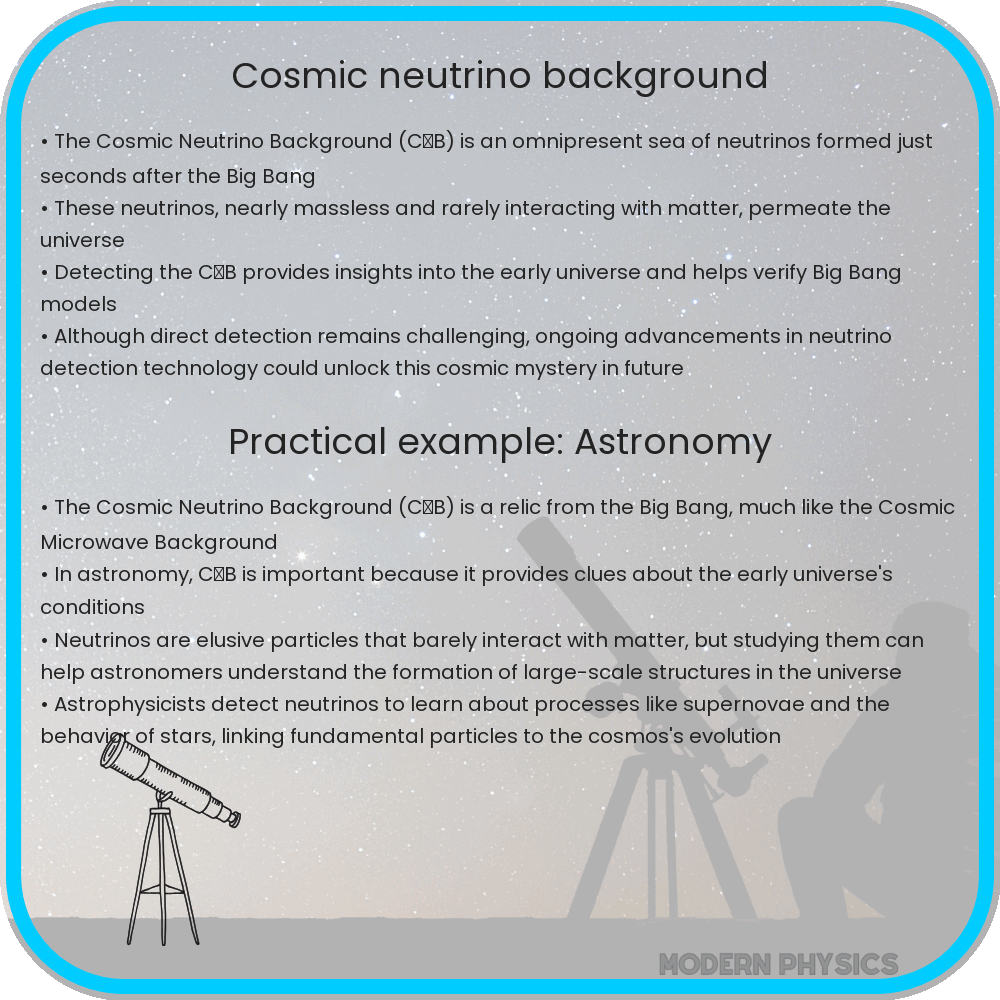
The Cosmic Neutrino Background (CνB) is a fundamental yet elusive aspect of the universe, offering insights into the earliest moments following the Big Bang. Neutrinos are subatomic particles, often referred to as ‘ghost particles’, due to their extremely weak interaction with matter. Despite their elusive nature, neutrinos are abundant, permeating the universe and carrying with them information from the dawn of time.
Detection of the CνB is a monumental challenge in modern physics. Unlike cosmic microwave background radiation, neutrinos do not couple to photons, making them extremely difficult to detect. However, advancements in particle physics have led to innovative detection methods. These include the use of massive underground water tanks or ice-filled caverns designed to observe the rare interactions between neutrinos and other particles.
- Impact on Cosmology: The study of CνB has profound implications for cosmology. It provides unique insights into the early universe, potentially offering answers to longstanding questions about the Big Bang and the subsequent evolution of the cosmos.
- Neutrino Mass: By studying the CνB, scientists hope to measure the absolute mass of neutrinos, a parameter that remains undetermined in particle physics. This measurement could lead to new understandings of particle mass generation and the overall mass-energy composition of the universe.
- Unveiling New Physics: Detection and analysis of the CνB could reveal new physics beyond the Standard Model, potentially uncovering new particles or forces that shape our universe.
The mystery surrounding the CνB is not just about understanding the universe’s infancy but also about unraveling the fundamental laws of physics. As detection techniques improve, the potential for groundbreaking discoveries increases, bringing us closer to answering some of the most profound questions about our cosmos.
The Future of Cosmic Neutrino Background Research
The pursuit to detect and analyze the Cosmic Neutrino Background (CνB) is at the forefront of astrophysical research. As technology advances, scientists are developing more sensitive and expansive detectors capable of capturing these elusive particles. Projects like the IceCube Neutrino Observatory in Antarctica and the future Deep Underground Neutrino Experiment (DUNE) in the United States aim to provide unprecedented insights into the neutrino sector.
Additionally, the integration of quantum computing and machine learning techniques offers promising advancements in data analysis, potentially enabling the identification of CνB signals amid cosmic noise. This multidisciplinary approach not only enhances our understanding of neutrinos but also paves the way for innovative technologies and methodologies in scientific research.
- Interdisciplinary Collaboration: The quest to uncover the secrets of the CνB fosters collaboration across various scientific disciplines, including astrophysics, particle physics, and computer science.
- Advancements in Technology: The development of new detection technologies and computational methods is crucial for the progress in CνB research, driving innovation in both theoretical and applied physics.
- Global Scientific Efforts: The international nature of neutrino research promotes cooperation among countries and institutions, highlighting the global pursuit of knowledge and understanding of the universe.
The detection and study of the Cosmic Neutrino Background represent a pivotal chapter in the annals of cosmology and particle physics. The potential discoveries lie not just in confirming the existence of these primordial particles but in unlocking the mysteries of the universe’s earliest moments and its fundamental constituents.
Conclusion
The Cosmic Neutrino Background remains one of the most tantalizing mysteries in modern astrophysics, offering a unique window into the universe’s formative seconds. Despite the technical and conceptual challenges, the relentless pursuit of CνB detection epitomizes the human quest for knowledge and our relentless pursuit of the cosmos’s secrets. As we stand on the brink of potentially transformative discoveries, the study of neutrinos promises not only to illuminate the past but also to shape the future of scientific exploration.