
Explore the precision, applications, and design principles of beam splitters, essential for advancements in scientific research and technology.
Understanding Beam Splitters: Precision, Applications, and Design Principles
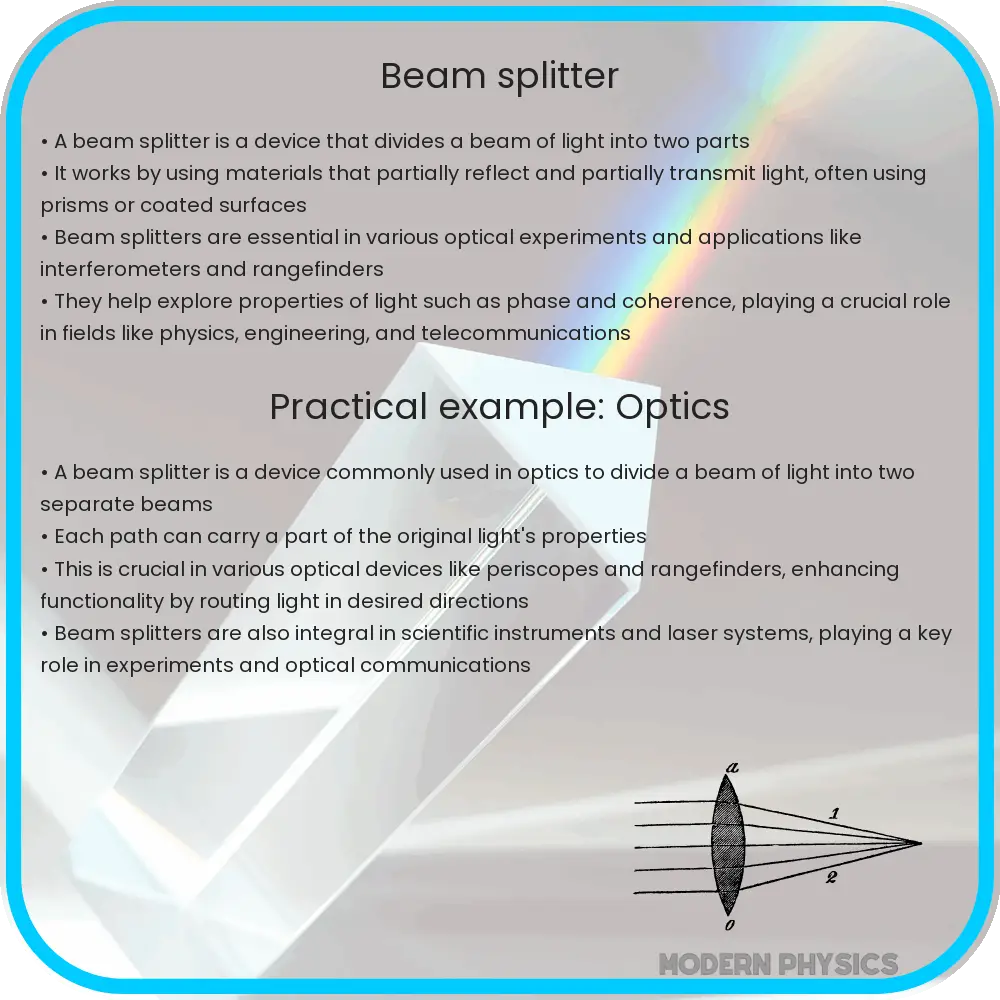
Beam splitters are integral optical components that divide a beam of light into two or more separate beams. Their precision and versatility make them indispensable in a variety of scientific, industrial, and technological applications. This article explores the principles behind beam splitters, their design considerations, and the wide range of applications they serve.
Design Principles of Beam Splitters
The design of a beam splitter is critical to its functionality and efficiency. At the heart of its design is the ability to control the division of light with high precision. Beam splitters are primarily categorized into two types: transmission type and reflection type. Transmission type beam splitters allow a certain percentage of light to pass through, while reflecting the rest. Conversely, reflection type beam splitters are designed to reflect a specific percentage of light, transmitting the remainder. The ratio of split light can vary, offering flexibility in applications requiring different light intensities.
Material selection is another crucial aspect of beam splitter design. Materials such as BK7 glass, fused silica, and even specialized polymers are used based on the required spectral range, thermal stability, and durability. Coatings also play a significant role, with dielectric or metallic coatings applied to achieve the desired reflection/transmission ratios and to minimize losses.
Applications of Beam Splitters
Beam splitters find applications across a broad spectrum of fields. In scientific research, they are pivotal in interferometry, allowing for the precise measurement of wavelengths, distances, and material properties. In telecommunications, they enable signal routing and mixing in optical fibers, crucial for efficient data transmission. Beam splitters are also fundamental in medical devices, particularly in diagnostic imaging techniques like OCT (Optical Coherence Tomography), providing high-resolution images of internal tissues. Furthermore, in laser systems, they are used to direct laser beams for cutting, engraving, and material processing, demonstrating their versatility in industrial manufacturing.
The precision of beam splitters also extends to their use in consumer electronics, notably in digital cameras and projectors, where they help in color separation and image clarity. This wide array of applications underscores the importance of understanding the principles and nuances of beam splitter design to optimize their use in various technological advancements.
Precision in Beam Splitter Design
The precision of a beam splitter not only depends on its material and design but also on the accuracy of the angle at which the light beam is split. This precision is crucial for applications requiring high-resolution imaging and exact light path control. Advanced manufacturing techniques, such as lithography and ion beam sputtering, are employed to achieve surface flatness and coating uniformity, ensuring that the splitter performs exactly as intended. The tolerance levels for beam splitters are specified in terms of wavelength, angle, and intensity, which are critical for the component’s performance in precise optical systems.
Challenges and Innovations
Despite their widespread use, designing and implementing beam splitters come with challenges. One major issue is the inherent loss of light intensity, which can affect the efficiency of the system in which the beam splitter is used. Innovations in coating technology and material science continue to mitigate these losses, enhancing the performance of beam splitters. Additionally, environmental factors such as temperature fluctuations and mechanical stress can alter the properties of the beam splitter, necessitating robust design strategies to ensure long-term reliability and performance.
Another area of advancement is in the customization of beam splitters for specific applications. This includes developing beam splitters that can handle a broad spectrum of light, from ultraviolet (UV) to infrared (IR), and those that can withstand high-power laser applications without degrading. As the demand for more complex optical systems grows, the flexibility in designing beam splitters to meet these specific needs becomes increasingly important.
Conclusion
Beam splitters are pivotal components in the realm of optical technologies, offering precision and versatility that fuel innovation across multiple disciplines. From enhancing scientific research to enabling the development of advanced consumer electronics, the applications of beam splitters are vast and varied. Understanding the principles behind their design, as well as the challenges and innovations that shape their evolution, is essential for leveraging their full potential. As technology advances, the role of beam splitters is set to expand, heralding new breakthroughs in optical science and engineering. The continual improvement in materials, coatings, and manufacturing processes will ensure that beam splitters meet the ever-increasing demands of modern optical applications, maintaining their status as indispensable tools in the quest for precision and efficiency in light manipulation.