
Discover how Optical Rail Systems enhance precision, flexibility, and stability in laboratories and industrial settings for streamlined operations.
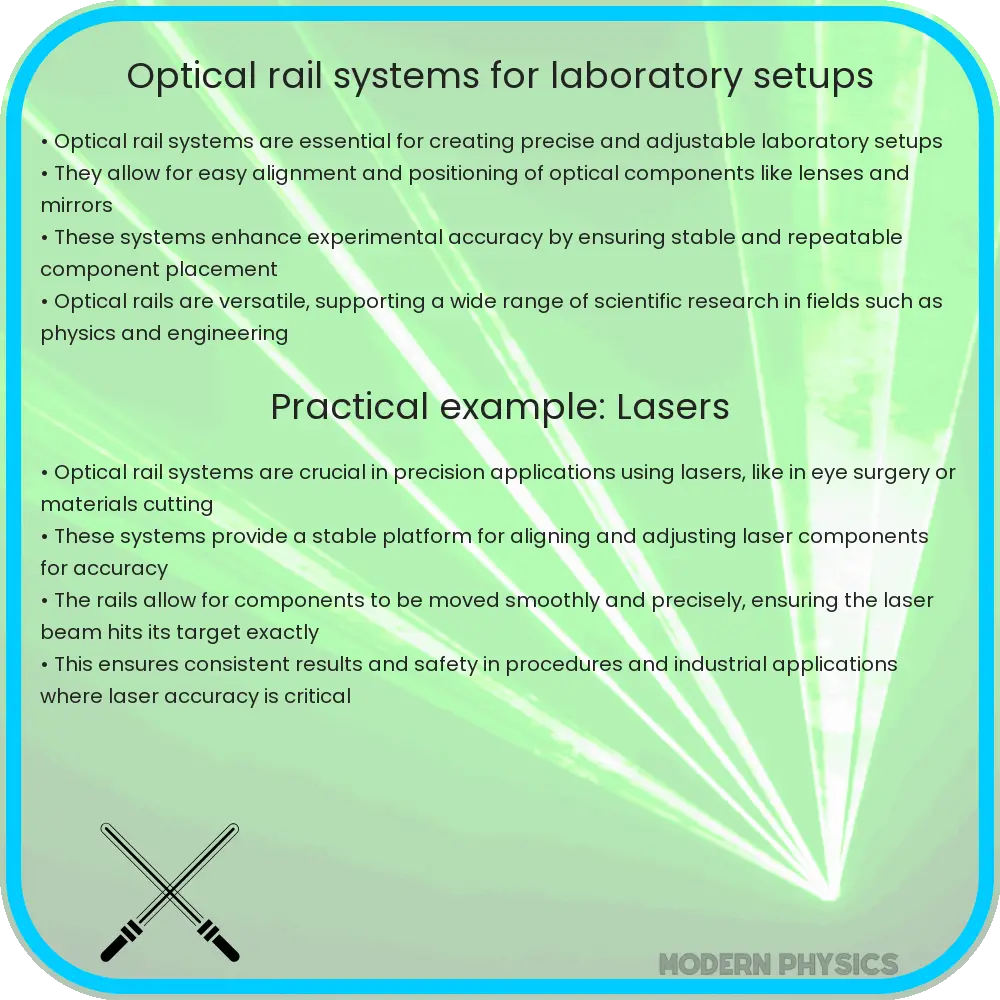
Understanding Optical Rail Systems: Precision, Flexibility, and Stability
Optical rail systems are foundational components in the world of precision optics and photonics, providing a modular and stable platform for complex optical experiments and setups. These systems are designed to meet the demanding requirements of researchers and engineers, offering unparalleled precision, flexibility, and stability in a variety of applications ranging from microscopy to laser optics.
The Core Advantages of Optical Rail Systems
- Precision: Optical rail systems are engineered to ensure precise alignment of optical components. The rails typically feature finely machined surfaces and alignment grooves, enabling components to be positioned with micron-level accuracy. This precision is critical for experiments and applications where the path and alignment of light beams must be controlled with utmost accuracy.
- Flexibility: The modular nature of optical rail systems allows for easy reconfiguration and expansion. Components such as lens holders, mirror mounts, and beam splitters can be quickly added, removed, or adjusted along the rail, facilitating rapid prototyping and customization of optical setups. This adaptability makes optical rail systems ideal for research and development environments, where experimental setups frequently change.
- Stability: Stability is paramount in optical experiments, as even minor vibrations or shifts can lead to significant errors. Optical rail systems are constructed from materials like anodized aluminum or stainless steel, offering robust mechanical stability. The design of the rails and carriers minimizes vibrations and ensures that once an optical component is positioned, it remains securely in place, maintaining the integrity of experimental setups over time.
Applications of Optical Rail Systems
Optical rail systems find applications in a wide range of fields, including but not limited to:
- Laser Experimentation: They provide a stable platform for aligning lasers, modulators, and detectors in experiments involving laser physics and optics.
- Microscopy: Optical rails facilitate the precise alignment of microscopy components for advanced imaging techniques, enhancing image quality and reproducibility.
- Quantum Computing: In the realm of quantum computing, optical rail systems enable the precise setup of optical components necessary for manipulating quantum bits (qubits) with light.
Optical Rail Systems: Enhancing Precision, Flexibility, and Stability in Optical Experiments
Optical rail systems are a cornerstone in the field of photonics, offering an unmatched blend of precision, flexibility, and stability for optical experiments and setups. These systems are designed to support a wide range of optical components such as lenses, mirrors, beam splitters, and detectors, enabling precise alignment and easy adjustments. Whether for research, educational purposes, or industrial applications, optical rail systems play a critical role in advancing optical technologies.
Key Features of Optical Rail Systems
One of the most significant advantages of optical rail systems is their ability to maintain high levels of precision and stability. Precision is paramount in optical experiments where the smallest misalignment can lead to significant errors in results. Optical rails provide a stable platform that ensures components remain in their exact positions once aligned. The rails are typically made from materials that minimize thermal expansion, further enhancing stability under varying environmental conditions.
Flexibility is another hallmark of optical rail systems. They are designed to accommodate a wide variety of optical components and instruments, allowing for easy reconfiguration of setups. This adaptability makes optical rail systems invaluable for research environments where experimental setups frequently change.
Applications of Optical Rail Systems
Optical rail systems find applications in a diverse range of fields, from basic physics research to advanced industrial processes. In academic settings, they are used for teaching concepts of optics and photonics, demonstrating principles such as light propagation, interference, and diffraction. For research, optical rails are essential for experiments in spectroscopy, laser physics, and quantum optics. In the industrial sector, these systems are used in precision manufacturing, quality control, and optical testing.
Conclusion
The importance of optical rail systems in the advancement of optical science and technology cannot be overstated. Their precision, flexibility, and stability make them indispensable tools in both research and industrial applications. By enabling precise alignment and easy modification of optical components, these systems facilitate experiments that push the boundaries of our understanding of light and its properties. As optical technologies continue to evolve, the role of optical rail systems will undoubtedly grow, supporting the next generation of innovations in the field of photonics.