
Explore the crucial role of optical filters in enhancing clarity and precision in geometrical optics, covering types, design, and future advancements.
The Essence of Optical Filters: Enhancing Clarity and Precision
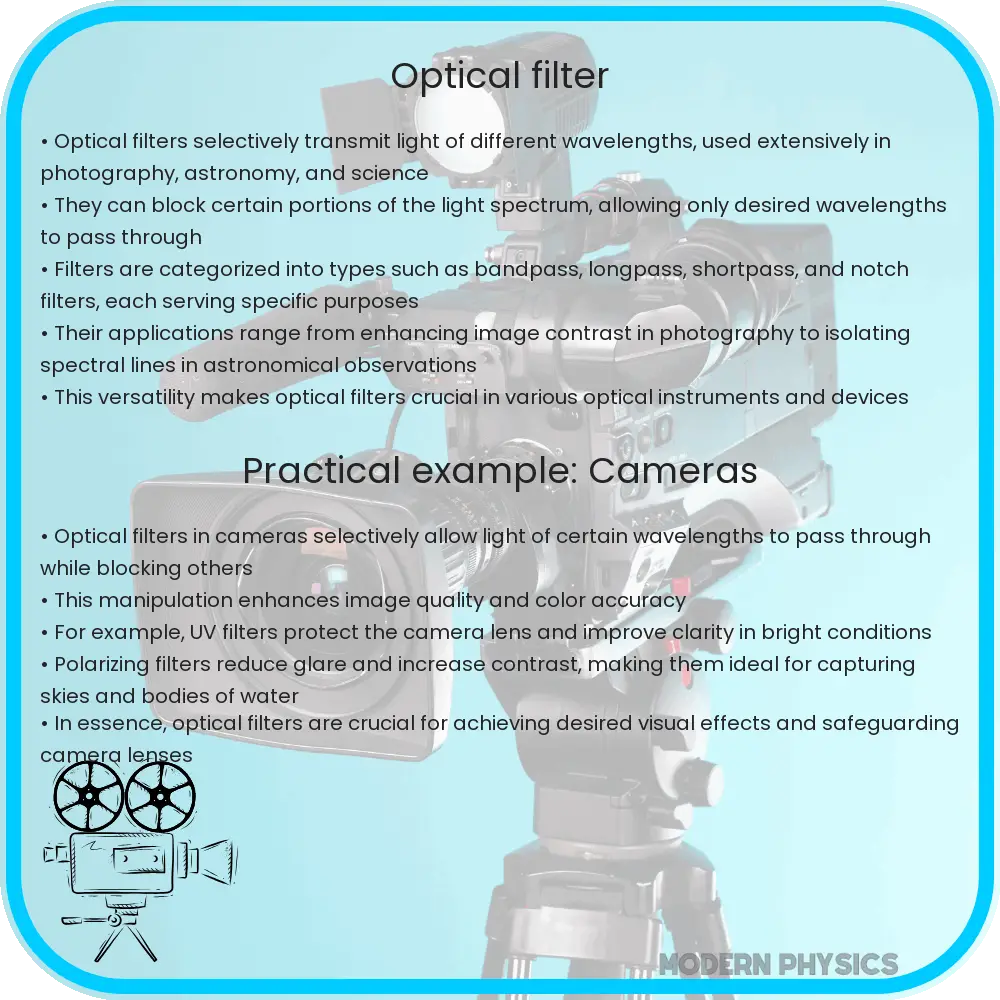
Optical filters play a pivotal role in the realm of geometrical optics, serving as critical components in various applications ranging from photography and astronomy to scientific research and industrial processes. These filters are designed to selectively transmit or block different parts of the light spectrum, thus allowing for the manipulation of light with high precision and clarity.
Understanding Optical Filters
At their core, optical filters are designed to target specific wavelengths of light, enabling the passage of desired spectral regions while attenuating others. This selective transmission is achieved through various methods, including absorption, reflection, refraction, and interference, each tailored to the filter’s intended application.
Key Types and Their Applications
- Bandpass Filters: Allow light within a certain wavelength range to pass through while blocking light outside that range. Ideal for applications requiring specific spectral illumination.
- Longpass and Shortpass Filters: Transmit light above (longpass) or below (shortpass) a certain cutoff wavelength, useful in isolating sections of the spectrum for analysis or imaging.
- Notch Filters: Block a specific narrow range of wavelengths, typically used in laser applications to prevent unwanted laser lines.
- Dichroic Filters: Reflect certain wavelengths while transmitting others, commonly used in fluorescence microscopy and RGB color separation in digital imaging.
Design Considerations for Optimal Performance
Designing an optical filter involves meticulous considerations to ensure it meets the specific needs of its application. Factors such as the filter’s material, thickness, and coating technologies play a crucial role in determining its efficiency, durability, and overall performance. Advanced coating techniques, such as ion beam sputtering (IBS) and vacuum deposition, are employed to achieve high precision and reliability. Furthermore, the geometric design of the filter, including its shape and size, is tailored to fit the optical system, ensuring seamless integration and optimal functionality.
Whether for enhancing the clarity of an image, protecting sensitive equipment from harmful radiation, or precisely controlling the spectral output of a light source, optical filters are indispensable tools in the manipulation of light. Their ability to refine and adjust light properties according to specific requirements makes them essential components in advancing optical technologies.
Advanced Materials and Technologies in Optical Filter Design
The evolution of optical filter technology is closely linked to advancements in materials science and fabrication techniques. Innovations such as ultra-thin films and nano-coatings have opened new possibilities for filter performance and miniaturization. Materials like fused silica, borosilicate glass, and various polymers are selected based on their transmission properties, thermal stability, and resistance to environmental factors. The precision in the deposition of these materials determines the filter’s spectral characteristics, allowing for the creation of highly specialized filters that meet rigorous scientific and industrial standards.
Challenges and Future Directions
Despite their wide-ranging applications and technological advancements, the development of optical filters faces several challenges. These include achieving high durability, maintaining performance under extreme conditions, and minimizing manufacturing costs without compromising quality. Additionally, as the demand for higher precision and efficiency grows, especially in fields like telecommunications, biotechnology, and space exploration, researchers and manufacturers are continuously exploring new materials and technologies to overcome these challenges.
The future of optical filter technology lies in the convergence of interdisciplinary research, incorporating insights from physics, chemistry, materials science, and engineering. Innovations such as metamaterials and plasmonic structures promise to revolutionize the design and functionality of optical filters, leading to even greater control over light properties and opening up new applications in areas yet to be explored.
Conclusion
Optical filters stand at the intersection of science and technology, embodying the quest for precision, clarity, and efficiency in the manipulation of light. From enhancing the quality of photographs to enabling groundbreaking research in optical sciences, these filters are integral to a wide array of applications. The ongoing advancements in materials, design methodologies, and manufacturing techniques continue to expand the capabilities and applications of optical filters. As we look towards the future, the potential for innovation in optical filter technology holds the promise of unlocking new realms of discovery and development across diverse scientific and industrial landscapes. Embracing these challenges and opportunities, the field of geometrical optics is poised for exciting advancements, furthering our ability to harness the power of light in ways we can only begin to imagine.