
Explore the mystery of baryogenesis and why our universe is made mostly of matter, delving into CP violation, Sakharov conditions, and cutting-edge research.
Baryogenesis: Unraveling the Cosmic Mystery
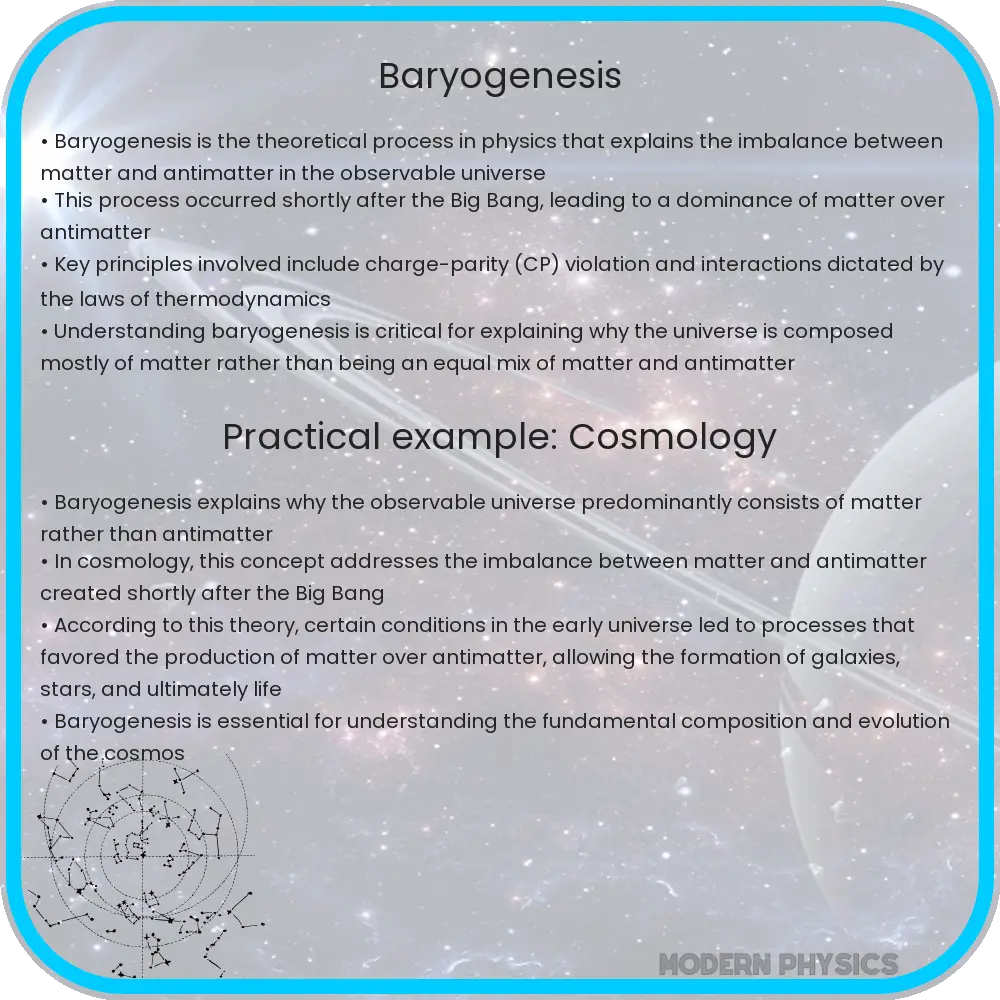
Baryogenesis is a term derived from Greek, where ‘barys’ means heavy and ‘genesis’ means origin. It refers to the theoretical process that explains the imbalance between matter and antimatter in the observable universe. Despite the Big Bang theory suggesting equal amounts of matter and antimatter were created at the dawn of time, our universe is predominantly composed of matter, a phenomenon that remains one of physics’ greatest conundrums.
The Standard Model of particle physics, while remarkably successful in explaining a wide range of phenomena, falls short of accounting for the observed asymmetry. According to this model, the universe should have annihilated itself into a sea of energy as matter and antimatter collided and destroyed each other shortly after the Big Bang. However, for reasons not entirely understood, matter prevailed over antimatter.
Several theories have been proposed to explain this imbalance. One of the most prominent is the concept of CP (Charge Parity) violation, which suggests that the laws of physics might not be the same for matter and antimatter. In particular, certain reactions involving quarks (the fundamental constituents of protons and neutrons) and leptons (such as electrons and neutrinos) could behave differently, leading to a slight excess of matter over antimatter in the early universe.
Another hypothesis involves the existence of undiscovered particles and forces beyond the Standard Model, often grouped under the umbrella of ‘new physics’. These could include phenomena like leptogenesis, which proposes that the decay of heavy neutrinos in the early universe led to an imbalance between leptons and antileptons, subsequently influencing the balance of baryons (protons and neutrons).
- Sakharov Conditions: For baryogenesis to occur, certain conditions must be met, known as the Sakharov conditions. These include baryon number violation, C-symmetry and CP-symmetry violation, and a departure from thermal equilibrium.
- Experimental Evidence: While direct evidence for baryogenesis is elusive, experiments in particle physics, such as those conducted at the Large Hadron Collider (LHC), aim to uncover the mechanisms behind CP violation and other related phenomena.
Understanding baryogenesis not only sheds light on the origins of our universe but also guides the search for new laws of physics beyond our current understanding. As research continues, the puzzle of why our universe is made predominantly of matter edges closer to resolution.
Exploring the Frontiers of Baryogenesis
The quest to unravel the mystery of baryogenesis extends into various domains of physics and cosmology. One significant area of research is the study of cosmic microwave background radiation (CMBR), which provides snapshots of the early universe. By examining the CMBR’s minute temperature fluctuations, scientists can glean insights into the conditions that prevailed during the era of baryogenesis.
Moreover, advancements in astronomical observations and particle physics experiments offer promising avenues to test theories related to matter-antimatter asymmetry. For instance, observations of neutron stars and the behavior of neutrinos could provide indirect evidence supporting the mechanisms proposed by baryogenesis theories. Additionally, ongoing experiments in particle accelerators, like the LHC, are crucial for investigating CP violation and the potential existence of new particles that could have played a role in the early universe’s evolution.
Despite these efforts, baryogenesis remains a topic fraught with uncertainties. The interplay between theoretical predictions and experimental data is complex, requiring the collaboration of physicists across multiple disciplines. One of the primary challenges is the integration of quantum mechanics and general relativity, two pillars of modern physics that are yet to be reconciled in a comprehensive theory of quantum gravity. This reconciliation is crucial for a deeper understanding of the universe’s initial conditions and the subsequent baryogenesis.
Conclusion
Baryogenesis is a cornerstone of cosmological research, addressing the fundamental question of why our universe is composed predominantly of matter. The journey to decipher this cosmic mystery involves a multifaceted approach, combining theoretical physics, particle experiments, and astronomical observations. While significant progress has been made, the full story of baryogenesis is yet to be uncovered, representing one of the most captivating challenges in modern science.
The implications of solving the baryogenesis puzzle are profound, potentially unlocking new realms of physics and reshaping our understanding of the universe. As we stand on the brink of these discoveries, the field remains ripe with opportunities for groundbreaking research. The answers we seek may not only explain the past but also illuminate the future, guiding us towards a more complete and unified theory of the cosmos.