
Explore Electroweak Baryogenesis in QED: uncovering the universe’s matter-antimatter asymmetry, CP violation, and beyond-Standard Model theories.
Understanding Electroweak Baryogenesis in Quantum Electrodynamics
Electroweak Baryogenesis, a fascinating phenomenon in the realm of theoretical physics, offers a potential explanation for the observed matter-antimatter asymmetry in our universe. This concept, embedded within the framework of Quantum Electrodynamics (QED), intertwines with the principles of the Standard Model, particularly during the early moments following the Big Bang.
Origins and Context
The theory of Electroweak Baryogenesis is rooted in the early universe’s conditions, a period characterized by extreme temperatures and energies. During this epoch, the unified electroweak force, a blend of electromagnetic and weak nuclear forces, played a pivotal role. As the universe cooled, a phase transition occurred, leading to the separation of these forces, a process integral to the generation of matter over antimatter.
Mechanisms of Baryogenesis
At the heart of Electroweak Baryogenesis lies the concept of symmetry breaking. As the universe cooled and underwent a phase transition, certain symmetries inherent in the laws of physics were broken. This symmetry breaking is essential for creating an imbalance between baryons (such as protons and neutrons) and antibaryons. The key mechanisms that facilitate this imbalance include:
- Sphalerons: Transient phenomena that violate baryon and lepton number conservation, sphalerons are believed to be instrumental in tilting the balance in favor of matter.
- CP Violation: CP (Charge Parity) violation refers to the difference in behavior between a particle and its antiparticle. This violation is a critical ingredient for baryogenesis, as it provides a directional bias in the creation of matter over antimatter.
Role of CP Violation
CP Violation is a cornerstone of the Electroweak Baryogenesis theory. In the Standard Model, CP violation is quantitatively insufficient to account for the observed matter-antimatter asymmetry. However, theories extending beyond the Standard Model propose additional sources of CP violation. These hypothetical interactions, possibly active during the electroweak phase transition, might have tipped the scales in favor of matter. Electroweak Baryogenesis, therefore, hinges on the existence of these additional CP-violating processes, which remain a subject of intense research and debate in the physics community.
As a bridge between the microcosm of particle physics and the macrocosm of cosmology, Electroweak Baryogenesis presents a compelling narrative, connecting the behavior of fundamental particles to the large-scale structure of the universe. The investigation into this phenomenon continues to challenge and inspire physicists, offering a window into the first moments of our universe and the mysterious predominance of matter over antimatter.
Investigating Beyond the Standard Model
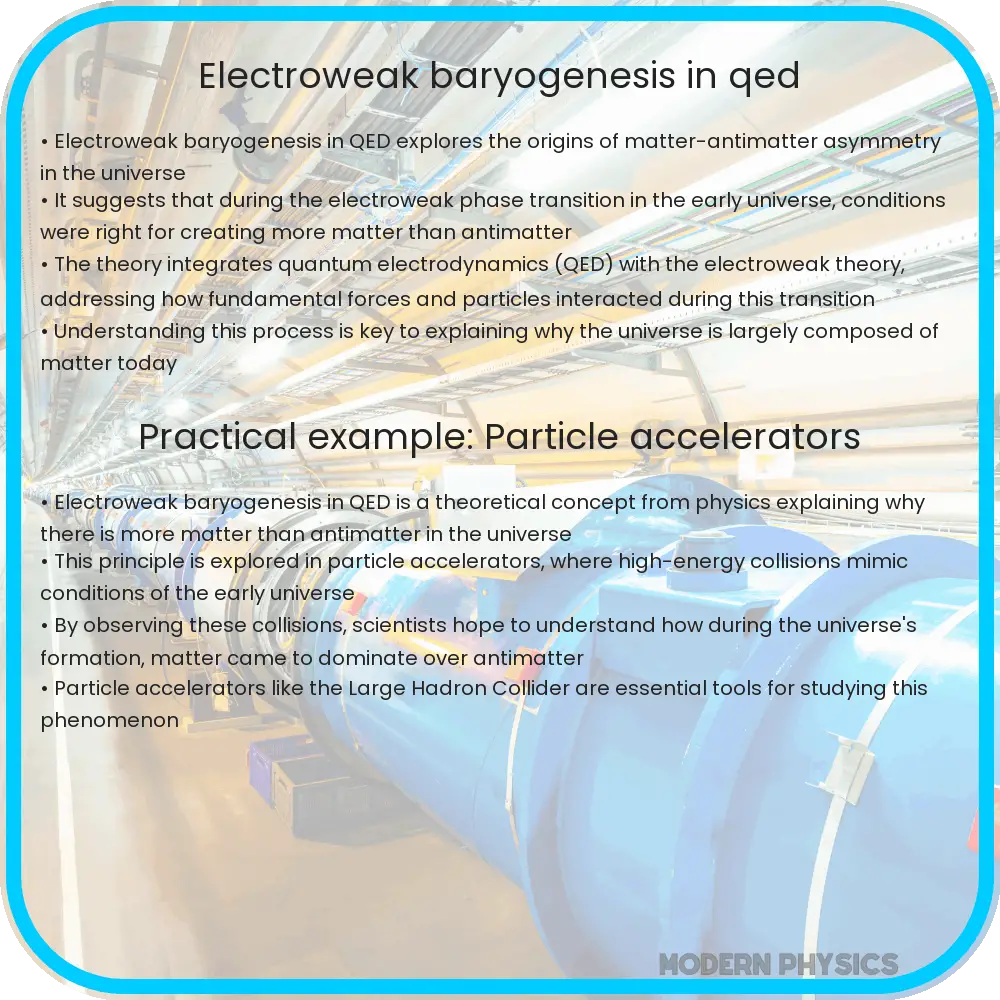
The quest to fully understand Electroweak Baryogenesis leads physicists beyond the confines of the Standard Model. Advanced theories like Supersymmetry (SUSY) and theories involving extra dimensions propose extended frameworks where additional CP-violating mechanisms could exist. These theories suggest that during the electroweak phase transition, new particles and interactions might have played a crucial role in tipping the balance towards matter. Experiments at particle accelerators, like the Large Hadron Collider (LHC), are pivotal in searching for evidence of these theories and the particles they predict.
Experimental Challenges and Future Prospects
Testing the principles of Electroweak Baryogenesis presents significant experimental challenges. The conditions of the early universe are extraordinarily difficult to replicate in laboratory settings. However, particle accelerators and experiments in particle physics provide indirect methods to probe these theories. By studying the properties of the Higgs boson and searching for new particles and CP-violating interactions, scientists hope to uncover clues about the mechanisms behind baryogenesis. Additionally, advancements in astrophysical observations could offer complementary insights, bridging the gap between particle physics and cosmology.
Implications for Cosmology and Fundamental Physics
The study of Electroweak Baryogenesis has far-reaching implications, extending beyond the realm of particle physics into cosmology. Unraveling the mystery of matter-antimatter asymmetry not only addresses a fundamental question about the composition of our universe but also sheds light on the underlying principles governing fundamental forces and particles. The insights gained from this research could redefine our understanding of the early universe, the forces that shape it, and the nature of the matter that comprises it.
Conclusion
Electroweak Baryogenesis stands at the crossroads of quantum physics and cosmology, offering a tantalizing explanation for one of the universe’s greatest mysteries. While the journey to fully understand and prove this theory is fraught with challenges, it holds the promise of unlocking profound truths about our universe. The interplay of advanced theoretical models, cutting-edge experimental research, and astrophysical observations continues to propel this field forward. As we delve deeper into the secrets of Electroweak Baryogenesis, we edge closer to answering fundamental questions about the origin and composition of our cosmos, testament to the unending quest of human curiosity and ingenuity.