
Leptonic CP violation examines differences in behavior between neutrinos and antineutrinos, potentially explaining matter’s dominance over antimatter.
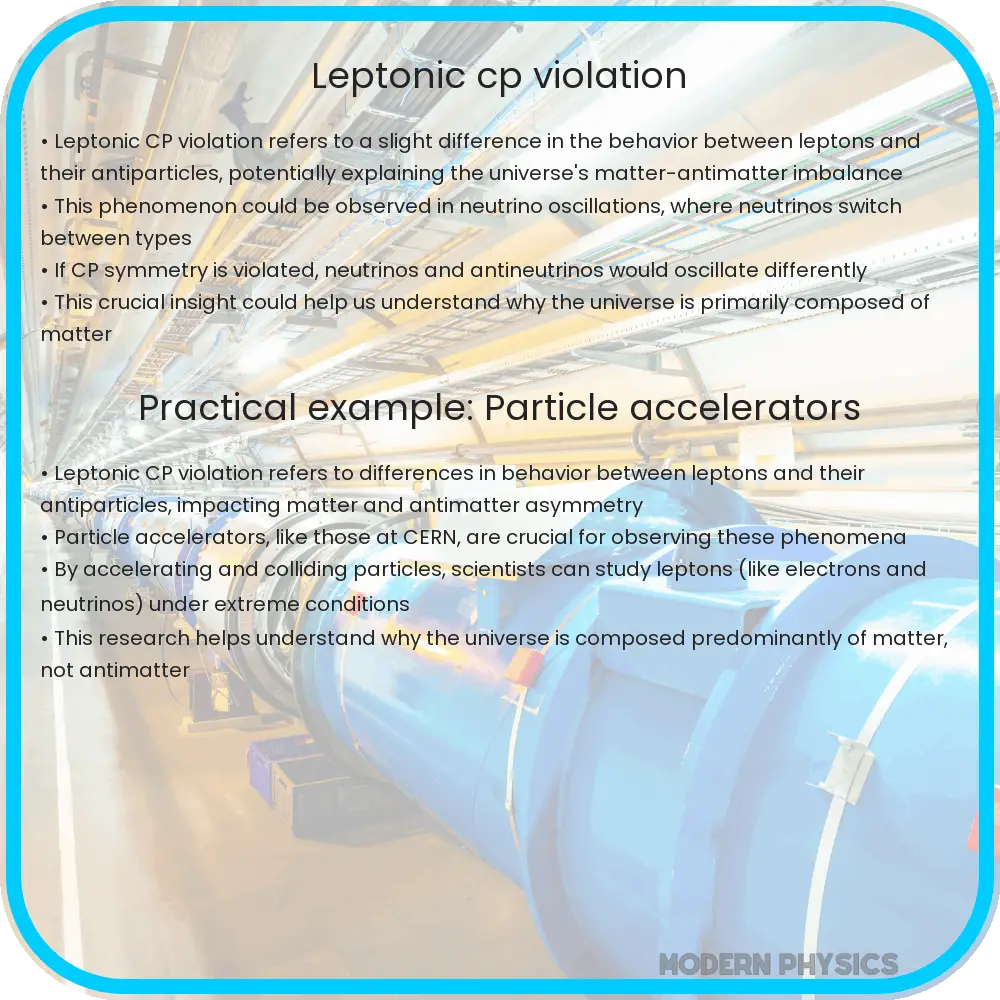
Understanding Leptonic CP Violation: Causes, Detection, and Significance
Leptonic CP violation is a deeply fascinating area in the field of particle physics. It encompasses complex phenomena that challenge our fundamental understanding of the universe. CP violation, or the violation of charge-parity symmetry, is a condition where the laws of physics show differences based on the exchange of particles with their antiparticles and mirror reflections. This article explores the causes of leptonic CP violation, how it is detected, and why it matters.
Causes of Leptonic CP Violation
In the Standard Model of particle physics, particles known as leptons include electrons, muons, and tau particles, as well as their associated neutrinos. CP violation in the leptonic sector mainly involves these neutrinos and is fundamentally linked to the differences in the way these neutrinos and their antiparticles, antineutrinos, behave. This asymmetry can be quantitatively described by a phase in the mixing matrix of neutrinos, known as the Pontecorvo-Maki-Nakagawa-Sakata (PMNS) matrix. This matrix, which explains how neutrinos oscillate between different types or “flavors” (electron, muon, and tau neutrinos), includes a complex phase component that could lead to CP violation.
The precise cause of CP violation in leptons remains theoretical but is generally attributed to the interactions that occur during these oscillations. When neutrinos transform from one flavor to another as they travel through space, certain conditions influenced by this complex phase might lead to measurable differences in behavior between matter and antimatter. This discrepancy is thought to be a key factor in explaining the dominance of matter over antimatter in our universe, a phenomenon known as baryon asymmetry.
Detection of Leptonic CP Violation
Detecting CP violation in neutrinos involves observing the outcomes of neutrino oscillations under controlled experimental conditions. Large, sophisticated experiments are designed to monitor neutrinos and antineutrinos emitted from nuclear reactors or produced in particle accelerators. One of the most notable experiments is conducted by the Tokai to Kamioka (T2K) project in Japan, which sends a beam of muon neutrinos or antineutrinos to a detector located 295 kilometers away.
By comparing the rate at which muon neutrinos convert to electron neutrinos (and vice versa for antineutrinos), scientists can gather evidence of CP violation. Another major experiment is the NOvA experiment in the United States, which analyzes the oscillations of neutrinos and antineutrinos fired over an 810-kilometer course to detect any differences in their transformation patterns. Both experiments aim to precisely measure the complex phase in the PMNS matrix and determine whether it leads to observable CP violation.
Significance of Leptonic CP Violation
The study of leptonic CP violation is not just a pursuit of theoretical interest; it has profound implications for understanding the universe’s very structure. If leptonic CP violation is confirmed, it would provide key insights into why the universe is predominantly composed of matter, not antimatter. This could solve one of the most persistent puzzles in cosmology: why was there more matter than antimatter in the early universe following the Big Bang?
Beyond cosmological implications, confirming leptonic CP violation would significantly advance our understanding of the Standard Model of particle physics. It could guide physicists in modifying existing theories or developing new ones to more accurately reflect the underpinnings of our universe. This exploration is crucial for the ongoing quest to unify all fundamental forces and particles under a single, comprehensive theory.
- Understanding these phenomena might also drive innovations in technology, similar to how the study of electrons led to electronics and significantly changed human lives.
Challenges in Studying Leptonic CP Violation
The detection and confirmation of leptonic CP violation pose significant scientific challenges. Firstly, the effects of CP violation are extremely subtle and require highly sensitive and calibrating instrumentation to observe. The experiments need to distinguish between very small differences in the behavior of neutrinos and antineutrinos over long distances, involving extensive data collection and analysis periods.
Moreover, external factors such as fluctuations in the Earth’s density or interactions with other particles can influence neutrino oscillations, complicating the precise measurement of CP-violating effects. This necessitates ongoing refinement of experimental methods and technologies to isolate and accurately measure the essential variables.
Future Prospects
Advances in technology and experimental techniques continue to improve the prospects of verifying leptonic CP violation. Innovations in detector materials, data processing algorithms, and neutrino beam production are expected to enhance the sensitivity and accuracy of experimental setups. Additionally, international collaborations are expanding, combining resources and expertise from around the world to tackle this complex challenge collaboratively.
As technology progresses, future experiments, such as the planned Deep Underground Neutrino Experiment (DUNE) in the United States and the Hyper-Kamiokande in Japan, promise even finer insights into the nature of neutrinos and their role in CP violation. These cutting-edge projects aim to provide definitive answers to the questions surrounding leptonic CP violation and its implications for the universe.
Conclusion
Leptonic CP violation is a cornerstone of modern particle physics, offering potential explanations for the universe’s dominance of matter over antimatter and challenging current scientific paradigms. Despite the theoretical and experimental complexities involved, the persistent efforts of scientists worldwide are leading towards more precise measurements and deeper understanding. The significance of this research extends beyond the confines of theoretical physics, possibly affecting our approach to understanding the universe’s fundamental aspects and influencing future technological advancements. As research continues to evolve, the answers we find will undoubtedly reshape our comprehension of the natural world, continuing the profound tradition of discovery in physics.