
Explore the mysteries of leptogenesis and its crucial role in explaining the universe’s matter-antimatter asymmetry since the Big Bang in this detailed analysis.
Leptogenesis: Unraveling the Universe’s Deepest Secrets
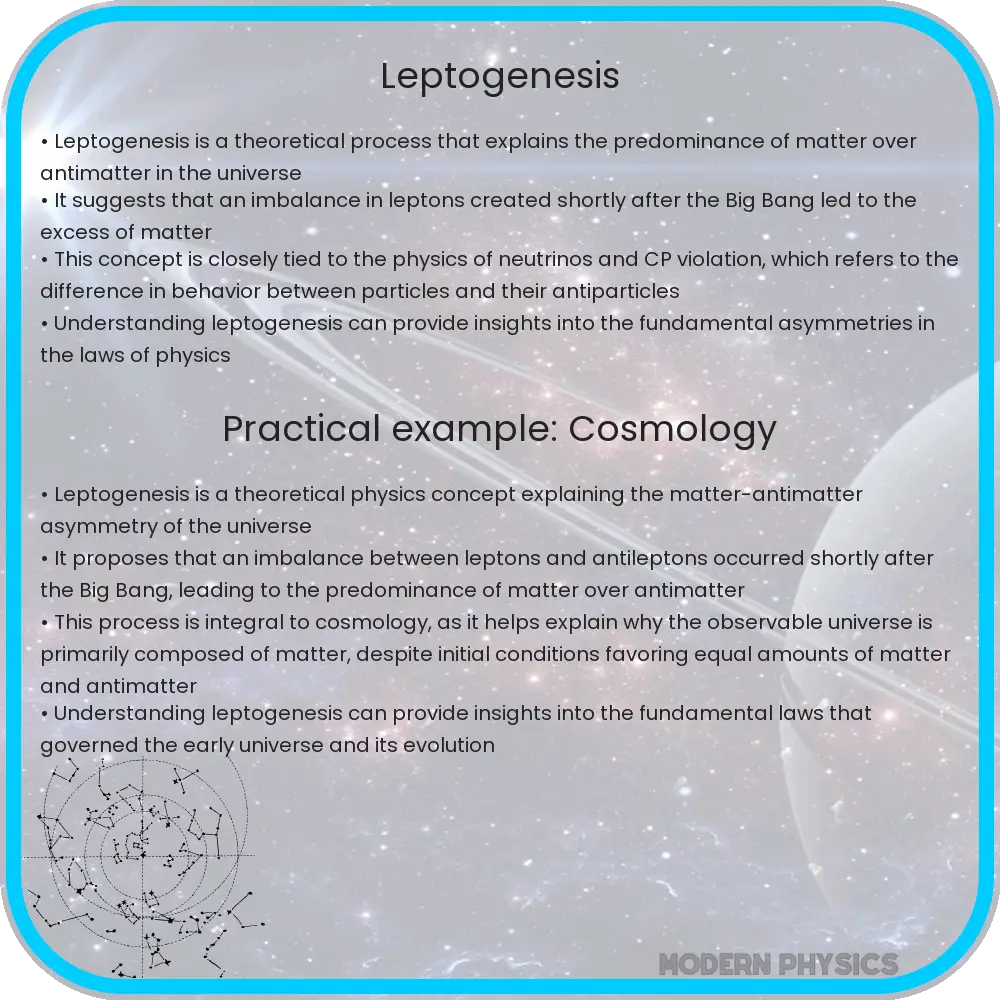
The concept of leptogenesis offers a compelling glimpse into the origins of the universe and the asymmetry between matter and antimatter. This theoretical framework is integral to understanding the conditions following the Big Bang, which led to the dominance of matter over antimatter, making our existence possible. Here, we delve into the mysteries surrounding leptogenesis, its theoretical underpinnings, and its role in cosmic evolution.
Theoretical Foundations of Leptogenesis
Leptogenesis is rooted in the field of particle physics, intertwining with the concepts of the Big Bang, baryogenesis, and neutrino physics. It proposes that the asymmetry between matter and antimatter observed today originated from processes involving leptons, a group of elementary particles that includes electrons, muons, and neutrinos. The theory extends from the work of Sakharov, which outlined three necessary conditions for baryogenesis: violation of baryon number, C-symmetry and CP-symmetry violation, and departure from thermal equilibrium.
Link with Neutrino Physics
A pivotal element of leptogenesis is the role of neutrinos, particularly through the mechanism of neutrino oscillations and the see-saw mechanism. This intricate dance of physics suggests that the mass of neutrinos and the generation of lepton asymmetry are interconnected, leading to the profound hypothesis that the tiny masses of neutrinos could be the key to understanding the dominance of matter in our universe.
Big Bang and Leptogenesis
The narrative of leptogenesis is deeply entwined with the events following the Big Bang. In the nascent universe, extreme temperatures and energies provided a crucible for the formation of elementary particles and antiparticles. As the universe expanded and cooled, processes outlined by leptogenesis theories could have led to a slight surplus of leptons over antileptons, setting the stage for the eventual dominance of matter over antimatter.
- Understanding the Sakharov Conditions
- Exploring the See-Saw Mechanism
- Investigating Neutrino Oscillations
This exploration into leptogenesis not only enhances our understanding of the early universe but also guides us in the quest to unravel the fundamental laws of nature, offering insights into the intricate ballet of particles that shaped our cosmic history.
Experimental Evidence and Challenges
The journey from theoretical models to tangible evidence is fraught with challenges, particularly in the realm of leptogenesis. Despite its solid theoretical foundations, direct experimental evidence remains elusive. Current research is heavily reliant on indirect observations, such as measurements of neutrino masses and oscillations, which align with the predictions made by leptogenesis theories. Advanced experiments in particle physics and cosmology, such as those conducted at the Large Hadron Collider (LHC) and various neutrino observatories, aim to shed light on this cosmic mystery.
Implications for Cosmology and Particle Physics
Leptogenesis has far-reaching implications beyond the realms of particle physics and cosmology. It intersects with several other theoretical frameworks, offering potential insights into the unified understanding of fundamental forces and particles. Furthermore, it provides a critical link between the microscopic world of quantum mechanics and the macroscopic realm of cosmology, offering a unique perspective on the evolution of the universe from its earliest moments.
Future Prospects and Research Directions
The quest to validate and refine leptogenesis continues, with several avenues for future research. Upcoming particle accelerators, improved neutrino detectors, and cosmic microwave background (CMB) observations may provide further clues. Additionally, interdisciplinary approaches combining theories of particle physics, astrophysics, and cosmology are essential to advance our understanding of the early universe and the fundamental asymmetries within it.
Conclusion
Leptogenesis stands as a pivotal concept in our quest to understand the fundamental asymmetries of the universe. While the journey from theoretical speculation to empirical evidence is complex and challenging, the potential rewards are immense. Unraveling the mysteries of leptogenesis could provide not only a deeper understanding of the events following the Big Bang but also a more profound comprehension of the laws governing our universe. As research progresses, we may inch closer to answering one of the most profound questions: why does anything exist at all? In the intricate dance of particles, leptogenesis offers a tantalizing glimpse into the past, shaping our understanding of the cosmos and our place within it.