
Explore the fascinating field of astrobiology, uncovering the origins and evolution of life, and the search for extraterrestrial existence in the cosmos.
Exploring Astrobiology: Unveiling the Mysteries of Life and the Cosmos
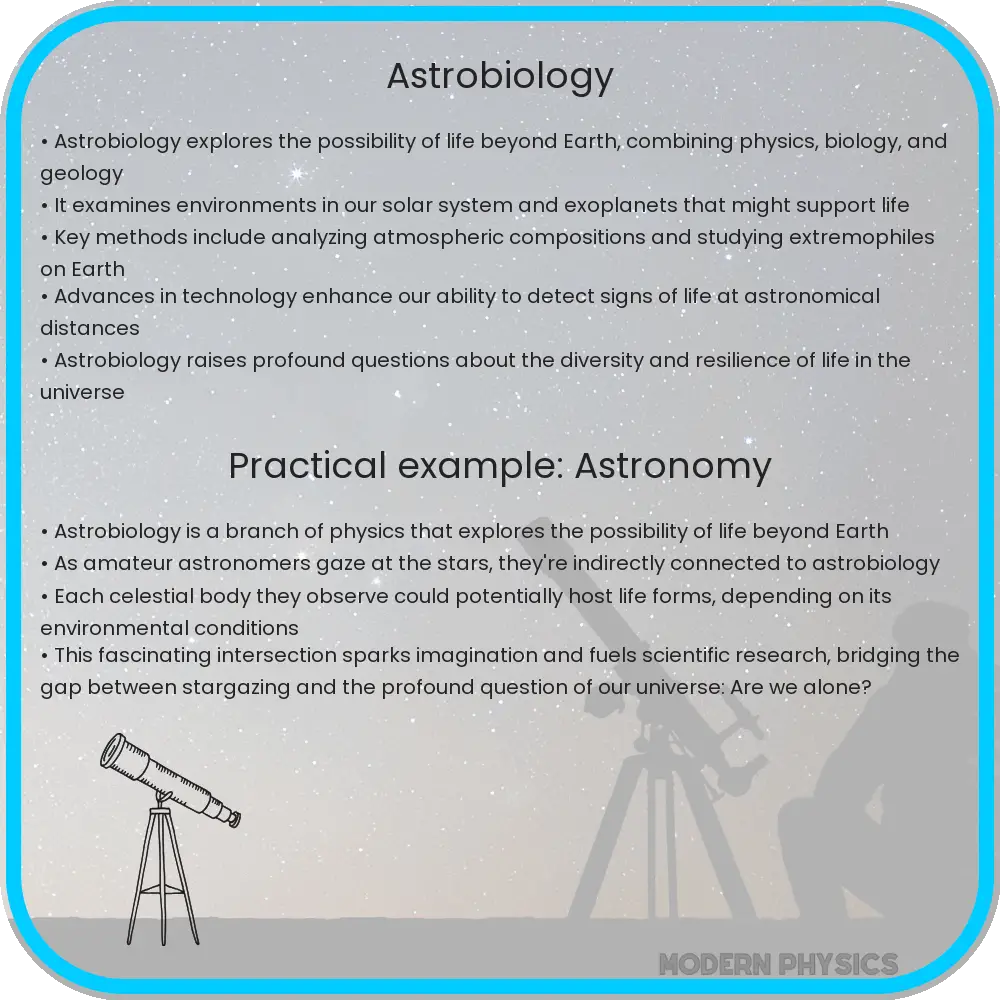
Astrobiology, a dynamic and interdisciplinary field, delves into the origins, evolution, and distribution of life throughout the cosmos. By merging principles from biology, chemistry, astronomy, and Earth sciences, astrobiologists aim to uncover the fundamental secrets of life’s inception and its potential existence beyond Earth.
The Origins of Life on Earth
Life’s origins on Earth are shrouded in mystery, but astrobiology seeks to unravel this enigma. The prevailing hypothesis suggests that life began in the “primordial soup,” a concoction of water and various organic compounds. Energy from lightning or Earth’s geothermal activity could have triggered chemical reactions leading to the formation of simple biomolecules. These molecules, over time, might have formed more complex structures like ribonucleic acid (RNA), setting the stage for the evolution of life.
Life’s Evolutionary Journey
Once life emerged, the process of evolution took over. Natural selection and genetic mutations drove the diversification of life forms. From single-celled organisms, life evolved into the vast array of species seen today. Astrobiology examines these processes not only to understand life on Earth but also to predict how life might evolve under different planetary conditions.
Searching for Life in the Cosmos
The search for extraterrestrial life is a central aspect of astrobiology. Scientists focus on planets and moons within our solar system and exoplanets orbiting distant stars. Key targets include Mars, with its history of water flow, and icy moons like Europa and Enceladus, which harbor subsurface oceans. Beyond our solar system, researchers identify exoplanets situated in the “habitable zone” of their stars, where conditions might be right for liquid water—a crucial ingredient for life as we know it.
Instruments such as telescopes and space probes, equipped with advanced technologies, are used to detect signs of life, known as biosignatures. These may include specific atmospheric gases, such as oxygen or methane, that are often associated with biological processes.
Astrobiology not only seeks to find answers about life beyond Earth but also aims to address profound philosophical and existential questions about our place in the universe. By understanding the conditions that lead to life, we can begin to comprehend the potential for other civilizations and the future of life under varying cosmic scenarios.
Challenges and Future Directions in Astrobiology
Astrobiology faces significant challenges, especially when it comes to detecting life beyond Earth. The vast distances, harsh conditions, and limited technology make space exploration and life detection exceedingly difficult. Moreover, defining life itself—especially in a form that might be completely different from Earth’s life—poses a conceptual challenge. Scientists continue to develop new methods and technologies, such as more sensitive detectors and AI algorithms, to analyze extraterrestrial environments and interpret complex data.
The Role of Astrobiology in Understanding Climate Change and Sustainability
Interestingly, astrobiology also offers critical insights into pressing Earthly concerns, such as climate change and sustainability. By studying the climates and ecosystems of other planets and moons, scientists can draw parallels with Earth, helping to predict future changes and guide our sustainability efforts. This comparative planetology helps us understand how planetary systems can remain habitable and how they might fail.
Interdisciplinary Collaboration and Public Engagement
Astrobiology thrives on interdisciplinary collaboration, merging insights from various scientific fields. This collaborative effort extends beyond academia, engaging the public through education and outreach programs. By sharing discoveries and fostering a sense of cosmic curiosity, astrobiology inspires future generations of scientists and thinkers.
Conclusion
Astrobiology stands at the crossroads of multiple scientific disciplines, exploring some of the most profound questions humanity has ever posed: Are we alone in the universe? How did life begin? Can we live on other planets? While the answers to these questions remain elusive, the journey of discovery itself enriches our understanding of life and the universe. Astrobiology not only extends the boundaries of our knowledge but also challenges our perceptions of life, encouraging us to think beyond our terrestrial confines. As we continue to explore the cosmos, astrobiology will undoubtedly play a pivotal role in shaping our understanding of our place in the vast, mysterious universe.