
Explore the intriguing field of astrochemistry, where chemistry meets astronomy to study molecules, reaction mechanisms, and chemical processes across the cosmos.
Astrochemistry: Bridging the Cosmos and Chemistry
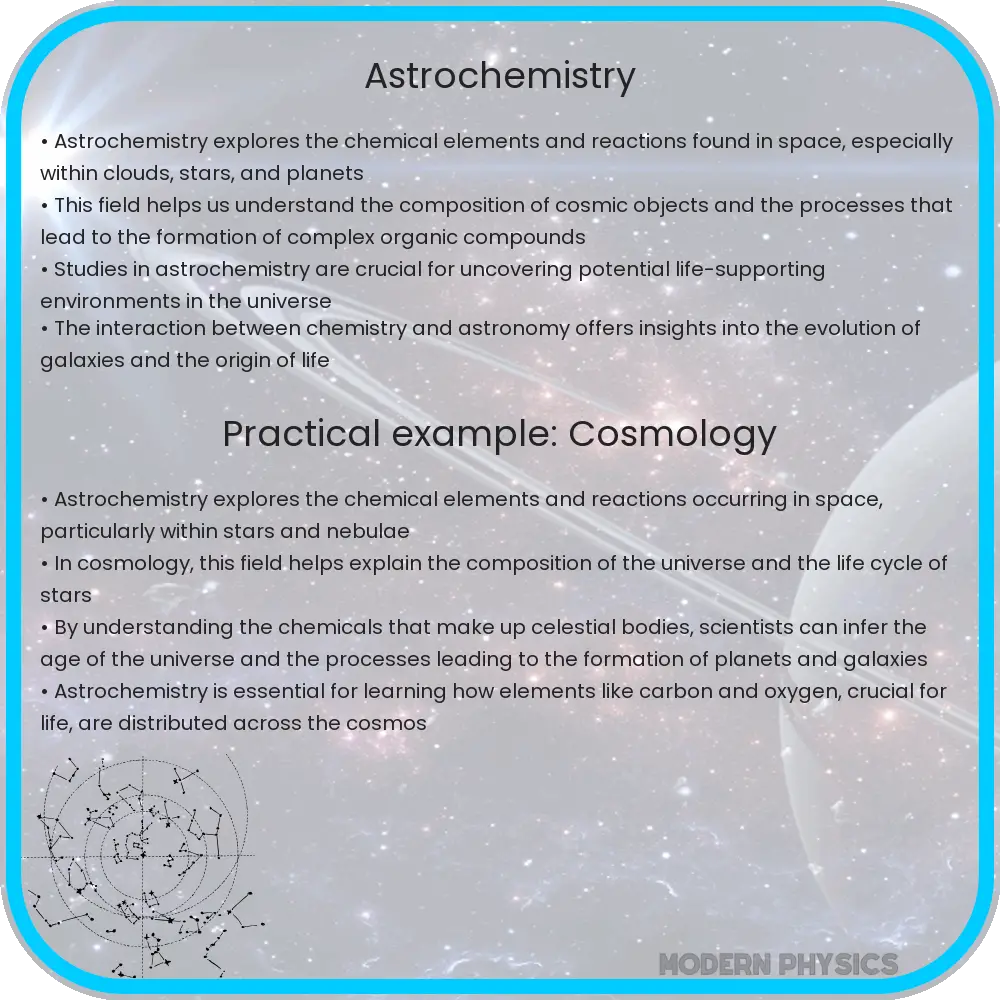
Astrochemistry is a fascinating interdisciplinary science that merges the principles of chemistry and astronomy to explore the molecular nature and chemical processes occurring in the Universe. From the dense clouds of the interstellar medium to the atmospheres of distant exoplanets, astrochemistry provides insights into the molecular composition, reaction mechanisms, and evolutionary pathways of celestial bodies and regions.
Molecules in the Cosmos
The cosmos is teeming with a variety of molecules, from simple diatomic species like molecular hydrogen (H2) to complex organic compounds. The detection and study of these molecules are achieved through spectroscopy, a technique that analyzes the light spectrum emitted or absorbed by substances in space. Notably, the discovery of molecules like water (H2O), ammonia (NH3), and methane (CH4) in various cosmic environments has profound implications for understanding the chemical diversity and potential habitability of celestial bodies.
Reaction Mechanisms in Space
The unique conditions of space, such as low density, ultraviolet radiation, and extreme temperatures, contribute to distinctive chemical reaction mechanisms not commonly observed on Earth. Ion-molecule reactions, radiative association, and photochemistry are among the key processes driving the formation and transformation of molecules in interstellar clouds and circumstellar environments. These mechanisms play crucial roles in shaping the chemical landscape of the cosmos and influencing the evolution of interstellar clouds into new stars and planets.
The Role of Dust Grains
Dust grains in space act as catalysts for chemical reactions and as sites for molecule formation, particularly in the cold and dense regions of interstellar clouds. The surfaces of these grains provide a platform for atoms and molecules to meet and react, leading to the synthesis of more complex organic molecules. This process is essential for the formation of prebiotic molecules, which are considered the building blocks for life as we know it.
Exploring the Chemical Evolution of the Universe
The study of astrochemistry extends beyond identifying molecules in space; it also encompasses understanding the chemical evolution of the cosmos. By examining how molecules form, interact, and break down in various celestial environments, scientists can piece together the history and progression of chemical complexity in the universe. This includes the transition from simple to complex organic molecules and the conditions that may lead to the emergence of life.
The Impact of Astrochemistry on Exoplanet Research
The field of exoplanet research greatly benefits from astrochemical studies. By understanding the chemical composition and processes of exoplanet atmospheres, researchers can infer the planet’s conditions, potential for water, and habitability. Astrochemistry also aids in interpreting exoplanetary spectra, which is crucial for distinguishing between different types of planetary atmospheres and assessing their suitability for life.
Future Directions in Astrochemistry
Advancements in technology and telescopes, such as the James Webb Space Telescope, are enabling more detailed and expansive studies of astrochemistry. Future research aims to uncover more about the cosmic origins of complex organic molecules, the chemical conditions of early Earth-like planets, and the potential for life beyond our solar system. Additionally, laboratory simulations of space conditions and computational models are enhancing our understanding of astrochemical processes and their implications for astronomy and planetary science.
Conclusion
Astrochemistry stands at the crossroads of chemistry and astronomy, offering profound insights into the molecular underpinnings of the universe. By unraveling the mysteries of molecular formation, reaction mechanisms, and chemical evolution in space, astrochemistry not only enhances our understanding of the cosmos but also sheds light on the fundamental questions about the origins of life and the nature of habitable worlds. As we continue to explore the vast chemical tapestry of the universe, the discoveries and insights gained from astrochemistry will undoubtedly play a crucial role in shaping our understanding of the cosmos and our place within it.