
Explore the fundamentals of afocal systems in optics, focusing on alignment, clarity, magnification, and their application in modern technology.
Understanding Afocal Systems in Optics
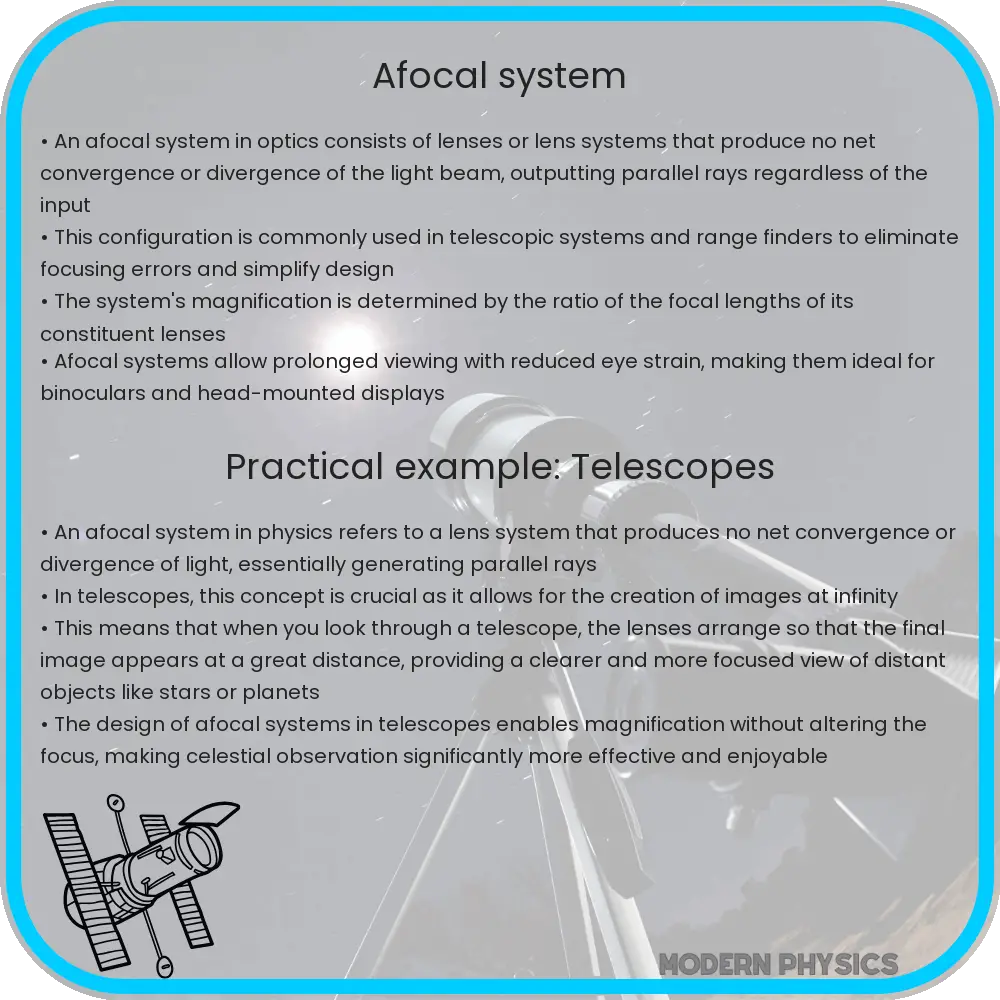
Afocal systems are a cornerstone in the field of optics, playing a critical role in enhancing the alignment, clarity, and magnification of images. These systems are distinguished by their ability to produce an image without a focal point, meaning the output is neither converging nor diverging at the exit of the system. This unique characteristic is pivotal for a variety of optical instruments, including telescopes, binoculars, and camera zoom lenses.
Principles of Afocal System Alignment
Proper alignment in afocal systems is essential for achieving optimal image clarity and magnification. This involves the precise arrangement of optical elements to ensure that light rays are correctly directed through the system. Misalignment can lead to various optical aberrations, such as astigmatism or chromatic aberration, significantly degrading image quality. Techniques such as laser alignment or the use of alignment telescopes are commonly employed to achieve precise optical alignment.
Enhancing Clarity through Afocal Systems
Clarity in afocal systems is achieved by meticulously designing the optical elements to minimize aberrations and by using high-quality lenses and mirrors. Anti-reflective coatings are also applied to surfaces to reduce light loss and glare, thereby enhancing the overall image clarity. The choice of materials and coatings is critical, as they directly affect the system’s ability to transmit and reflect light without distortion.
Magnification Capabilities of Afocal Systems
The magnification in afocal systems is a function of the ratio of the focal lengths of the optical elements involved. By adjusting these focal lengths, afocal systems can provide a wide range of magnification levels without altering the object’s distance from the system. This feature is particularly beneficial in applications requiring variable magnification, such as in zoom lenses where users can easily switch between different magnification levels to focus on objects at varying distances.
In conclusion, afocal systems are instrumental in advancing the field of optics, offering unparalleled alignment, clarity, and magnification. Through the careful selection and arrangement of optical components, these systems enable the production of high-quality images across a wide range of applications, from astronomical observations to everyday photography.
Optimizing Afocal Systems for Diverse Applications
The versatility of afocal systems extends beyond traditional optical instruments, finding utility in advanced applications such as laser rangefinders, night vision devices, and optical add-ons for smartphones. Each application demands specific modifications to the afocal system design to optimize performance. For instance, in night vision devices, afocal systems are tailored to amplify low-light scenes without compromising field of view or depth perception. Similarly, smartphone lens attachments benefit from miniaturized afocal designs that enhance camera capabilities without significant bulk.
Challenges and Solutions in Afocal System Design
Designing afocal systems presents several challenges, primarily related to balancing magnification, field of view, and image quality. High magnification levels can narrow the field of view and introduce image distortion. To counteract these effects, optical engineers employ complex lens designs and aspherical elements to correct aberrations. Computational imaging techniques and adaptive optics are also increasingly used to dynamically adjust and optimize the optical pathway in real-time, enhancing the system’s performance under varied conditions.
Future Directions in Afocal Optics
The future of afocal optics is poised for innovation, with research focusing on materials science, nanotechnology, and computational optics. Emerging materials like meta-materials offer new possibilities for controlling light with unprecedented precision, potentially leading to thinner, lighter, and more efficient afocal systems. Moreover, the integration of computational optics with afocal systems promises to revolutionize image quality and functionality, enabling smarter, adaptive optical devices that can automatically correct for aberrations and adjust to changing light conditions.
Conclusion
Afocal systems represent a foundational element in optical engineering, offering unique advantages in terms of alignment, clarity, and magnification. Their application spans a broad spectrum, from enhancing the performance of traditional optical instruments to enabling the development of innovative technologies. The continuous evolution of afocal systems is driven by advancements in optical design, materials, and computational techniques, ensuring their relevance and utility in a rapidly changing technological landscape. As these systems become more sophisticated, they will undoubtedly open new vistas in optical science and applications, further blurring the boundaries between the visible and the unseen.