
Explore the essentials of security camera lenses, focusing on clarity, zoom, and low-light performance to enhance your surveillance capabilities.
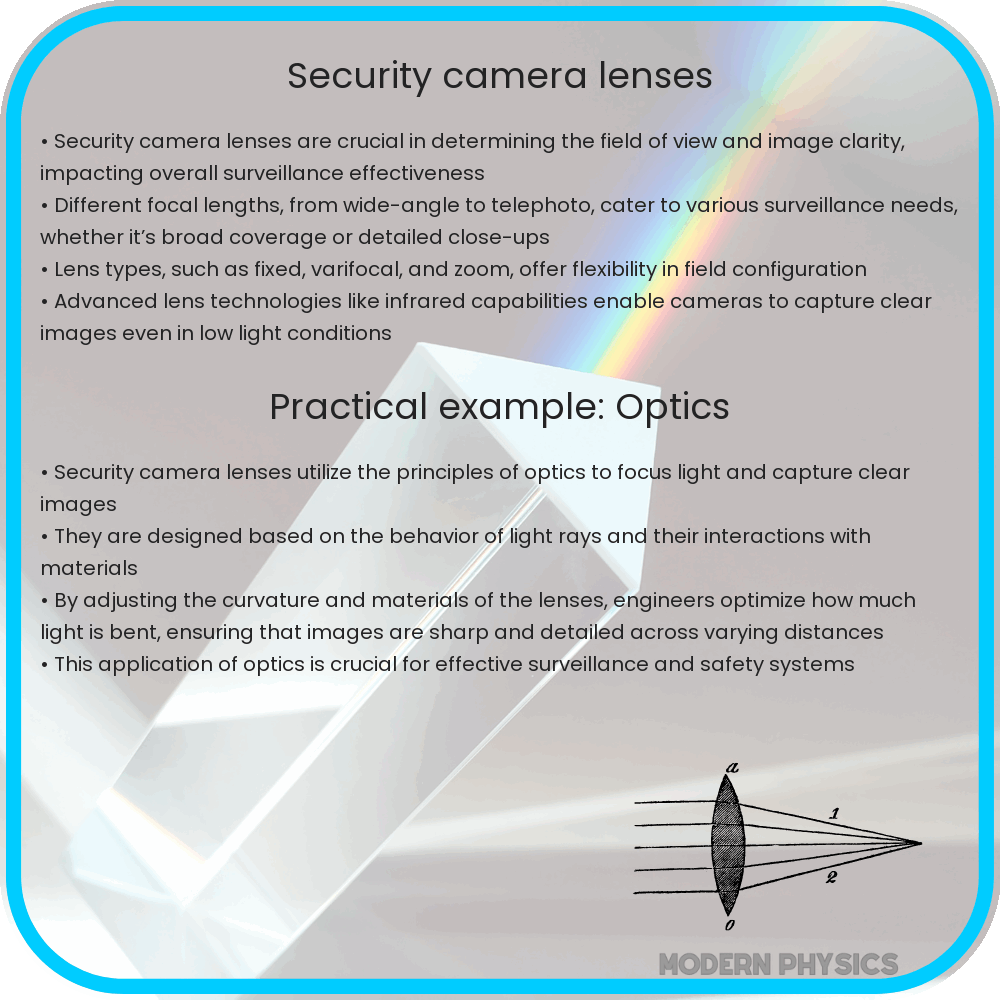
Understanding Security Camera Lenses: A Guide to Clarity, Zoom, and Low-Light Performance
Security camera lenses are critical components that significantly influence the quality of the surveillance footage. The right lens can enhance image clarity, offer superior zoom capabilities, and ensure excellent low-light performance. This guide aims to demystify the complexities surrounding security camera lenses, helping you make informed decisions for your security needs.
Clarity and Resolution
The clarity of a security camera is largely determined by its lens quality and the sensor’s resolution. A high-quality lens ensures that the camera captures sharp images with minimal distortion. The resolution, measured in megapixels, indicates how many pixels the sensor can use to depict the image. Higher megapixel counts allow for clearer images, even when zoomed in, making it easier to identify details such as faces or license plates.
Zoom Capabilities
Zoom lenses on security cameras come in two main types: optical and digital. Optical zoom adjusts the camera lens to bring the subject closer, without sacrificing image quality. Digital zoom, on the other hand, enlarges the image digitally, which can reduce clarity. For surveillance where details are critical, especially over long distances, optical zoom is the preferred choice.
Low-Light Performance
The ability of a security camera to perform in low-light conditions depends on the lens aperture and the sensor’s sensitivity. The aperture, measured in f-numbers (e.g., f/1.4), indicates the size of the lens opening. A lower f-number means the lens can open wider to allow more light to hit the sensor, improving low-light performance. Additionally, sensors designed for low light can capture clearer images in poorly lit conditions by using technologies such as backside illumination (BSI).
When choosing a security camera lens, consider the environment it will be used in and what you need to monitor. A lens with a wide aperture and high-quality optical zoom will be beneficial for areas requiring detailed surveillance, especially in low-light conditions. Understanding these key features will help you select a security camera that meets your security requirements while providing clear and reliable footage.
Understanding Security Camera Lenses: A Comprehensive Guide
Security camera lenses are crucial components that significantly influence the camera’s clarity, zoom capabilities, and performance in low-light conditions. Choosing the right lens is essential for ensuring that your security system captures high-quality, detailed images under various conditions. This article will delve into the aspects of security camera lenses, focusing on clarity, zoom, and low-light performance, to help you make an informed decision for your security needs.
Clarity and Resolution
Clarity in security cameras is primarily determined by the lens’s resolution and its ability to focus light onto the camera’s sensor accurately. A higher resolution lens can produce sharper images, capturing more details. This is particularly important in security applications where identifying faces or license plates is necessary. The lens’s optical design, including the number and quality of lens elements, also plays a significant role in minimizing distortions and aberrations, further enhancing image clarity.
Zoom: Optical vs. Digital
Zoom capabilities allow security cameras to capture details of distant objects. There are two types of zoom: optical and digital. Optical zoom involves physically moving the lens to magnify the image, preserving the resolution and clarity of the image. In contrast, digital zoom enlarges the image through software, which can result in a loss of quality. For security purposes, optical zoom is preferred for its ability to maintain image integrity even at high magnification levels.
Low-Light Performance
Low-light performance is critical for security cameras, as many security incidents occur during the night or in poorly lit areas. The lens’s aperture size, measured in f-numbers (e.g., f/1.4), determines how much light can enter the camera. A lower f-number means a larger aperture, allowing more light to reach the sensor, thus improving low-light performance. Advanced lens coatings can also reduce glare and lens flare, enhancing visibility in challenging lighting conditions.
Conclusion
Selecting the right lens for a security camera is a vital decision that impacts the system’s effectiveness in surveillance tasks. A lens with high resolution and clarity ensures that critical details are captured, while optical zoom capabilities allow for flexibility in monitoring distant subjects without compromising image quality. Furthermore, a lens with excellent low-light performance is indispensable for capturing clear images in any lighting condition. By understanding these key aspects, individuals and businesses can choose security camera lenses that best meet their surveillance needs, ensuring safety and security around the clock.