
Aeroelastic tailoring optimizes aircraft design by enhancing structural integrity and aerodynamic efficiency through material selection and configuration.
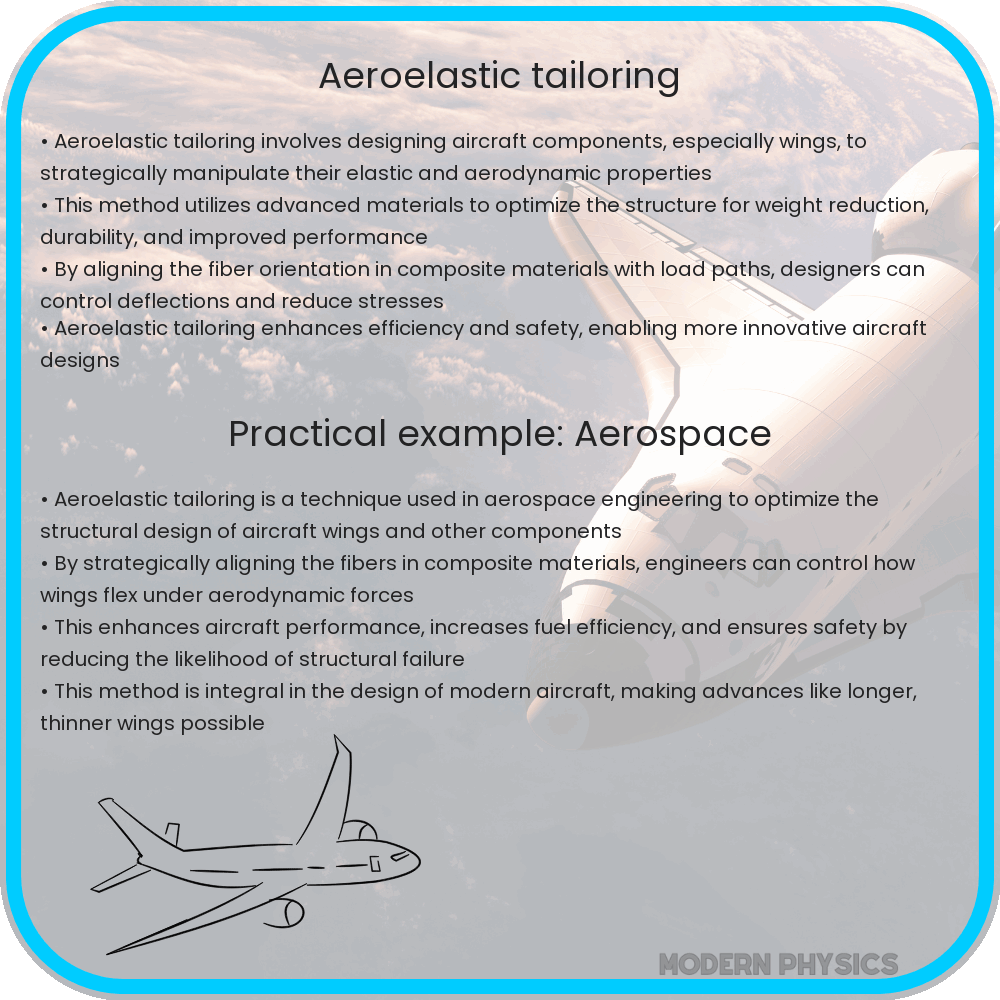
Aeroelastic Tailoring: Enhancing Aircraft Performance through Innovative Design
The science of aeroelastic tailoring is an intriguing aspect of aerospace engineering that focuses on optimizing the structural and aerodynamic properties of aircraft components. This innovative approach ensures aircraft are not only more efficient but also maintain high levels of stability and integrate seamlessly with the surrounding hydrodynamic environment. Here’s a deeper dive into how aeroelastic tailoring is reshaping modern aircraft design.
Understanding Aeroelasticity
Aeroelasticity deals with the interaction between the aerodynamic forces, elastic properties, and inertial forces of aircraft structures. Specifically, it examines how these interactions can lead to phenomena such as flutter, divergence, and control reversal, which can be detrimental to the aircraft’s performance and structural integrity. Aeroelastic tailoring comes into play as a method to counter these potential issues through the design of the aircraft’s structural layout and material composition based on how it responds aerodynamically.
The Role of Aeroelastic Tailoring in Efficiency and Stability
One of the primary goals of aeroelastic tailoring is to improve aerodynamic efficiency. By selecting materials and designing structures that align with the airflow, engineers can significantly reduce drag. This not only enhances fuel efficiency but also contributes to a lower carbon footprint of the aircraft. Moreover, aeroelastic tailoring ensures the aircraft remains stable under different flying conditions. Integrating flexibility and stiffness appropriately within the aircraft wings and fuselage can significantly enhance its response to aerodynamic loads, maintaining stability and safety.
Hydrodynamic Integration
Beyond the skies, aeroelastic tailoring principles also apply to hydrodynamic integration for vehicles like hydrofoils and amphibian aircraft that operate in aqueous environments. In these cases, the design must also consider the dynamics of moving through water. Hydrodynamic forces can differ significantly from aerodynamic forces, so proper tailoring ensures that the aircraft maintains optimal performance without compromising its structural integrity when transitioning between air and water or while solely operating in a water environment.
The integration process involves rigorous computational simulations and physical experiments to test how well the structure withstands various hydrodynamic pressures while maintaining efficiency and stability. Advanced materials capable of withstanding diverse strain rates and pressures are crucial in these designs to adapt to dual environments seamlessly.
- Streamlined design to reduce drag and enhance efficiency both in air and water.
- Material selection that withstands different environmental pressures.
- Balance between rigidity and flexibility to optimize aerodynamic and hydrodynamic response.
Thus, aeroelastic tailoring is a key player in making modern aircraft not just weapons against the force of wind and water, but finely tuned instruments that leverage these elements to the advantage of performance and efficiency.
Material Advances in Aeroelastic Tailoring
Aeroelastic tailoring is as much about material science as it is about aerodynamics. The development and incorporation of new materials such as composites and shape-memory alloys play a pivotal role. Composites are favored for their strength-to-weight ratios and flexibility in tailoring mechanical properties to specific needs. Shape-memory alloys, on the other hand, offer unique capabilities to change stiffness in response to temperature, which can be used to adapt to varying aerodynamic and hydrodynamic conditions dynamically. Such materials empower engineers to design structures that are light yet robust, capable of withstanding and adapting to the complex forces encountered during flight and aquatic maneuvers.
Future Prospects and Challenges
The future of aeroelastic tailoring holds promise for even more sophisticated aircraft designs. As computational tools and material science continue to evolve, the precision in predicting and handling aeroelastic effects will improve, leading to more innovative applications. However, these developments also present challenges, such as the need for advanced manufacturing techniques and the integration of these materials into existing design frameworks. Additionally, engineers must also address the increased costs associated with adopting cutting-edge materials and technologies.
Despite these challenges, the rewards of pursuing advanced aeroelastic tailoring are substantial. Enhancing performance while minimizing environmental impact positions this approach as a crucial development in the evolution of aircraft design.
Conclusion
Aeroelastic tailoring represents a major advancement in the field of aerospace engineering, offering significant improvements in both performance and efficiency. By understanding and leveraging the interplay between aerodynamic forces and structural dynamics, engineers are able to create designs that are not only more efficient and stable but also better integrated with the environment—whether that be air or water.
This integration of cutting-edge material science, advanced computational methods, and innovative engineering practices makes aeroelastic tailoring a cornerstone of modern aerospace design strategies. As technology progresses, this field will likely see even greater efficiencies and capabilities, steering the future of aircraft towards unprecedented heights. Aeroelastic tailoring is not just about overcoming the challenges posed by nature; it’s about using these challenges as stepping stones for greater achievements in aircraft performance.
With every aircraft that benefits from this tailored approach, the boundaries of what is possible in aerospace engineering are expanded, promising a future where air and water vehicles not only coexist with their environments but excel because of them.