
Explore hydrodynamic stability in fluid dynamics: from basics to advanced applications in engineering, environmental science, and CFD analysis.
Understanding Hydrodynamic Stability in Fluid Dynamics
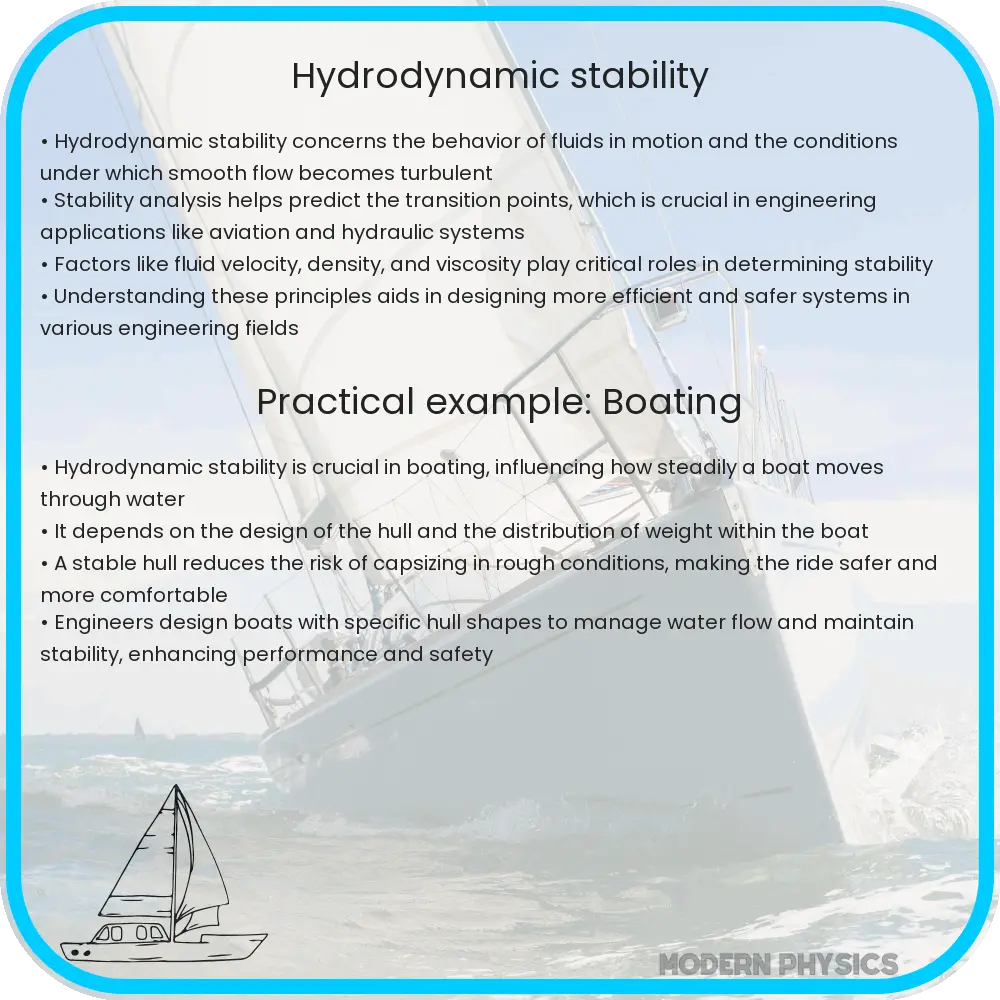
Hydrodynamic stability is a fundamental concept in fluid dynamics, crucial for the analysis and control of fluid flows. It refers to the behavior of fluid flows when they are subjected to small disturbances. Understanding this concept is essential in various fields, including engineering, meteorology, and oceanography.
The Basics of Hydrodynamic Stability
At its core, hydrodynamic stability involves the study of how fluid flow reacts to minor perturbations. A stable flow will return to its original state after a disturbance, while an unstable flow will deviate further from its initial state. This phenomenon can be observed in both laminar and turbulent flows. In laminar flow, the fluid moves in smooth, orderly layers, whereas in turbulent flow, the movement is chaotic and irregular.
Linear Stability Analysis
One of the primary methods used to study hydrodynamic stability is linear stability analysis. This technique involves applying small perturbations to the flow and observing the linear response of the system. The governing equations of fluid motion, typically the Navier-Stokes equations, are linearized around a base flow to simplify the analysis.
Rayleigh’s Criterion and the Orr-Sommerfeld Equation
A key development in understanding hydrodynamic stability was Rayleigh’s criterion, which provides a condition for the stability of inviscid (frictionless) parallel flows. Building on this, the Orr-Sommerfeld equation, a fundamental equation in fluid dynamics, describes the behavior of viscous flows and allows for more comprehensive stability analysis.
Application in Flow Control
Hydrodynamic stability analysis is not just theoretical; it has practical applications in flow control. By understanding the stability characteristics of a flow, engineers can design systems to either enhance stability (in cases like aircraft wing design) or exploit instability (as in mixing processes in chemical engineering).
Conclusion
In summary, hydrodynamic stability is a critical aspect of fluid dynamics, offering insights into the behavior of fluid flows under disturbances. Through techniques like linear stability analysis and the application of principles such as Rayleigh’s criterion, researchers and engineers can predict and manipulate flow behavior for various practical applications.
Advanced Aspects of Hydrodynamic Stability
Delving deeper into hydrodynamic stability, researchers explore complex scenarios beyond basic laminar or turbulent flows. This includes the study of transitional flows, where the flow changes from laminar to turbulent, a critical area in aerodynamics and marine engineering.
Nonlinear Stability Analysis
While linear stability analysis offers a starting point, real-world fluid dynamics often require nonlinear stability analysis. This approach considers the full magnitude of disturbances, providing a more accurate picture of fluid behavior, especially in highly turbulent or chaotic systems.
Computational Fluid Dynamics (CFD) in Stability Analysis
With advancements in computational power, Computational Fluid Dynamics (CFD) has become a vital tool in studying hydrodynamic stability. CFD allows for the simulation of complex fluid flows, enabling detailed analysis of stability in scenarios that are difficult to replicate in laboratory settings.
Stability in Multiphase Flows
Multiphase flows, involving more than one phase of matter (like liquid-gas mixtures), present unique stability challenges. Understanding the stability in these flows is crucial in industries ranging from oil and gas to pharmaceuticals.
Environmental and Geophysical Applications
Hydrodynamic stability also plays a significant role in environmental and geophysical contexts. For example, understanding ocean current stability is vital for climate modeling, while atmospheric stability analysis is essential in weather prediction and climate research.
Conclusion
Hydrodynamic stability is a multifaceted field, integral to understanding and controlling fluid flows in various applications. From aerodynamics to environmental science, the principles of stability analysis guide the design and optimization of systems. As computational capabilities continue to grow, so too will our understanding and ability to manipulate fluid dynamics for human benefit. This field, blending theory with practical application, remains a vibrant area of research and innovation, promising further advancements and discoveries in the future.