
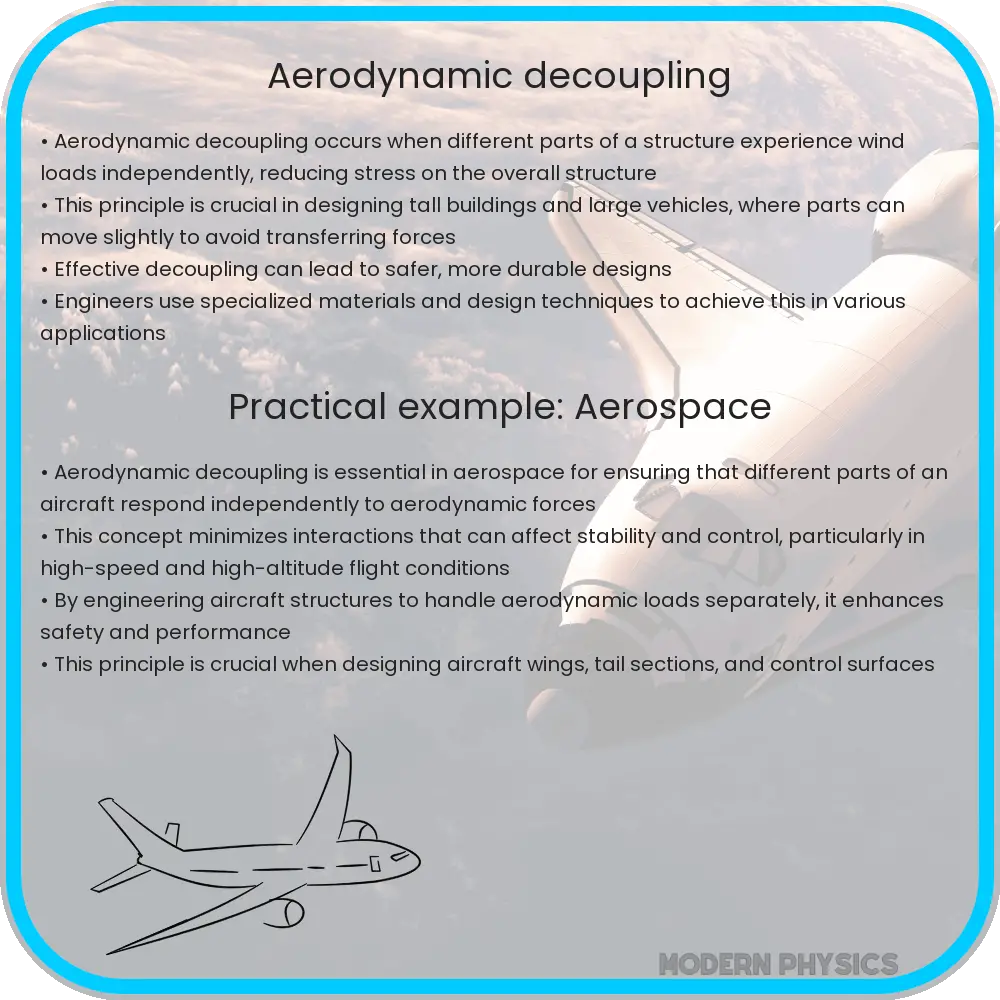
Aerodynamic decoupling enhances structural vehicle efficiency and stability by minimizing adverse aerodynamic interactions.
Aerodynamic Decoupling: Understanding Efficiency and Stability
Aerodynamics, a crucial branch of fluid mechanics, plays an essential role in designing and understanding the behavior of objects moving through air. When it comes to designing vehicles, aircraft, and even buildings, engineers need to consider how these objects disrupt and interact with airflows. One intriguing aspect of this interaction is aerodynamic decoupling—a concept that enhances both the efficiency and stability of a structure or vehicle.
Aerodynamic decoupling refers to the strategic separation or isolation of different parts of a structure from adverse aerodynamic interactions. By optimizing the shape and configuration of an object, engineers can minimize undesirable aerodynamic forces that contribute to drag and instability.
Evaluating Aerodynamic Efficiency
The efficiency of a vehicle or structure in aerodynamics is significantly determined by how well it reduces drag—a force opposing the direction of motion. Reducing drag not only improves the smoothness of travel but also enhances fuel efficiency, which is particularly critical in automotive and aerospace applications. Aerodynamic decoupling allows for the design of components that can operate at optimal parameters without influencing each other negatively.
For example, in automotive design, engineers might use aerodynamic decoupling to separate the airflow over a car’s body from that around its tires and wheel wells, areas that can generate significant aerodynamic drag and turbulence. Practical applications include the use of wheel arch covers or strategically designed spoilers that redirect airflow to reduce the impact on overall vehicle drag.
Increasing Stability Through Aerodynamic Decoupling
Stability in aerodynamics refers to the ability of a structure or vehicle to maintain its intended direction of travel without excessive pitching, rolling, or yawing. Aerodynamic forces, if not managed properly, can induce instability. By employing aerodynamic decoupling, engineers can design structures in which disruptive aerodynamic forces on one part of the structure do not unduly affect other parts.
An example of aerodynamic decoupling improving stability can be seen in aircraft design. By isolating the aerodynamic interactions between the wings and the fuselage, or between the engine housings and the tailplane, designers can minimize interference that might lead to undesired aerodynamic behaviors. This kind of decoupling involves thoughtful considerations of component placement, orientation, and shape, all of which contribute to a more stable performance.
Extension to Hydrodynamics
Although traditionally associated with air, the principles of aerodynamic decoupling apply equally to hydrodynamics—the study of objects moving through water. Similar to air, water is a fluid, and objects moving through water face analogous challenges related to drag and flow-induced forces. In maritime engineering, hydrodynamic decoupling is employed to optimize the design of ships’ hulls and propellers, ensuring that the interaction between water currents and different parts of the vessel does not compromise performance.
For instance, the design of a ship’s bow can be optimized to minimize wake and reduce drag, thereby isolating its effects from the stern and propeller operation. This reduces fuel consumption and increases the stability of the ship in various sea conditions.
In both air and water, engineers must account for the fluid dynamics involved to maximize efficiency and stability through aerodynamic and hydrodynamic decoupling. These concepts, though complex, are fundamental to the development of more efficient and stable vehicles and structures in multiple engineering fields.
Challenges and Future Perspectives
Despite the proven benefits of aerodynamic and hydrodynamic decoupling, integrating these principles into practical designs presents significant challenges. One of the main obstacles is the complexity of accurately modeling the fluid dynamics involved, especially in turbulent flow conditions. Advanced computational tools and experimental methods are continuously being developed to better predict and manipulate fluid behavior around complex shapes.
Future advancements in materials science and smart technologies also promise to enhance the implementation of aerodynamic decoupling. For instance, the use of adaptive materials that can change their properties in response to changing airflow or water flow conditions could revolutionize how structures interact with fluids dynamically. This could lead to the development of vehicles and buildings that not only resist adverse conditions but actively adapt to optimize their own aerodynamic and hydrodynamic efficiency.
Conclusion
Aerodynamic and hydrodynamic decoupling represent powerful strategies in the ongoing quest to enhance both the efficiency and stability of structures and vehicles in their respective fluid environments. By understanding and implementing these principles, engineers can significantly reduce drag and avoid unwanted interactions between different parts of a structure, leading to more sustainable and cost-effective designs.
As we continue to push the boundaries of what is possible in engineering, the insights gained from studying aerodynamic and hydrodynamic interactions will undoubtedly play a critical role in shaping the future of transportation, architecture, and even environmental management. The exploration of these complex fluid dynamics is not just about overcoming resistance; it’s about moving forward smoothly and steadily into a more efficient future.