
Learn how the Biot-Savart Law, fundamental in electromagnetism, is crucial for analyzing air movement in aerodynamics and aircraft design.
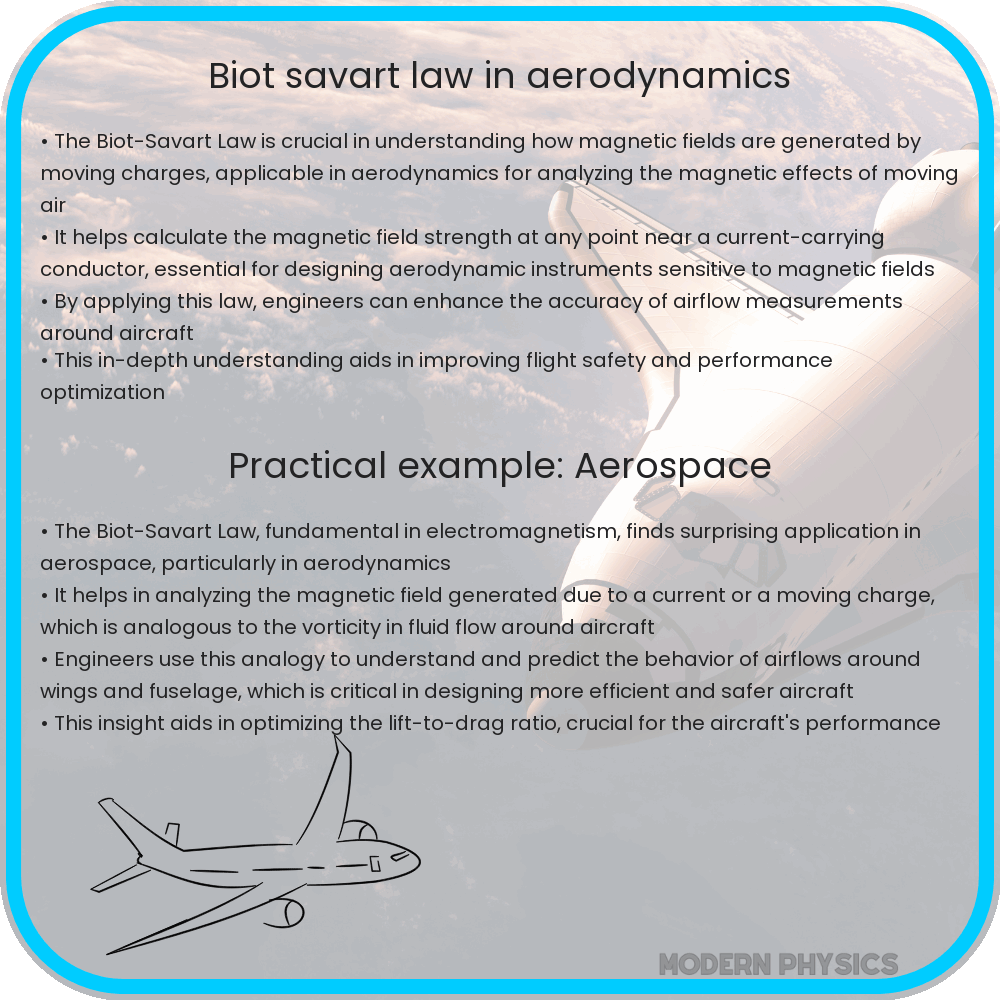
Understanding the Biot-Savart Law in Aerodynamics
The Biot-Savart Law is a critical principle in electromagnetism, originally formulated to describe the magnetic field generated by a steady electric current. However, its application extends beyond electromagnetism and plays a significant role in the study of aerodynamics, particularly in the analysis of how air moves around objects like aircraft wings.
Basics of Biot-Savart Law
Before diving into its aerodynamic applications, let’s first understand the basics of the Biot-Savart Law. Fundamentally, the law provides a mathematical model to calculate the magnetic field induced at a point due to a small segment of current carrying wire. The law is expressed as:
\[ \vec{B} = \frac{\mu_0}{4\pi} \int \frac{I \, d\vec{l} \times \hat{r}}{r^2} \]
Where:
- \(\vec{B}\) is the magnetic field,
- \(\mu_0\) is the permeability of free space,
- \(I\) represents the current,
- \(d\vec{l}\) is the infinitesimal length of the wire,
- \(\hat{r}\) is the unit vector from the wire to the point of observation,
- \(r\) is the distance from the element to the point of observation.
Application in Aerodynamics
In aerodynamics, the Biot-Savart Law helps in understanding and predicting how air moves around objects, crucial for aircraft design and analysis. While air is not a charged particle flow similar to electric currents in a wire, the velocity field around an object can still be expressed in a form analogous to the magnetic field in the Biot-Savart equation.
Considering a vortex line in a fluid, the velocity field induced at a point in the fluid because of this vortex line can be described using a modified form of the Biot-Savart Law:
\[ \vec{v} = \frac{\Gamma}{4\pi} \int \frac{d\vec{l} \times \hat{r}}{r^2} \]
Here, \(\vec{v}\) represents the velocity field induced by the vortex, and \(\Gamma\) is the circulation around the vortex, analogous to the electric current \(I\) in the traditional Biot-Savart Law.
This relation is particularly useful for understanding the effects of wingtip vortices, which are circular patterns of rotating air left behind a wing as it generates lift. Understanding these vortices is critical for mitigating their effects on aircraft performance and safety.
Impact on Aircraft Performance and Safety
Applying the Biot-Savart Law, engineers can model how vortices develop and interact with various surfaces of the aircraft. This information is crucial for designing more efficient wings that reduce vortex strength or alter their position relative to the aircraft to minimize negative impacts on stability and fuel efficiency.
The use of this law also extends to the design of airport runways. Effective spacing and layout considerations can mitigate the risk of accidents caused by the wake turbulence of large aircraft affecting smaller, following aircraft.
The Biot-Savart Law, therefore, provides a fundamental tool for improving both the aerodynamic performance and safety of aircraft, contributing significantly to modern aviation technologies.
Real-World Examples and Further Implications
Beyond aircraft and runway design, the Biot-Savart Law also finds application in helicopter blade design and wind turbine analysis. By understanding air flow patterns around rotating blades, engineers can enhance lift characteristics and reduce noise and vibrations, leading to more efficient and quieter operation.
Furthermore, in the realm of competitive sports such as sailing or cycling, knowing how to manipulate airflow can provide a significant advantage. The principles derived from the Biot-Savart Law help in the design of sails that optimize wind interaction and cycling gears that minimize air resistance.
Educational Value and Future Prospects
For students and budding engineers, the Biot-Savart Law serves as a gateway to complex fluid dynamics and electromagnetism applications. By bridging the gap between theoretical physics and real-world engineering problems, it encourages a more intuitive understanding of how forces interact in both natural and engineered systems.
The ongoing research and enhancements in computational fluid dynamics (CFD) software further extend the potential of the Biot-Savart Law. These advancements allow for more precise simulations and predictions, driving innovation in aerodynamics and related fields.
Conclusion
From its origins in electromagnetism to its crucial applications in aerodynamics, the Biot-Savart Law exemplifies how fundamental scientific principles can transcend their initial contexts to provide widespread benefits. By offering a powerful method to analyze and predict air flow phenomena, this law plays an indispensable role in the development of technologies related to aircraft, wind turbines, and even sports equipment. As computational tools grow more sophisticated and our understanding of fluid dynamics deepens, the future applications of the Biot-Savart Law are bound to expand, continuing to impact engineering innovations and safety regulations across multiple industries.