
Explore the search for Z’ bosons, the cutting-edge endeavor in particle physics aiming to unveil new forces beyond the Standard Model and its impacts on science.
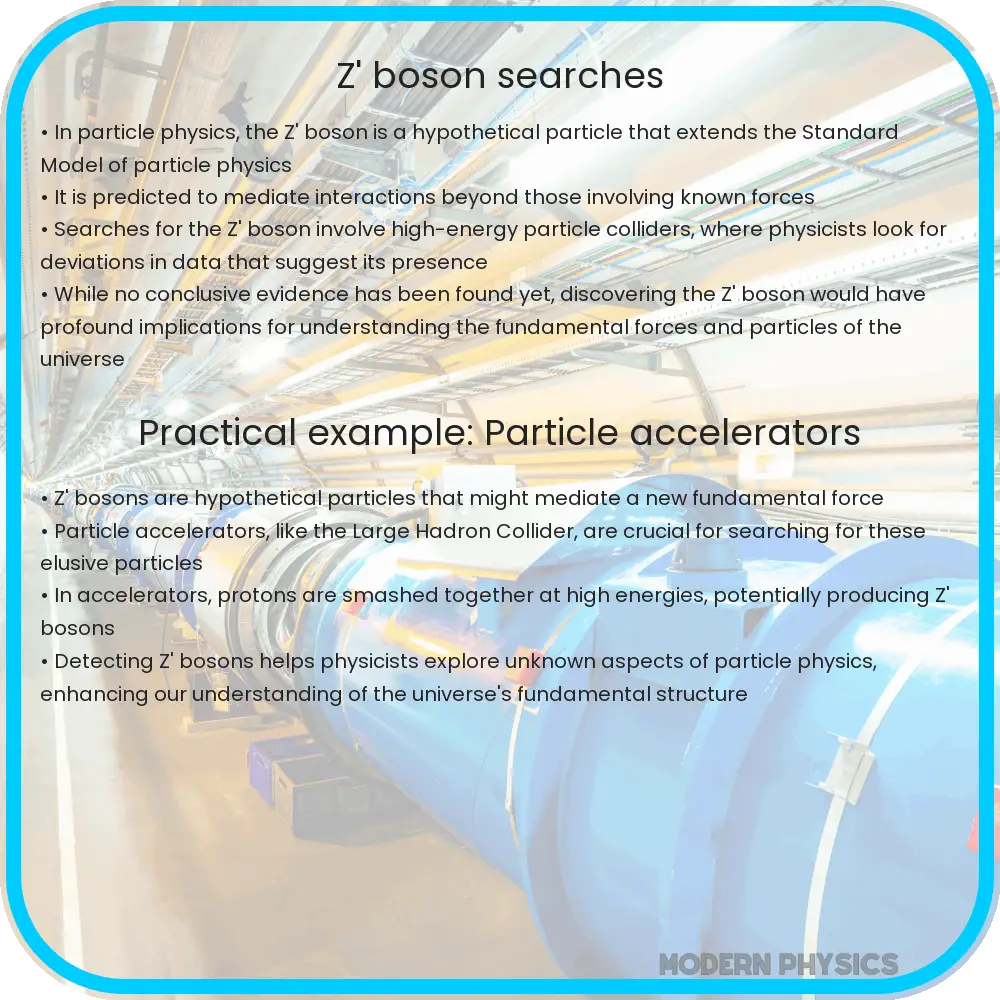
Z’ Boson Searches: Unveiling the Mysteries of Particle Physics
The search for Z’ bosons represents one of the cutting-edge endeavors in the field of particle physics, aiming to uncover forces beyond the Standard Model. The Z’ boson is hypothesized as a heavier version of the Z boson, which mediates the weak nuclear force. This exploration is not only pivotal for understanding the fundamental constituents of the universe but also for identifying new physics phenomena.
Key Discoveries in Z’ Boson Searches
Although direct detection of Z’ bosons remains elusive, significant progress has been made. Experiments conducted at Large Hadron Collider (LHC) and other high-energy physics facilities have set stringent limits on the mass and coupling strength of Z’ bosons. These searches are guided by various theoretical models, such as the Extended Gauge Theories, Grand Unified Theories, and Superstring Theories, each predicting different properties and manifestations of Z’ bosons.
Methods Employed in Z’ Boson Searches
The primary method of searching for Z’ bosons involves high-energy particle collisions. At facilities like the LHC, protons are accelerated to near the speed of light and collided, creating an array of secondary particles. Detectors analyze these particles, searching for anomalies that could indicate the presence of a Z’ boson. Key to these searches is the analysis of events where dileptons (pairs of electrons or muons) are produced, as these could signify the decay of a Z’ boson.
- Collider Experiments: Utilize large particle accelerators to create high-energy collisions, producing environments conducive to the formation of Z’ bosons.
- Dilepton Analysis: Focuses on the detection of electron or muon pairs resulting from the potential decay of Z’ bosons, a hallmark signal in searches.
- Data Mining: Involves the sophisticated analysis of vast amounts of collision data to identify potential Z’ boson signatures amid background noise.
Each method contributes uniquely to the overarching goal of detecting Z’ bosons, thereby offering insights into the universe’s unseen forces.
Impacts of Z’ Boson Searches
The quest for Z’ bosons extends beyond the mere identification of a new particle; it holds profound implications for our understanding of the universe. A confirmed discovery would signify the existence of forces beyond those described by the Standard Model of particle physics, potentially leading to a paradigm shift in our understanding of the fundamental forces. Additionally, Z’ boson research contributes to the unification theories, aiming to merge gravity with other fundamental forces, and could provide insights into the mysterious dark matter that constitutes a significant portion of the universe’s mass.
Challenges and Future Prospects
Despite the advanced technology and methodologies employed, Z’ boson searches face considerable challenges. The foremost is the sheer scale of data produced by particle collisions, requiring sophisticated algorithms for analysis and interpretation. Moreover, the high energy levels needed to potentially produce Z’ bosons push the limits of current accelerator technologies. Future prospects hinge on advancements in particle accelerator technology, improved detection methods, and enhanced theoretical models to guide searches more effectively.
Collaboration among international research teams and the development of next-generation particle accelerators, like the proposed Future Circular Collider, are crucial for advancing Z’ boson research. Additionally, interdisciplinary approaches combining insights from astrophysics, cosmology, and particle physics are expected to play a pivotal role in future discoveries.
Conclusion
The search for Z’ bosons represents a critical frontier in particle physics, challenging our understanding of the universe’s fundamental components and forces. While direct evidence remains elusive, the ongoing efforts and technological advancements continue to narrow down the search parameters, providing valuable insights into the structure of matter and the forces governing it. The potential discovery of Z’ bosons would not only confirm the existence of new physical phenomena but also pave the way for a new era in theoretical and experimental physics. As we stand on the brink of these potential discoveries, the field of particle physics remains more vibrant and exciting than ever, promising profound implications for our comprehension of the universe.