
Explore the mysteries of Axino particles and the cosmos, delving into dark matter, advanced detection methods, and the intersection of particle physics and cosmology.
Axino Research: Unraveling the Mysteries of Particles and the Cosmos
The realm of Axino Research delves into the enigmatic and profound universe of elementary particles and cosmic phenomena. This field of study, grounded in the principles of quantum mechanics and astrophysics, seeks to understand the fundamental components of matter and the overarching structure of the cosmos.
The Enigmatic Axino Particle
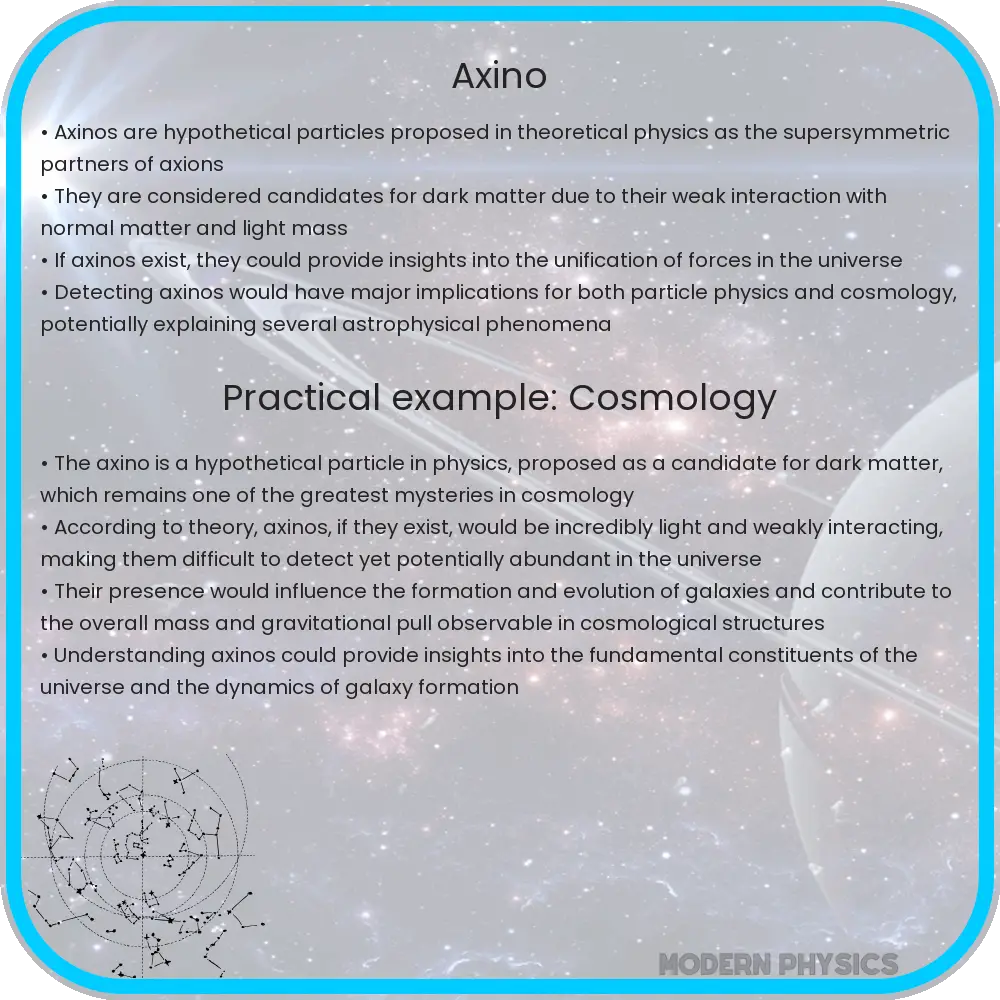
At the heart of Axino Research lies the theoretical particle known as the Axino. Stemming from supersymmetry theories, the Axino is postulated as the supersymmetric partner of the axion, a candidate for dark matter. Unlike its well-studied counterparts, the Axino remains shrouded in mystery, primarily due to its weak interaction with ordinary matter and its elusive nature.
Theoretical physicists propose that Axinos, with their extremely light mass and feeble interactions, could play a crucial role in the early universe’s thermal dynamics. They are considered as cold dark matter candidates, contributing to the universe’s mass without emitting, absorbing, or reflecting light, making them virtually invisible to current detection methods.
Exploring the Cosmos: Beyond Visible Light
Axino Research extends beyond particle physics into the vastness of the cosmos. By studying celestial phenomena and cosmic microwave background radiation, scientists hope to glean insights into the universe’s early stages and the nature of dark matter. These investigations challenge our understanding of the universe, pushing the boundaries of human knowledge.
The study of cosmic phenomena not only aids in understanding the universe’s structure but also in identifying the properties of particles like the Axino. Advanced telescopes and detectors are continually being developed and utilized to scan the heavens, searching for signals that could unravel the mysteries of the cosmos and shed light on the elusive nature of dark matter.
In conclusion, Axino Research represents a pivotal field in modern physics, merging the domains of particle physics and cosmology. As scientists unravel the properties of the Axino and other theoretical particles, we edge closer to deciphering the universe’s most profound secrets.
Advanced Methodologies in Axino Research
The quest to detect and understand Axinos involves sophisticated methodologies and technologies. Particle accelerators, such as the Large Hadron Collider (LHC), play a pivotal role in simulating conditions similar to those of the early universe, potentially unveiling new particles and interactions. Additionally, indirect detection methods, which observe the effects of dark matter particles like the Axino on visible cosmic structures, contribute significantly to this field.
Computational physics also plays a crucial role in Axino Research. Through detailed simulations and models, scientists can predict the properties and behaviors of these elusive particles. This theoretical framework is essential for guiding experimental searches and interpreting observational data.
Interdisciplinary Impacts and Future Prospects
Axino Research is inherently interdisciplinary, blending quantum field theory, cosmology, and astrophysics. This convergence has led to significant advancements in our understanding of the universe and has propelled technological innovations, especially in detector and sensor technologies.
The future of Axino Research holds promising prospects. As detection technologies advance and our theoretical models become more refined, the likelihood of identifying Axinos increases. Uncovering the Axino would not only mark a monumental breakthrough in particle physics but also provide profound insights into the universe’s dark matter composition and the early moments following the Big Bang.
Conclusion
The journey into the mysteries of particles like the Axino and the vast cosmos is a testament to human curiosity and ingenuity. Axino Research stands at the frontier of our quest to understand the fundamental nature of reality. It challenges our perceptions, pushing us to explore beyond the visible and known into the realms of the unseen and unknown.
As we continue to probe the universe’s depths, the synthesis of particle physics and cosmology promises to illuminate the dark corners of our universe, offering answers to age-old questions while undoubtedly raising new ones. The pursuit of knowledge in the mysterious interplay between particles and the cosmos is an ever-evolving saga, one that will continue to inspire generations of scientists and enthusiasts alike.