
Explore the weak nuclear force, its role in particle physics, beta decay, and its significance in the universe, bridging concepts from the micro to macro cosmos.
Understanding the Weak Nuclear Force in Particle Physics
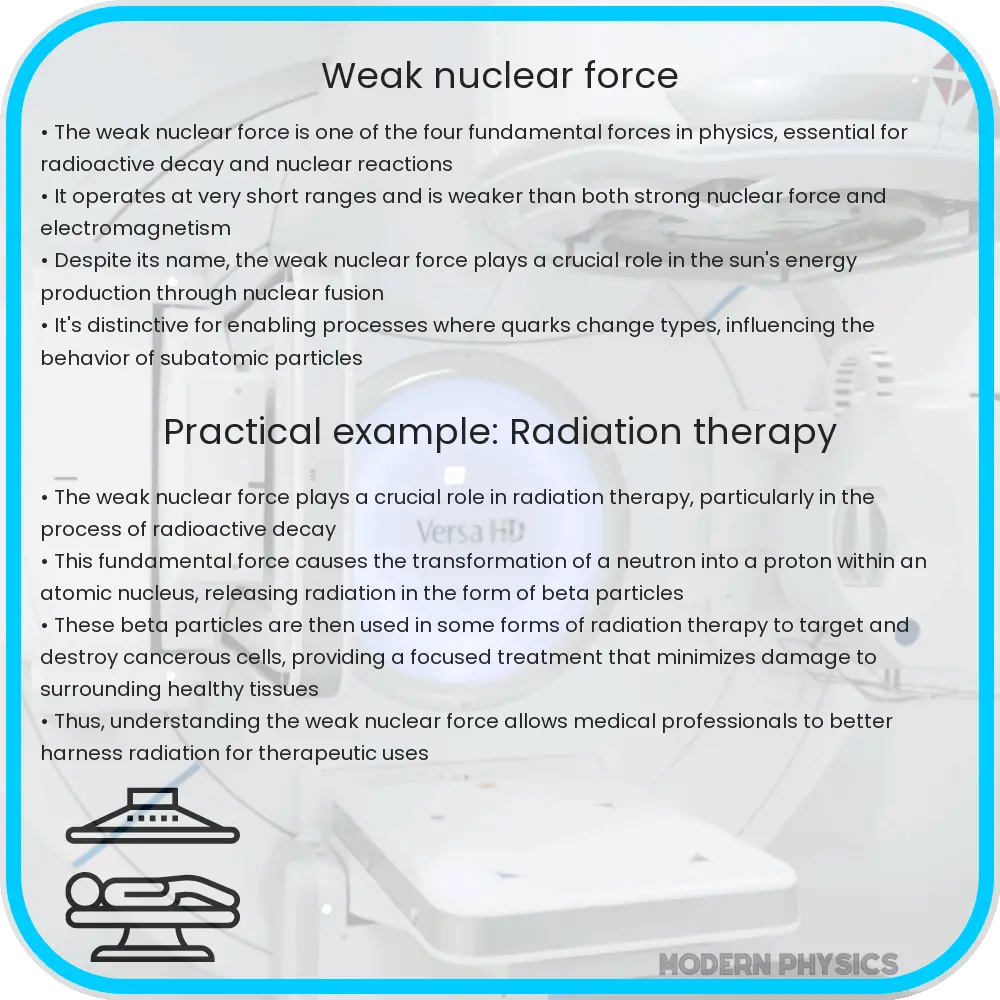
The weak nuclear force, one of the four fundamental forces of nature, plays a crucial role in the realm of subatomic particles. Unlike the gravitational and electromagnetic forces, which have infinite range and are familiar in our daily lives, the weak force operates at incredibly short distances and is responsible for processes that are less apparent but essential for the universe’s functioning.
Characteristics of the Weak Nuclear Force
The weak nuclear force acts over a minute range, typically less than 0.1% of the diameter of a typical atomic nucleus. Despite its short range, it has a profound impact on the behavior of subatomic particles. The force is mediated by three massive gauge bosons: W+, W–, and Z0. These particles are significantly heavier than protons and neutrons, which explains the weak force’s short range and relative weakness compared to other fundamental forces.
Particle Interactions and Decay Processes
One of the most notable phenomena involving the weak nuclear force is beta decay, a type of radioactive decay in which a neutron transforms into a proton while emitting an electron (β–) and an antineutrino. Conversely, in positron emission, a proton converts into a neutron, releasing a positron (β+) and a neutrino. These processes are vital for understanding stellar phenomena and the elemental composition of the universe.
Significance in the Cosmos
The weak force is essential for the sun’s energy production through the process of nuclear fusion. During fusion, hydrogen nuclei combine to form helium, a reaction facilitated by the weak nuclear force, releasing vast amounts of energy in the form of sunlight. Without this force, stars could not burn, and the cosmos would be a very different place.
- Mediators of the Weak Force: W+, W–, and Z0 particles
- Key Processes: Beta decay, nuclear fusion, and elemental transmutation
- Range: Less than 0.1% of an atomic nucleus diameter
Experimental Evidence and Theoretical Development
The discovery and understanding of the weak nuclear force have evolved through groundbreaking experiments and theoretical advancements. The identification of the W and Z bosons in the early 1980s at CERN was a monumental achievement, confirming the predictions of the electroweak theory formulated by Sheldon Glashow, Abdus Salam, and Steven Weinberg. This unification of the weak nuclear force with electromagnetism marked a significant milestone in particle physics, illustrating the underlying connections between different forces.
Implications in Modern Physics
The study of the weak force extends beyond understanding radioactive decay and stellar processes. It plays a crucial role in the Standard Model of particle physics, which is the theoretical framework describing the electromagnetic, weak, and strong nuclear forces. Investigations into the weak force have led to insights into the asymmetry between matter and antimatter, known as CP violation, which has profound implications for the origins of the universe and its current composition.
Challenges and Future Directions
Despite its successes, the Standard Model is not the ultimate theory of everything. The weak nuclear force, along with the other fundamental forces, is part of ongoing research aiming to uncover a more unified, comprehensive theory. Scientists are exploring beyond the Standard Model to address unanswered questions, such as the nature of dark matter and the unification of all forces under a single framework, potentially through string theory or quantum gravity.
Conclusion
The weak nuclear force is a pivotal element of the subatomic world, influencing the universe from the smallest particles to the stars in the sky. Its discovery and integration into the Standard Model represent a remarkable triumph of human curiosity and intellect. As we continue to probe the mysteries of the universe, the weak force remains a key area of research, challenging our understanding and pushing the boundaries of physics. The journey from radioactive decay to cosmic evolution showcases the interconnectedness of all forces and particles, reminding us of the complex, beautiful tapestry that is our universe.