
The X-Plane Program’s hydrodynamics simulation utilizes advanced computational fluid dynamics to enhance maritime engineering designs and applications.
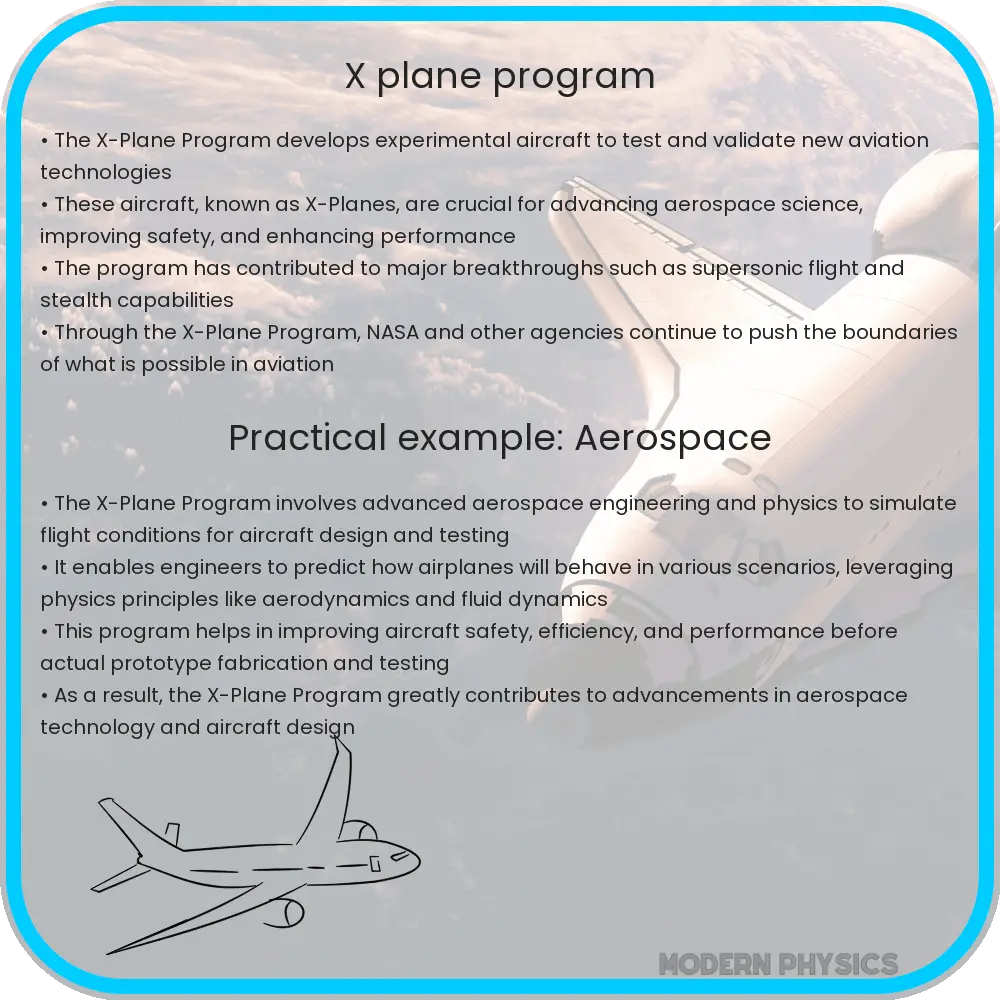
Exploring the X-Plane Program: Revolutionizing Hydrodynamics Simulation
The X-Plane Program, although primarily recognized for its contributions to aerospace simulations, also plays a pivotal role in the field of hydrodynamics. Hydrodynamics, the branch of physics concerned with the motion of fluids, is crucial for understanding and designing objects that move through water. This includes everything from small watercraft to large naval ships. Through the use of advanced simulation tools like those found in the X-Plane Program, engineers and scientists can predict how water flows around objects with incredible accuracy.
One of the key elements of the X-Plane’s hydrodynamics simulation is its ability to model the behavior of fluids in various conditions. It uses computational fluid dynamics (CFD), a method that employs numerical analysis and data structures to solve and analyze problems that involve fluid flows. This technology enables the X-Plane Program to simulate complex fluid interactions with physical structures, enhancing the design and safety of watercraft.
Accuracy of Hydrodynamics Simulation in X-Plane
The accuracy of hydrodynamics simulation in the X-Plane Program is achieved through the meticulous calculation of various physical and environmental parameters. These include fluid density, flow velocity, and the interaction of the fluid with surfaces of different textures and shapes. The program uses the Navier-Stokes equations, which describe the motion of fluid substances. These equations are fundamental to the field of fluid mechanics and are given by:
\[ \frac{\partial \rho}{\partial t} + \nabla \cdot (\rho \mathbf{u}) = 0 \]
\[ \frac{\partial (\rho \mathbf{u})}{\partial t} + \nabla \cdot (\rho \mathbf{u} \otimes \mathbf{u}) = -\nabla p + \nabla \cdot \mathbf{T} + \mathbf{f} \]
Here, \(\rho\) represents the fluid density, \(\mathbf{u}\) is the flow velocity vector, \(p\) stands for the pressure, \(\mathbf{T}\) is the stress tensor, and \(\mathbf{f}\) signifies the body forces per unit volume, such as gravity.
Understanding and solving these equations is complex, as they are non-linear partial differential equations. X-Plane’s simulation software handles this complexity by discretizing the equations, breaking them down into smaller, solvable units, which can then be computed efficiently using modern computing techniques.
Real-World Applications and Benefits of Hydrodynamics Simulations in X-Plane
The real-world implications of accurate hydrodynamics simulation are immense. In maritime engineering, the ability to preview the performance of a ship’s hull design in various water conditions can lead to significant improvements in efficiency and safety. It allows engineers to optimize the shape and materials of the hull to reduce resistance, minimize fuel consumption, and enhance stability in the water.
Moreover, the X-Plane Program’s simulations are also vital in the academic sector, where researchers utilize these tools to study environmental and ecological impacts. For instance, understanding how oil spills disperse in oceans or how aquatic plants affect water flow can help in better managing and mitigating environmental disasters.
Impact on Educational and Training Programs
The use of the X-Plane Program in educational settings marks a significant step forward in the training of future engineers and scientists. By integrating real-time simulations into the curriculum, educators can provide students with hands-on experience in understanding fluid dynamics. This not only enriches the learning process but also helps students to develop analytical skills critical for solving complex hydrodynamic problems.
Simulation-based training tools like X-Plane also offer an invaluable resource for professional development. Engineers working in the field can use these simulations to test and refine their designs before actual production, reducing the risk and cost associated with physical prototypes.
Challenges and Future Directions
Despite the advanced capabilities of the X-Plane Program in hydrodynamics simulation, challenges remain. The accuracy of simulations can be limited by computational power and the detail of the data models used. As technology advances, there is a continual push to enhance the precision of these simulations by incorporating more complex algorithms and higher-resolution data.
Future enhancements may include better integration of real-world environmental data, improving the predictive capabilities of the program under various scenarios. Additionally, the development of more user-friendly interfaces could make these advanced simulations more accessible to non-specialists, broadening the tool’s application and impact.
Conclusion
The X-Plane Program’s contribution to hydrodynamics simulation represents a blend of sophisticated engineering prowess and practical application, which has significantly impacted both theoretical and applied fluid dynamics. It not only aids in designing safer and more efficient watercraft but also facilitates a deeper understanding of environmental phenomena affecting aquatic ecosystems. With ongoing advancements in computational fluid dynamics, the potential for future innovations in hydrodynamics simulation is vast, promising even greater contributions to science, engineering, and environmental management.
The intersection of technology and traditional hydrodynamics has indeed opened new avenues for exploration and discovery, making the X-Plane Program a quintessential tool in the arsenal of today’s engineers and researchers. Its continued development and adaptation will surely underpin the next generation of innovations in watercraft design and environmental stewardship.