
Exploring the engineering approach of wing-body blending in aircraft design focused on enhancing aerodynamic efficiency by integrating wings and fuselage.
Introduction to Wing-Body Blending in Aircraft Design
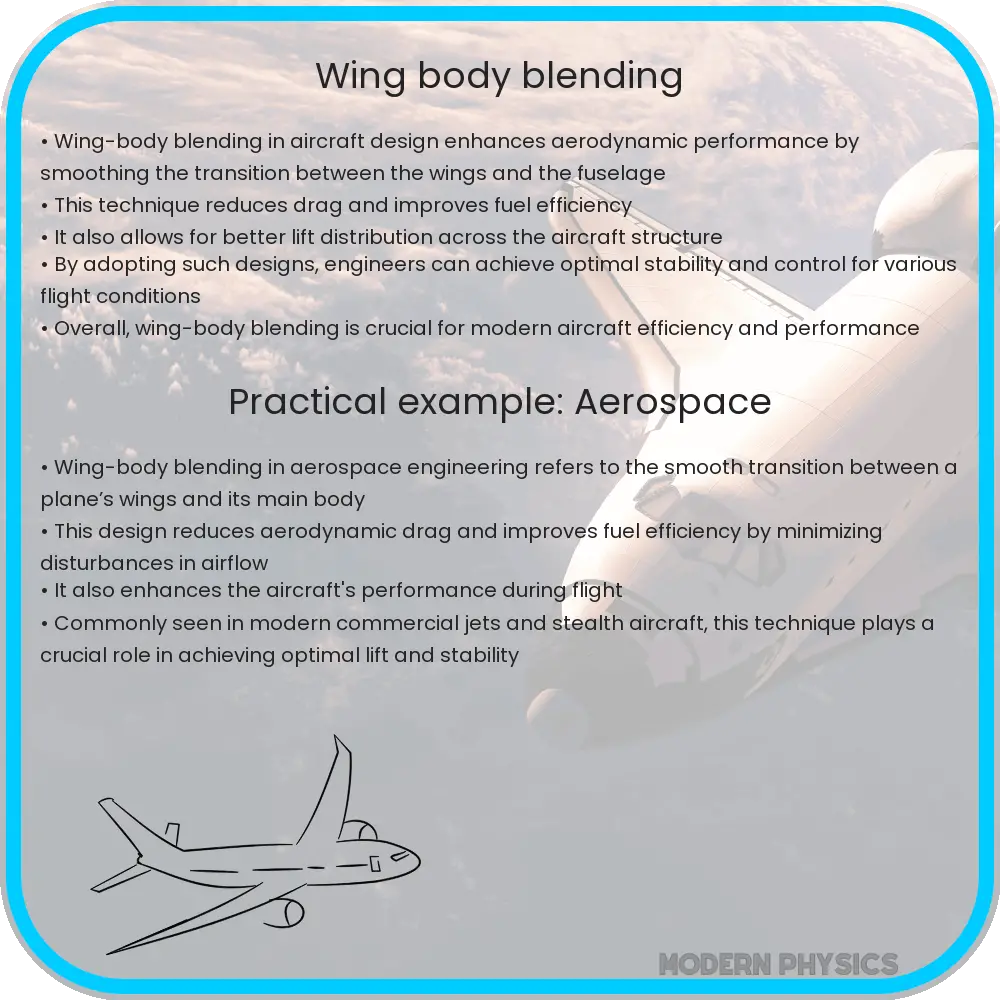
Wing-body blending is an engineering approach that optimizes the junction between the wings and the main body (fuselage) of an aircraft. This design strategy not only influences the aesthetic appeal of the aircraft but plays a crucial role in improving its aerodynamic efficiency. By seamlessly integrating the wings with the fuselage, engineers can significantly reduce drag, enhance lift, and improve fuel efficiency.
Understanding Hydrodynamics and Aerodynamics
Before delving into the specifics of wing-body blending, it’s essential to understand the key concepts of hydrodynamics and aerodynamics that govern the behavior of objects moving through fluids, such as air or water. Aerodynamics is the study of the motion of air, particularly when interacting with a solid object like an aircraft. Hydrodynamics addresses similar principles but involves the movement of water. Both fields share common fundamentals, including the concepts of drag, lift, and the streamline flow of the medium.
- Drag: This is the resistance an object encounters when moving through a fluid. In aircraft design, reducing drag is crucial for improving speed and reducing fuel consumption.
- Lift: Lift is the force that acts perpendicular to the direction of motion through the air, allowing the aircraft to ascend and maintain flight. This force is generated by differences in air pressure on the upper and lower surfaces of the aircraft wings.
- Streamline Flow: This refers to a smooth, regular pattern of flow in which the fluid’s velocity at a given point remains constant or varies linearly.
The Role of Wing-Body Blending in Aerodynamics
In traditional aircraft design, the wings are often attached to the fuselage with a distinct joining mechanism, creating high-drag regions due to abrupt changes in the shape and flow patterns. Wing-body blending smooths out these transitions and can drastically enhance the aircraft’s aerodynamic performance. This smoother transition minimizes the formation of vortices and turbulent flow, which are primary contributors to increased drag.
The engineering concept involves the use of sophisticated curves and contours that guide the airflow seamlessly from the fuselage across the wings. This technique is not only used in aircraft but can also be found in the design of high-speed trains and automotive applications where reducing drag is essential.
Practical Applications and Benefits
One of the most notable implementations of wing-body blending can be found in modern “stealth” aircraft, where the technique also helps in minimizing radar cross-section. For commercial aviation, the approach fosters substantial benefits:
- Enhanced Lift-to-Drag Ratio: Improved aerodynamics increase the lift-to-drag ratio, a crucial performance metric in aviation that impacts fuel efficiency and range.
- Reduced Fuel Consumption: With lower aerodynamic drag, aircraft require less thrust to maintain the same speed, leading to noticeable reductions in fuel consumption.
- Increased Range and Payload Capacity: Enhancements in fuel efficiency and aerodynamics can allow for longer flight ranges or greater payload capacity without the need for additional fuel.
The implementation of wing-body blending in aircraft design represents a significant advancement in both military and commercial aviation, leading to more efficient, quieter, and environmentally friendly aircraft.
Future Trends in Wing-Body Blending
As we advance further into the 21st century, the importance of sustainability in aviation continues to grow. Future trends in wing-body blending are likely to focus on the development of designs that are not only more efficient but also use lighter and more sustainable materials. Innovations might include adaptive wing-body configurations that can change shape in real time to optimize aerodynamics during different phases of flight. This adaptability could further reduce drag and fuel consumption while enhancing overall performance.
Challenges and Innovations
Despite the benefits, implementing wing-body blending poses significant engineering challenges. The seamless integration of wings and fuselage must account for structural integrity and safety. Advanced materials such as carbon-fiber composites are often required to handle the stresses involved while maintaining a light frame. Moreover, intricate computational models and simulations are vital in predicting and optimizing airflow patterns around these unified structures, ensuring the aircraft meets all performance and safety standards.
- Computational Fluid Dynamics (CFD): Engineers use CFD to simulate airflow around the aircraft. This tool is crucial in designing efficient wing-body blends, allowing for numerous iterations without the need for physical prototypes.
- Material Science Innovations: The development of new alloys and composites that are both light and durable can significantly impact the sustainability and efficiency of aircraft design.
- Testing and Validation: Rigorous testing, both in simulated environments and through actual flight trials, ensures that the designs perform as expected under various conditions.
Conclusion
Wing-body blending represents a pivotal innovation in aircraft design, melding aesthetics with functionality to create sleeker, more efficient flying machines. By understanding and applying principles of aerodynamics and materials science, engineers can continue to push the boundaries of what is possible in aviation. Looking to the future, the ongoing evolution of this design approach promises to deliver aircraft that are not only faster and more fuel-efficient but also more adaptable and environmentally friendly. As we face the challenges of modern aerospace engineering, wing-body blending stands out as a beacon of innovative possibility, guiding the way toward a more sustainable and efficient future in aviation.