
Exploring the integration of aeroacoustic simulations with hydrodynamics to enhance noise prediction and efficiency in engineering designs.
Understanding Aeroacoustic Simulations and Hydrodynamics Integration
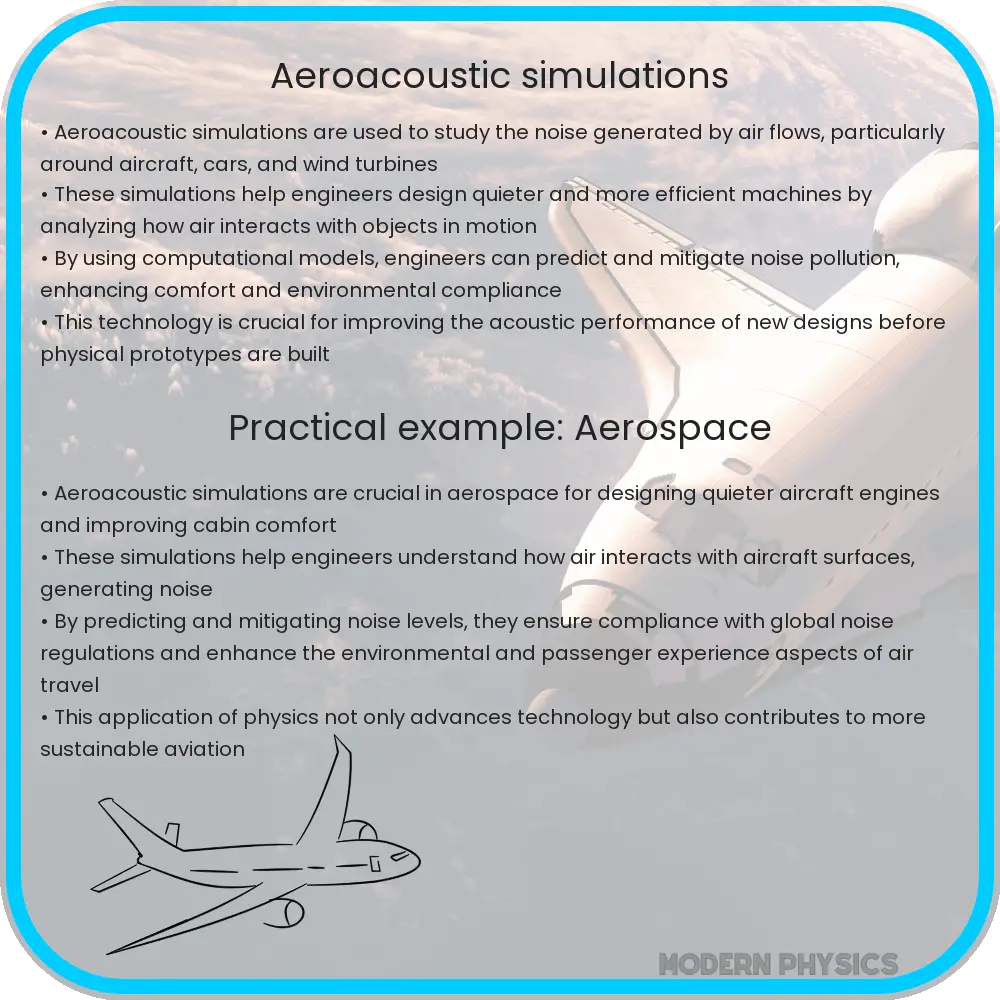
Aeroacoustic simulations form a pivotal aspect of modern engineering, particularly in fields like aerospace, automotive, and environmental science. These simulations are used to predict and analyze the noise generated by turbulent fluid flow, especially around objects such as vehicles or aircraft. Integrating these simulations with hydrodynamics—the study of fluids in motion—not only enhances the precision of predictions but also helps in designing quieter and more efficient machines.
To begin, let’s delve into the fundamental concept of aeroacoustics, which is the science of sound generated by air movement, where the air is the working fluid. When air flows around any object, it can create noise as a result of complex interactions between the air molecules and the object’s surface. The primary goal of aeroacoustic simulations is to model these interactions and predict the resultant sound, enabling engineers to make informed decisions to mitigate unwanted noise.
The Role of Hydrodynamics in Aeroacoustic Simulations
Hydrodynamics plays a crucial role in aeroacoustic simulations. It provides a detailed analysis of how fluids behave and interact with structures, which is essential for understanding the source and propagation of sound in air or any other fluid. By integrating hydrodynamic data, simulations can more accurately depict how changes in fluid flow affect acoustic outcomes.
This integration is typically achieved through computational fluid dynamics (CFD), a branch of fluid mechanics that uses numerical analysis and algorithms to solve and analyze problems involving fluid flows. Engineers use CFD to simulate the flow of fluids around objects and predict the resulting acoustic effects. The precision of these predictions hinges significantly on the quality of the hydrodynamic integration.
Key Technologies in Aeroacoustic Simulations
One of the most important technologies in aeroacoustic simulations is the Direct Numerical Simulation (DNS) of turbulence. DNS resolves all scales of turbulent flow and provides detailed data that can be used to understand and predict sound generation and propagation. While extremely accurate, DNS is also computationally demanding.
Another critical technology is the Large Eddy Simulation (LES). LES is a mathematical model used in fluid dynamics that simulates the large structures of turbulent flow while modeling smaller scales. This approach is less computationally intensive than DNS and provides a good balance between accuracy and computational feasibility.
Both DNS and LES require substantial computational resources, making the integration of efficient computational techniques crucial. The building of efficient computational models involves understanding various scaling laws of turbulence and how they affect acoustic propagation.
Practical Applications of Aeroacoustic Simulations
In real-world scenarios, aeroacoustic simulations are instrumental in several areas. In aerospace, they are used to reduce the noise of jet engines, enhancing passenger comfort and meeting regulatory requirements. In the automotive industry, these simulations help in designing quieter cars, particularly in reducing the noise produced by the interaction of tires with the road surface. Environmental science also benefits from these simulations, using them to study the impact of noise pollution from industrial sources and its effects on habitats and human communities.
Moreover, the integration of hydrodynamics with aeroacoustics is not just limited to air but is also applicable to other fluids like water. In marine engineering, for example, understanding the hydrodynamic behavior of water around ship hulls is essential for mitigating noise pollution that can adversely affect marine life.
- Detailed fluid behavior analysis through hydrodynamics to guide aeroacoustic adjustments.
- Use of advanced simulation technologies, such as DNS and LES, for enhanced precision.
- Practical applications in aerospace, automotive, and environmental sciences for better designs and compliance with noise regulations.
The next section will focus on the technical methodology of integrating hydrodynamics with aeroacoustic simulations, including specific case studies showcasing the real-world applications and benefits of this integration.
Technical Methodology and Case Studies
The technical methodology behind integrating hydrodynamics with aeroacoustic simulations involves several key steps. Initially, fluid behavior around the object of interest is analyzed using CFD techniques to capture detailed hydrodynamic data. This data forms the basis for simulating sound propagation, employing tools like DNS and LES for detailed and accurate results. Careful calibration and validation against experimental data are crucial to ensure the reliability of the simulations.
For example, in a case study involving an aircraft, engineers use CFD to simulate air flow over the wings and fuselage under various operating conditions. The subsequent aeroacoustic simulations predict the sound levels in different flight phases, helping in the design adjustments aimed at noise reduction.
Another case study in the automotive sector might focus on the airflow around car windows and mirrors, areas known for generating significant wind noise. By fine-tuning the aerodynamic design using the insights gained from hydrodynamic and acoustic data, engineers can considerably reduce this noise, leading to quieter vehicles.
Conclusion
Aeroacoustic simulations integrated with hydrodynamics stand at the forefront of modern engineering, presenting a powerful tool that spans multiple disciplines and industries. By understanding and manipulating the complex interplays between fluid dynamics and acoustics, engineers can create designs that are not only efficient and effective but also more environmentally friendly and pleasant for human use. As computational capabilities continue to evolve and improve, so too will the precision and applicability of these simulations, further enhancing our ability to design quieter and more sustainable technologies for the future.
The advancements in computational fluid dynamics and aeroacoustic simulations provide not only a technical edge but also a pathway to understanding and solving some of the modern world’s most pressing environmental and engineering challenges. By fostering a deep understanding of these sophisticated tools, we pave the way for innovative solutions that could substantially improve quality of life and environmental health worldwide.