
Learn about wormlike micelles, cylindrical structures formed by surfactant molecules that exhibit unique flexibility and strength.
Understanding Wormlike Micelles: Flexibility, Strength, and Self-Assembly
Wormlike micelles are fascinating structures that play critical roles in various scientific fields, including chemistry, physics, and bioengineering. These micelles are cylindrical structures formed by the self-assembly of surfactant molecules in a solution. Imagine tiny, flexible threads that can twist, bend, and even break under certain conditions, yet have the remarkable ability to recombine into new forms. This dynamic behavior enables them to exhibit unique properties of flexibility and strength, making them incredibly useful in various applications.
What Are Wormlike Micelles?
At the molecular level, a micelle is a structure where surfactant molecules arrange themselves into a spherical form in water, with their hydrophilic (water-attracting) heads facing outward and their hydrophobic (water-repelling) tails tucked inside. However, when certain conditions are met, these spherical micelles can transform into elongated, wormlike structures. This transformation depends primarily on the concentration of surfactants, the type of surfactant used, the temperature of the solution, and the presence of electrolytes in the solution.
Flexibility of Wormlike Micelles
The flexibility of wormlike micelles is one of their most notable characteristics. This flexibility arises from the physical properties of the surfactant molecules themselves and how they interact with each other within the micelle. The ability to bend without breaking allows wormlike micelles to flow like a liquid, enabling them to conform to and fill containers of any shape.
In terms of physics, the flexibility of these micelles can be described using the concept of persistence length, which is a measure of the stiffness of a polymer chain. In simple terms, a longer persistence length indicates a stiffer chain. Wormlike micelles typically have a persistence length that allows for significant bending and twisting without fragmenting, situating them somewhere between rigid rod-like structures and highly flexible polymer chains.
Strength and Structural Integrity
Despite their flexibility, wormlike micelles are also known for their remarkable strength. This strength is derived from the cooperative interactions among the surfactant molecules. When stress is applied to a solution containing wormlike micelles, they can stretch, aligning along the direction of the force. Upon removal of the stress, they can spontaneously revert to their relaxed state, thanks to the self-healing nature of the physical bonds between the molecules.
These interesting properties make wormlike micelles useful in activities that require both durability and adaptability. The molecular strength allows them to endure under mechanical stresses that would typically break down simpler micellar systems.
Self-Assembly and Adaptability
The self-assembly of wormlike micelles is guided by non-covalent interactions, which are weaker than covalent bonds but crucial for reversible and adaptive behaviors. This self-assembly is a spontaneous process driven by the minimization of free energy in the system, which occurs when surfactant molecules arrange themselves to maximize hydrophobic interactions while minimizing repulsive electrostatic interactions.
This ability to self-assemble and adapt makes wormlike micelles incredibly versatile. It allows them to change shape and rearrange themselves in response to environmental stimuli, such as changes in pH, temperature, or the introduction of additional chemicals to the solution. Such adaptability is essential for applications ranging from drug delivery systems to the creation of self-healing materials.
Applications in Industry and Medicine
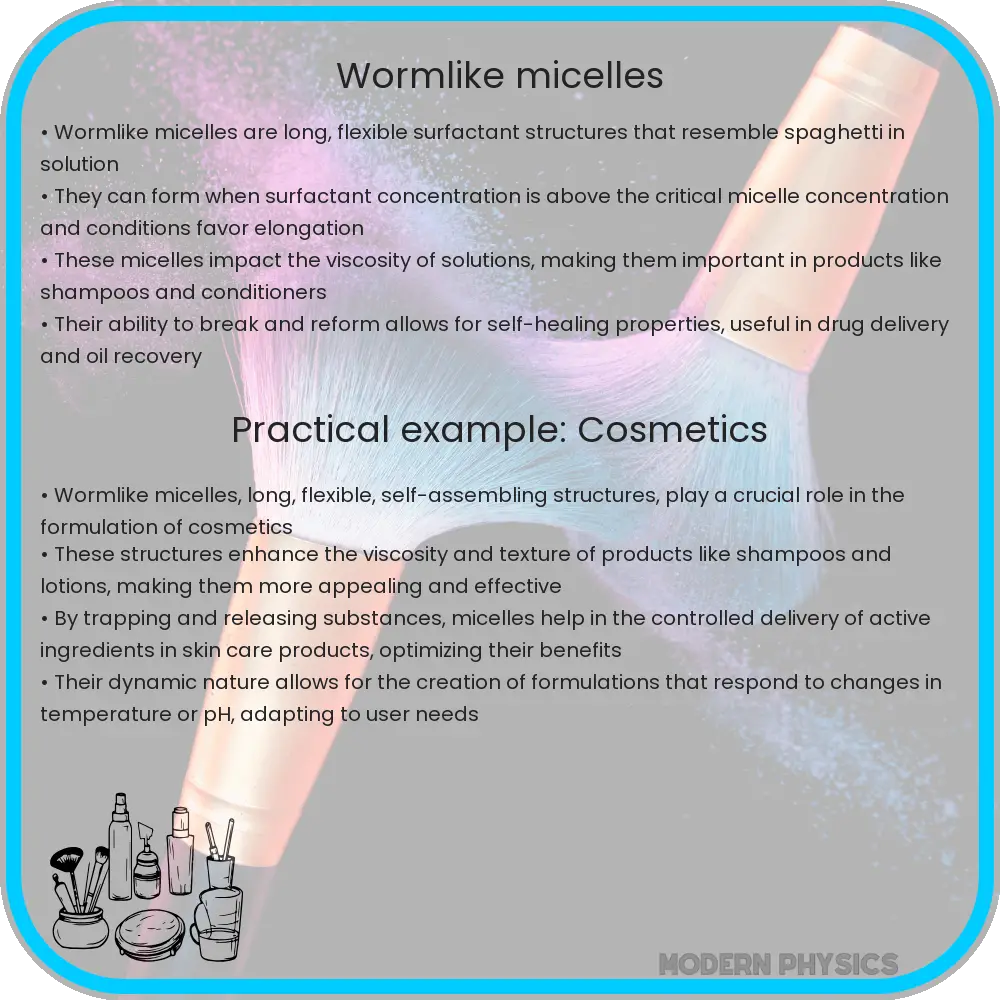
Wormlike micelles find extensive applications in both industrial and medical fields due to their unique properties. In industry, they are used as thickeners in cosmetic products, as stabilizers in food products, and as agents in enhanced oil recovery processes. The ability of wormlike micelles to change viscosity and flow characteristics of solutions makes them valuable in these areas.
In medicine, wormlike micelles are employed for drug delivery systems. Their self-assembly nature allows them to encapsulate drugs and release them at targeted sites within the body. This targeted delivery is particularly valuable in treating diseases where localized therapy is more effective and can help reduce side effects associated with systemic drug distribution.
Environmental Impact and Sustainability
The development and use of wormlike micelles also raise questions about environmental impact and sustainability. The surfactants used to create these micelles often come from petrochemical sources, which carry concerns about pollution and depletion of non-renewable resources. However, ongoing research focuses on deriving surfactants from renewable sources, such as plant oils and sugars, which could lessen these environmental impacts and lead to more sustainable production methods.
Furthermore, the biodegradability of wormlike micelles can be adjusted through the choice of surfactant, making them more eco-friendly. Scientists are working on designing micelles that break down more easily in natural environments, reducing the risk of accumulation and ecological damage.
Conclusion
Wormlike micelles are a prime example of how fundamental physics and chemistry can be harnessed to create structures with practical applications that stretch across various fields. From industrial manufacturing to targeted drug delivery, the characteristics of these micellar systems exploit principles like flexibility, strength, and self-assembly to solve real-world problems. Additionally, the ongoing research to make these systems more sustainable and environmentally friendly reflects the dynamic nature of science in addressing not only functional requirements but also global sustainability challenges. This adaptability and broad utility make the study of wormlike micelles not only fascinating but also immensely relevant to future scientific and engineering endeavors.