
Vitrimers are innovative materials combining the durability of thermosets with the recyclability of thermoplastics, revolutionizing sustainable material design.
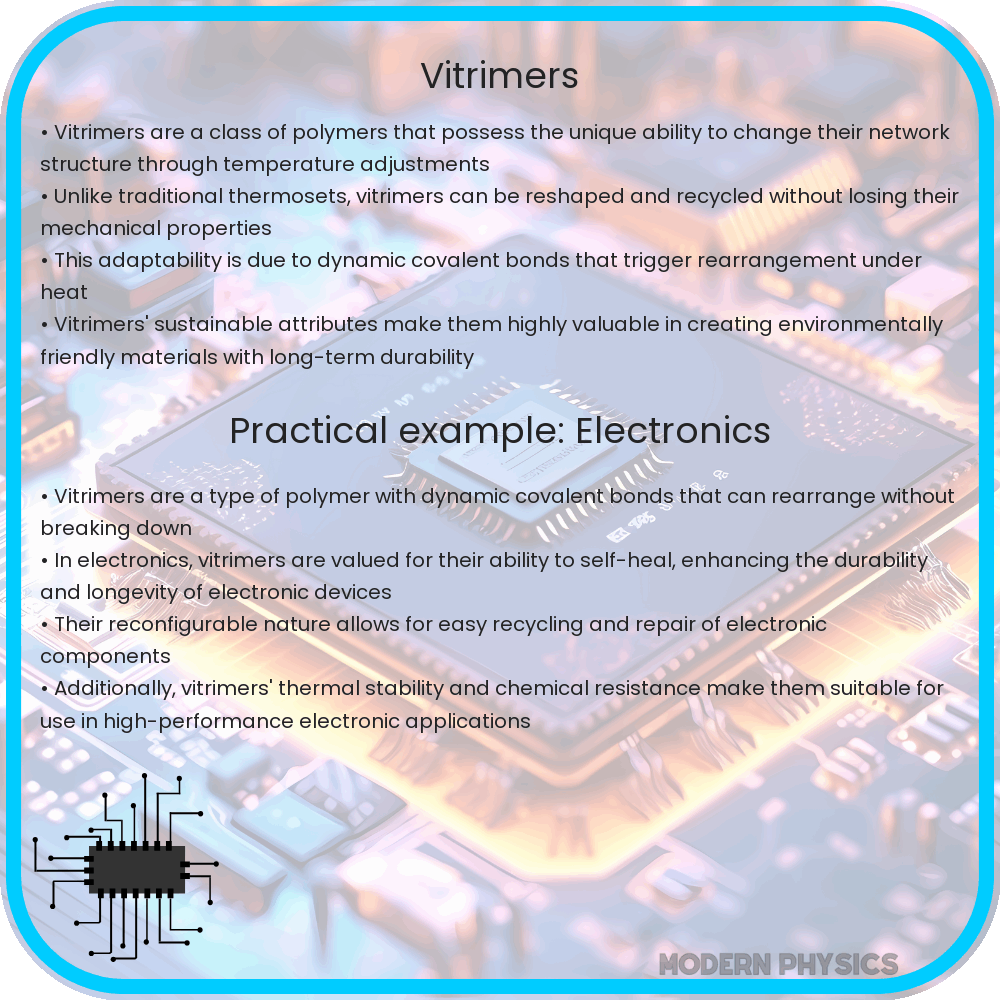
Vitrimers: Pioneering the Future of Recyclable and Durable Materials
In the landscape of materials science, an exciting development has emerged with the creation of vitrimers. These innovative materials hold the promise of merging the benefits of thermosets and thermoplastics, providing both high mechanical strength and recyclability. This combination positions vitrimers as a potential solution to some of the sustainability issues faced by modern industries.
Understanding Vitrimers
Vitrimers are a class of polymers that behave like thermosets in providing high thermal and mechanical stability but can also be reshaped and recycled like thermoplastics when heated. The key to their unique properties lies in their chemical structure, which allows them to rearrange their bonds under certain conditions without degrading the material. This process is known as topological reconfiguration.
Chemical Composition and Properties
The backbone of vitrimers’ adaptable nature is their dynamic covalent bonds. Unlike typical thermosets that have permanent cross-links, vitrimers contain reversible bonds that can break and reform. These bonds rearrange at elevated temperatures, a process that can endure without significant loss of material integrity, allowing vitrimers to “heal” themselves or be reprocessed.
Typically, the bonds in question are ester, vinylogous urethane, or imine, among others. Through an exchange mechanism, generally catalyzed by heat and sometimes acids or bases, these bonds allow for the reshuffling of polymer chains.
Manufacturing and Processing
The manufacturing process of vitrimers resembles that of traditional thermosetting plastics. They can be molded using conventional techniques like injection molding, extrusion, and compression molding. However, because of their unique ability to rearrange polymer chains, vitrimers offer additional processing benefits post-initial curing. For instance, unlike typical thermosets, damaged or deformed vitrimer components can be healed or reshaped through the application of heat, extending their life cycle and efficiency.
Applications of Vitrimers
The adaptable and durable nature of vitrimers makes them suitable for a wide range of applications. In the automotive industry, they could be used to manufacture parts that are both lightweight and capable of self-repair, potentially leading to longer-lasting vehicles with reduced maintenance costs. Additionally, due to their chemical resistance and high-temperature stability, vitrimers are ideal candidates for use in harsh environments such as in aerospace or chemical processing equipment.
- Electronics: Their ability to flow when heated, yet retain strong mechanical properties when cooled, makes vitrimers a valuable material for encapsulating electronic components.
- Construction: As durable, moldable materials that can heal themselves and be reprocessed, vitrimers offer new opportunities for sustainable building practices.
- Recycling: Perhaps one of the most compelling attributes of vitrimers is their potential to be fully recyclable. Unlike traditional thermosets, vitrimers can be reformed and reused, potentially reducing waste and enhancing sustainability in manufacturing processes.
Indeed, the versatile properties of vitrimers herald a promising future in multiple industries, aiming not only to enhance product performance and longevity but also to advance environmental sustainability. As research and development continue, it is likely we will see these materials becoming more prevalent in our daily lives.
Environmental Impact and Future Outlook
Another significant advantage of vitrimers is their potential to reduce environmental impact. Traditional plastics and thermosets pose significant challenges in waste management due to their non-degradable nature. Vitrimers, with their reprocessable and recyclable capabilities, present an alternative that could lead to less environmental degradation. This aligns well with global efforts to reduce plastic waste and promote sustainability in material production.
The future of vitrimers looks incredibly promising as scientists and engineers continue to unravel their potential. Ongoing research aims to enhance the properties of vitrimers, such as increasing their thermal stability, optimizing curing times, and reducing the need for high temperatures during the recycling process. These advancements could broaden the applications of vitrimers, making them more competitive with traditional materials in terms of cost-effectiveness and performance.
Challenges and Research Directions
Despite their remarkable properties, vitrimers also face some challenges. One of the primary issues is the need for precise control over the bond exchange processes to ensure consistent quality and performance in finished products. Additionally, while vitrimers offer environmental benefits, the full lifecycle impact of these materials needs thorough evaluation to better understand their sustainability profile.
Research is also directed towards developing new catalysts that can expedite the bond exchange reactions at lower temperatures and discovering new monomer systems that can further enhance the versatility and efficiency of vitrimers. These studies could lead to faster production times and expand the range of possible applications.
Conclusion
Vitrimers represent a breakthrough in polymer technology with their unique blend of durability, reprocessability, and potential for recyclability. They offer the promise of more sustainable material solutions across a range of industries, from automotive to electronics, and even construction. As we advance our understanding and capabilities in creating and manipulating these materials, it is crucial to continue exploring their environmental impacts and optimize their lifecycle management.
The journey of vitrimers from the lab bench to widespread industrial use will require collaboration among chemists, engineers, policymakers, and industry leaders. It is an exciting time in materials science, and vitrimers are poised to be at the forefront of this innovation, driving us towards a more sustainable and efficient future.