
Learn about ultrathin films, nanometer-thick materials crucial for high-tech applications like electronics and optics.
Understanding Ultrathin Films: A Cornerstone of Modern Technology
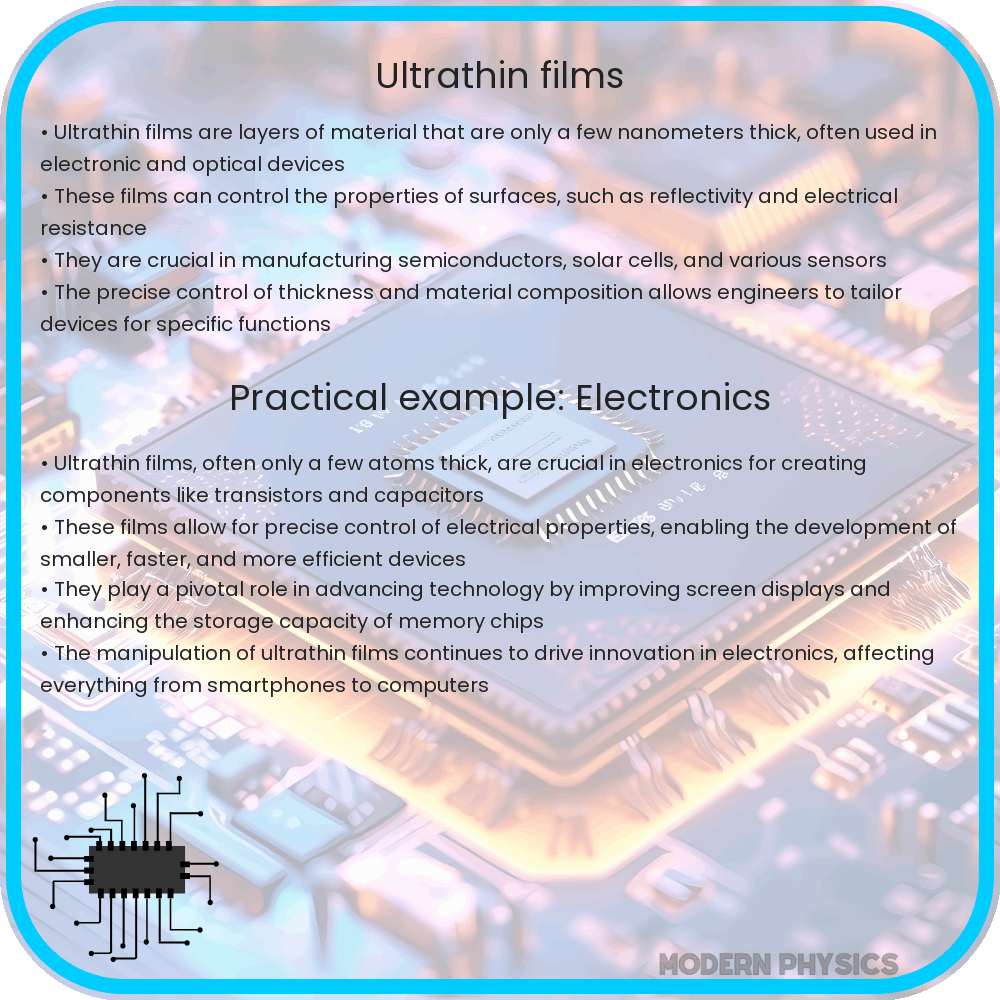
Ultrathin films are incredibly thin layers of material, typically only a few nanometers (nm) in thickness. These layers, often thinner than one thousandth of a human hair, are engineered to exhibit specific properties and functionalities that are not inherently present in bulk materials. This unique characteristic makes ultrathin films integral to a wide array of high-tech applications, including electronics, optics, and protective coatings.
The Science Behind Ultrathin Films
At their core, ultrathin films exploit the principles of surface science and nanotechnology to achieve their extraordinary properties. Depending on their intended use, these films can be made from metals, polymers, semiconductors, or ceramics. The process of creating ultrathin films involves technologies like chemical vapor deposition (CVD), physical vapor deposition (PVD), and atomic layer deposition (ALD). These techniques allow for precise control over the thickness and composition of the films, enabling scientists and engineers to design materials at the atomic scale.
Applications of Ultrathin Films
The versatility of ultrathin films arises from their engineered properties which can include high transparency, electrical conductivity, magnetic properties, or resistance to corrosion and wear. Here are a few areas where ultrathin films are making a significant impact:
- Electronics: In electronics, ultrathin films are crucial for the development of microchips and semiconductors. They are used to form the various layers of integrated circuits, which require precise electrical properties and minimal space usage.
- Energy: In solar panels, ultrathin films of photovoltaic materials capture sunlight and convert it into electricity with high efficiency, promoting the use of renewable energy sources.
- Optics: Ultrathin films are used in the production of anti-reflective coatings on glasses and lenses, drastically improving efficiency and clarity by minimizing light loss and glare.
The innovation in ultrathin film technology continues to expand their applications and improve their effectiveness, making them a crucial component in advancing the frontier of modern technology.
The Future of Ultrathin Films
As technology progresses, the potential applications for ultrathin films only continue to grow. Advances in materials science and nanotechnology could lead to even thinner and more functional films. Researchers are exploring the use of ultrathin films in biomedicine, for example, where they could serve as biosensors or in drug delivery systems. The ability to control and manipulate material properties at the nanoscale promises to open new frontiers in medical, environmental, and quantum computing technologies.
Challenges in Ultrathin Film Development
Despite their impressive capabilities, the development of ultrathin films is not without challenges. The primary issues include the complexity of production processes, the need for high precision, and the cost of materials and technology. Additionally, the durability and stability of these films over time and under different environmental conditions remain areas requiring ongoing research and improvement.
Conclusion
Ultrathin films represent a fascinating area of study in both physics and engineering. Their development leverages advanced techniques in chemical and physical deposition to create materials that are fundamentally different from their bulk counterparts and superior in targeted applications. As integral parts of electronics, energy systems, and optical devices, they highlight how cutting-edge science can be harnessed to solve real-world problems and enhance the performance of various technologies. The road ahead is filled with both exciting potential and significant challenges, promising to push the boundaries of what’s possible in technology and materials science. By continuing to innovate and overcome the obstacles inherent in ultrathin film technology, the future can hold solutions to some of the most pressing issues facing our world today.