
Explore the world of optical thin-film coatings, their impact on technology, and future trends in durability, precision, and clarity in optics.
Understanding Optical Thin-Film Coatings
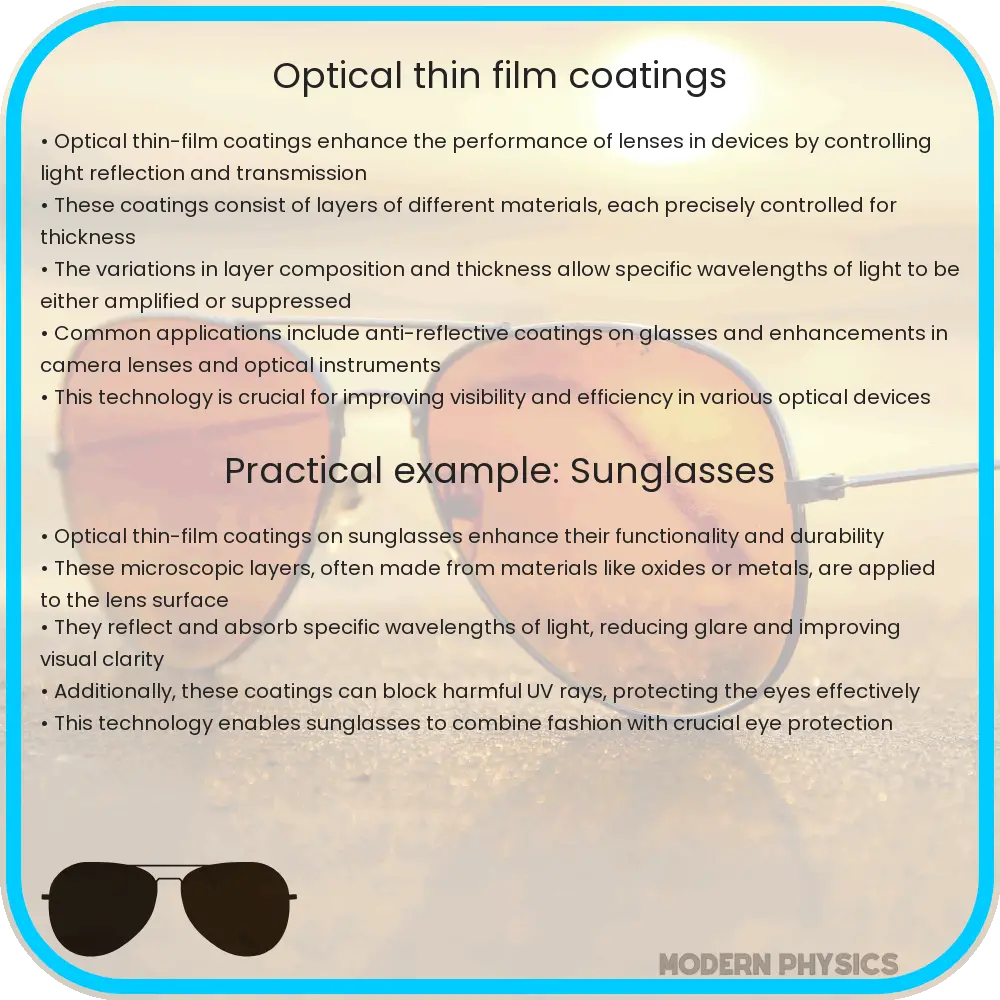
Optical thin-film coatings are at the forefront of advancing the performance and durability of optical systems. These coatings, typically measuring just a few micrometers or less in thickness, play a pivotal role in enhancing the transmission, reflection, and polarization properties of optical components. The science behind these coatings is intricate, involving precise manipulation of light through various materials.
Key Properties of Thin-Film Coatings
The effectiveness of optical thin-film coatings is governed by three main attributes: durability, precision, and clarity. Durability ensures the coating withstands environmental and operational stresses, such as temperature fluctuations, humidity, and physical wear. Precision in the coating process is crucial for achieving the desired optical properties, as the thickness and uniformity of the layers determine the behavior of light interacting with them. Clarity, or the absence of optical imperfections, is essential for maintaining the integrity of the light passing through the coating.
Materials and Techniques
Various materials are employed in thin-film coatings, including metals, oxides, and fluorides. Common materials include Titanium Dioxide (TiO2), Silicon Dioxide (SiO2), and Magnesium Fluoride (MgF2). The choice of material depends on the desired optical properties and the specific application. Techniques such as Physical Vapor Deposition (PVD) and Chemical Vapor Deposition (CVD) are used to apply these materials in layers, each contributing to the overall performance of the coating.
Applications in Different Fields
Optical thin-film coatings have diverse applications across various fields. In astronomy, they are used in telescopic lenses to reduce glare and enhance image clarity. In consumer electronics, they improve the efficiency and durability of screens and camera lenses. The medical industry benefits from these coatings in precision instruments like endoscopes and microscopes, where clarity and accuracy are paramount. Additionally, in the telecommunications sector, these coatings are crucial for fiber optics, enhancing signal transmission by reducing loss and dispersion.
The versatility and advancement of optical thin-film coatings continue to push the boundaries of what is possible in optics, making them an indispensable component in modern technology.
Challenges and Innovations in Thin-Film Coatings
While optical thin-film coatings offer significant benefits, they also present unique challenges. One of the primary concerns is the environmental stability of the coatings. Exposure to harsh environmental conditions can degrade the coating, affecting its optical properties. Manufacturers are continually seeking new materials and processes to enhance the longevity and resilience of these coatings. Another challenge is the control of deposition processes, such as achieving uniform thickness across large or complex surfaces. Technological innovations, including advanced monitoring and control systems, are being employed to overcome these hurdles.
Future Trends and Developments
The future of optical thin-film coatings is likely to see significant advancements. Nanotechnology is playing a crucial role, enabling the development of nanostructured coatings with unprecedented properties. Such coatings can provide better control over light-matter interactions, leading to higher efficiency and performance. Additionally, the exploration of new materials, like complex oxides and chalcogenides, is expected to open up new possibilities in optical coating technology. Environmental considerations are also driving the development of eco-friendly coating materials and processes, reducing the ecological impact of coating production.
Conclusion
Optical thin-film coatings represent a remarkable fusion of material science, optics, and engineering. They are pivotal in enhancing the performance, durability, and clarity of optical components across a wide range of applications. Despite the challenges involved in their production and application, ongoing research and technological innovations continue to push the boundaries of what these coatings can achieve. As we move forward, the role of optical thin-film coatings in advancing technology and improving our daily lives remains more significant than ever. The continued exploration and development in this field promise to bring forth new solutions and opportunities, making an indelible impact on various industries and scientific research.