
Exploring the revolutionary impact of nanostructured coatings, detailing their applications and benefits across various industries.
Introduction to Nanostructured Coatings
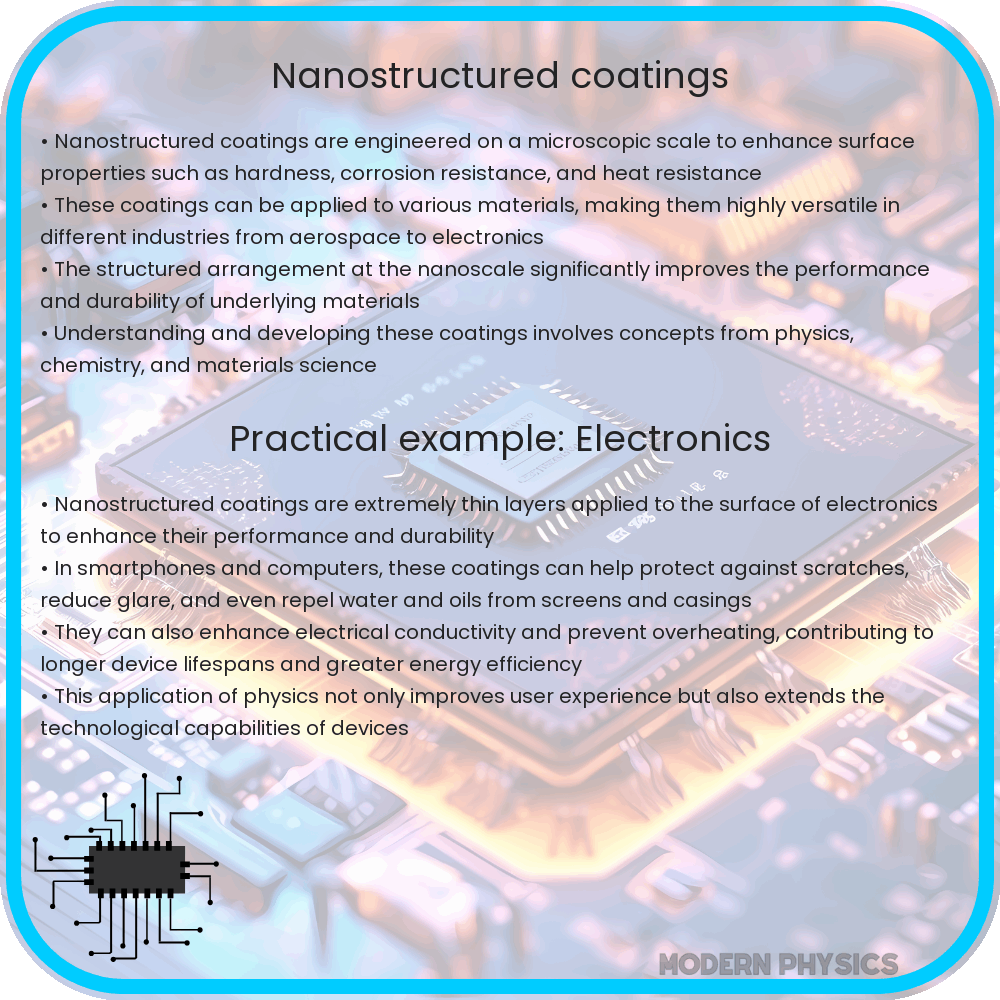
Nanostructured coatings are thin layers of materials applied at the nanoscale to surfaces. These coatings are engineered with structures measured in nanometers—typical structures being significantly less than 100 nanometers (1 nm = 10-9 meter). By leveraging the unique properties that materials exhibit at these scales, nanostructured coatings can dramatically enhance the performance and longevity of various products ranging from electronics to aerospace components.
Key Benefits of Nanostructured Coatings
The implementation of nanostructured coatings brings numerous advantages across several industries. Key benefits include enhanced durability, improved efficiency, and fostering innovation in product functionalities and applications. Such benefits are derived from the unique physical, chemical, and biological properties that materials possess at the nanoscale.
- Durability: Nanostructured coatings are exceptionally resistant to wear, corrosion, and thermal impacts. This makes them ideal for applications that require materials to withstand harsh environmental conditions.
- Efficiency: These coatings can significantly increase the efficiency of mechanical and electrical systems. For instance, nano-coatings used on cutting tools can reduce friction and tool wear, leading to faster and more efficient manufacturing processes.
- Innovation: By altering the surface properties at the molecular level, nanostructured coatings enable new product features, such as self-cleaning surfaces, anti-reflective treatments, and improved electrical conductivity, which can lead to innovative solutions in various fields.
Scientific Principles Behind Nanostructured Coatings
The effectiveness of nanostructured coatings can be attributed to two scientific principles primarily: increased surface area and quantum effects.
- Increased Surface Area: At the nanoscale, materials have a much higher surface area to volume ratio compared to the same mass of material in bulk form. This increased surface area offers more reactive sites, which can enhance properties like adhesion, chemical reactivity, and mechanical strength.
- Quantum Effects: Quantum mechanical effects become significant at the nanoscale. These effects can alter the optical, electrical, and magnetic behaviors of materials, giving rise to novel properties that can be exploited in various applications.
As we dive deeper into the applications and specific types of nanostructured coatings, it becomes evident how these principles translate into real-world utilities and advancements. This will include discussions on coatings used in electronics for heat management, in the marine industry for biofouling control, and in the medical field for antibacterial surfaces.
Industrial Applications of Nanostructured Coatings
The versatility of nanostructured coatings makes them suitable for a wide array of applications. They are used in sectors ranging from healthcare to automotive to electronics, each benefiting from different aspects of these advanced materials.
- Electronics: In electronics, nanostructured coatings are used to enhance heat dissipation capabilities in devices such as computers and smartphones, thereby improving their performance and lifespan.
- Automotive: The automotive industry uses nano-coatings for improving the fuel efficiency of engines by reducing friction and wear in moving parts. These coatings also contribute to the aesthetics and durability of automotive exteriors through scratch-resistant finishes.
- Healthcare: In healthcare, nano-coatings on medical devices can prevent bacterial adhesion and growth, leading to reduced infection rates and higher sanitary standards in medical environments.
The adoption of nanostructured coatings continues to grow as more industries recognize their potential to solve traditional challenges and create new opportunities for innovation.
Emerging Trends and Future Prospects
The ongoing research and development in nanostructured coatings are paving the way for even more innovative applications. Emerging trends include the development of multifunctional coatings that combine anti-corrosion, anti-fouling, and self-healing properties. These advanced coatings are expected to have a profound impact on the maintenance cycles and durability of high-performance equipment and infrastructures.
- Energy Sector: The energy sector stands to benefit greatly from nano-coatings that enhance the efficiency and durability of solar panels and wind turbines, potentially reducing the cost of renewable energy.
- Environmental Protection: Nanostructured coatings are also being developed to help reduce environmental impacts, such as coatings that minimize harmful emissions from vehicles and industrial processes.
- Smart Coatings: Future developments are also likely to include ‘smart’ nano-coatings that can adapt to environmental changes, offering dynamic functionality like thermochromic properties for energy-efficient buildings.
The alignment of nanotechnology with digital technologies such as AI and IoT could further revolutionize this field, leading to coatings that not only protect and perform but also gather data used to monitor and optimize performance in real-time.
Conclusion
Nanostructured coatings represent a groundbreaking advancement in material science with their capacity to fundamentally alter the properties of surface treatments. By manipulating matter at the atomic or molecular level, these coatings have already shown their ability to enhance durability, efficiency, and innovation across multiple industries. As research continues to develop, the future of nanostructured coatings holds exciting possibilities for even more robust, intelligent, and ecologically sensitive solutions. This dynamic field of engineering not only offers practical applications today but also sets the stage for the high-tech surfaces of tomorrow.
By understanding the science and application of nanostructured coatings, industries are better positioned to tackle existing challenges while paving the way for new achievements. Whether it’s extending the life of medical devices or improving the environmental footprint of the automotive and energy sectors, nanostructured coatings are at the forefront of technological innovations that are transforming our world.