
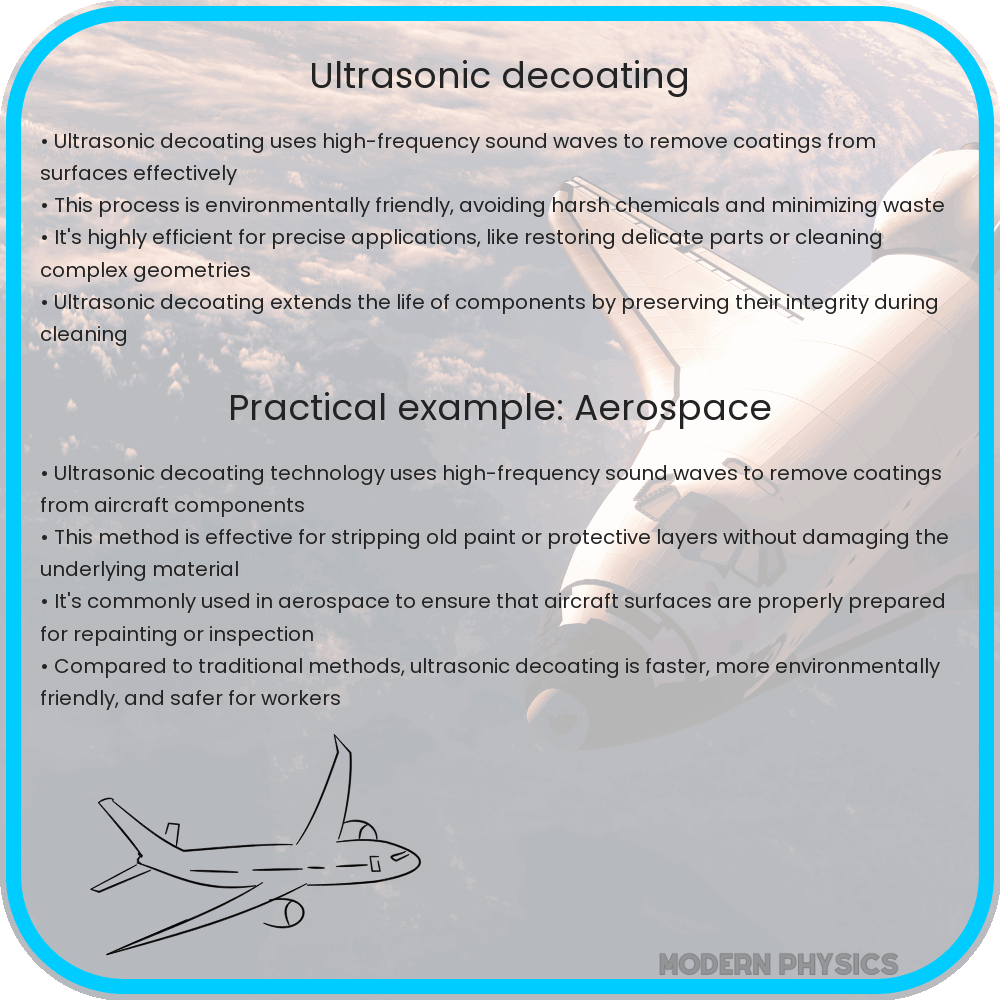
Ultrasonic decoating is a technology that uses high-frequency sound waves to efficiently remove coatings from surfaces without damaging the substrate.
Understanding Ultrasonic Decoating: A Leap in Advanced Acoustics
Ultrasonic decoating is an emerging technology that utilizes high-frequency sound waves to remove coatings and finishes from various surfaces without damaging the underlying material. This method has gained popularity due to its efficiency, environmental friendliness, and non-destructive nature, making it an ideal choice in industries where precision and surface integrity are critical.
How Ultrasonic Decoating Works
At its core, ultrasonic decoating operates on the principle of ultrasonic vibration. Equipment used in this technique generates ultrasonic waves typically in the frequency range of 20 kHz to 40 kHz. These high-frequency waves create rapid mechanical vibrations applied to a coated surface. The energy from the vibrations disrupts the bond between the coating and the substrate without affecting the substrate itself.
The process begins with the immersion of the coated item into a tank filled with a liquid medium, often water or specialized solvents that assist in the decoating process. The ultrasonic generator then produces waves that travel through the liquid and impact the coated surface. The agitation caused by the ultrasonic waves induces cavitation; tiny bubbles form and implode on the coating’s surface, leading to its removal.
Advantages of Ultrasonic Decoating
- Non-Destructive: One of the primary benefits of ultrasonic decoating is its non-destructive nature. The substrate remains intact and unaltered, which is crucial for high-value components in aerospace, automotive, and electronics industries.
- Environmentally Friendly: Unlike traditional chemical stripping methods that often use toxic solvents, ultrasonic decoating can be performed using water or eco-friendly solvents. This significantly reduces the environmental impact associated with coating removal.
- Efficiency: Ultrasonic decoating is significantly faster than many conventional decoating methods. It can reduce process times by a substantial margin, thus increasing overall productivity.
- Versatility: This technology is effective on a wide range of materials and coatings, including metals, plastics, ceramics, and composites, making it versatile for various industrial applications.
Applications in Industry
Ultrasonic decoating technology is particularly valuable in sectors where both the conservation of the substrate and the removal of outdated or defective coatings are simultaneously necessary. In the automotive industry, for example, it enables the removal of paint from car bodies or parts without harming the underlying metal. In the aviation sector, precise removal of specific layers without damaging critical parts is crucial for maintenance and restoration.
The electronics industry also benefits from this technology, especially in recycling and refurbishing where removing coatings from valuable components can be done without risking damage to sensitive electronic parts. Ultrasonic decoating offers a reliable solution that preserves integrity while ensuring complete removal of coatings and finishes.
In medical device manufacturing, the cleanliness and sterilization of products are paramount. Ultrasonic decoating helps in removing old coatings and preparing surfaces for new coatings without the use of harsh chemicals that could linger and contaminate medical devices.
Frequently Asked Questions About Ultrasonic Decoating
For those new to the concept of ultrasonic decoating, several common inquiries often arise:
- Is ultrasonic decoating safe for all types of coatings? While ultrasonic decoating is highly versatile, its effectiveness can vary depending on the coating material and thickness. It is always advisable to conduct a small-scale test to determine the suitability for specific coatings.
- What are the limitations of ultrasonic decoating? The main limitations include the need for the items to be fully immersed in a liquid medium, which may not be feasible for all components or materials. Additionally, extremely thick or hardened coatings may require multiple treatments or alternative methods.
- How does ultrasonic decoating compare to laser decoating? Ultrasonic decoating is generally less expensive and better for large or complex surfaces. Laser decoating, on the other hand, offers higher precision for localized area treatment but can be costlier and potentially damaging to heat-sensitive materials.
Future Prospects of Ultrasonic Decoating
The ongoing research in ultrasonic technology suggests promising enhancements that could expand its application base. Innovations in ultrasonic wave generation and modulation may soon allow for even more precise control over decoating processes, potentially opening up new industrial applications. Additionally, as environmental regulations become stricter, the demand for green technologies like ultrasonic decoating is likely to increase, supporting further investments and technological advancements in this field.
Given its benefits and emerging developments, ultrasonic decoating looks set to revolutionize surface treatment processes across various industries. By aligning with sustainability goals and improving efficiency, this technique not only addresses the immediate needs of the market but also contributes to broader environmental conservation efforts.
Conclusion
Ultrasonic decoating represents a significant advancement in surface treatment technology. By offering a non-destructive, environmentally friendly, and efficient alternative to traditional methods, it caters to the growing demand for sustainable industrial processes. Its versatility across different industries—from automotive to electronics and medical devices—illustrates its broad utility and transformative potential. As technology continues to evolve, ultrasonic decoating promises to play a pivotal role in the future of manufacturing and refurbishing, making it an essential technique for companies aiming to stay competitive in a rapidly changing industrial landscape.