
Explore key principles and innovative designs in earthquake-resistant structures, ensuring safety and stability in seismic zones.
Understanding Earthquake-Resistant Structures: Key Concepts and Design Strategies
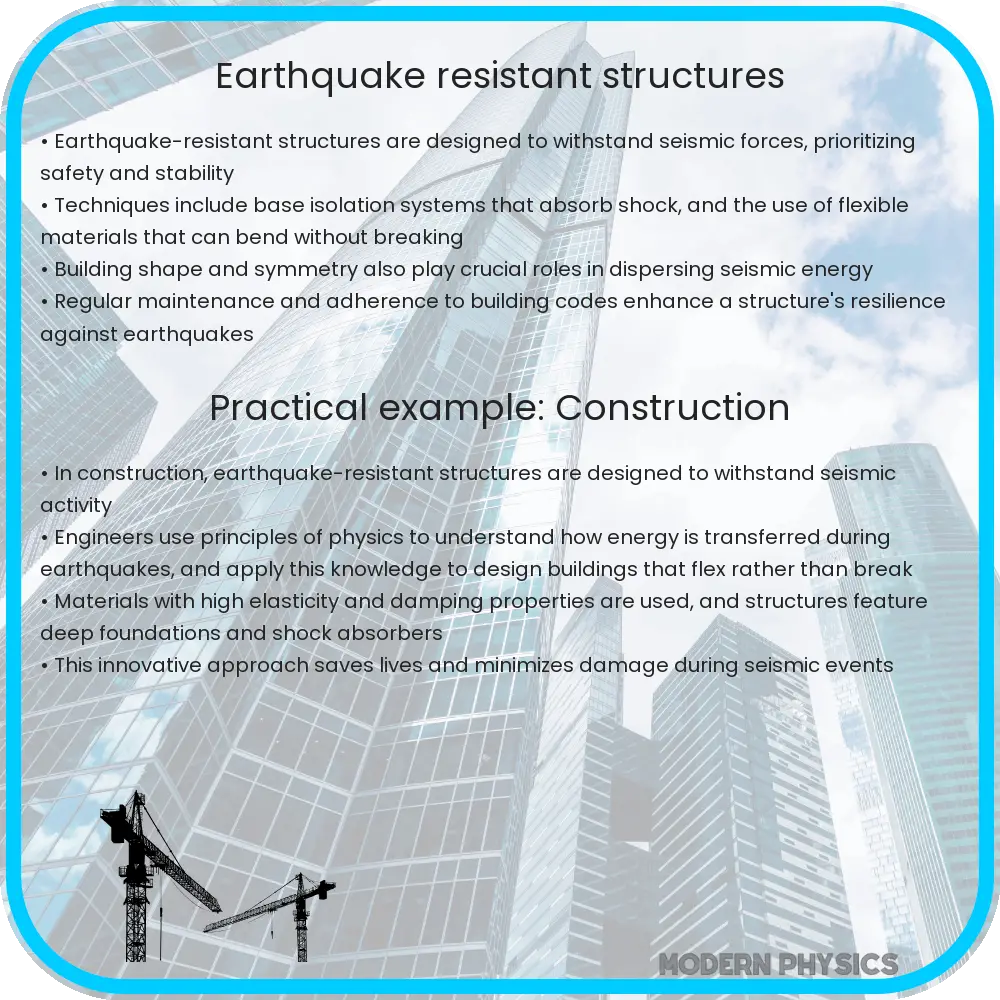
Earthquake-resistant structures are ingeniously designed to withstand the seismic waves generated by earthquakes, thus ensuring the safety and stability of the buildings and their occupants. This article delves into the fundamental principles and design approaches that underpin earthquake-resistant construction.
Principles of Earthquake-Resistant Design
The primary goal of earthquake-resistant design is to minimize damage during seismic activity. This involves several key principles:
- Energy Dissipation: Structures must be able to absorb and dissipate the energy from seismic waves. This is often achieved through the use of damping systems which convert kinetic energy into other forms, like heat.
- Flexibility: Rigidity can be detrimental in an earthquake. Thus, buildings are designed to be flexible enough to sway with the seismic waves, reducing the stress on the structure.
- Redundancy: Incorporating redundancy in structural design ensures that if one component fails, others can take over the load-bearing function, preventing catastrophic collapse.
- Strong Connections: Joints and connections in the structure should be strong enough to hold different components together, yet flexible enough to accommodate movement.
Key Design Elements of Earthquake-Resistant Buildings
Several design elements are crucial in creating earthquake-resistant structures:
- Base Isolation: This technique involves constructing the building on shock absorbers, allowing the base to move independently of the structure above, significantly reducing seismic forces.
- Shear Walls: These are rigid walls placed in strategic locations in a building to resist lateral forces acting on it during an earthquake.
- Diaphragms: Horizontal elements like floors and roofs, act as diaphragms, distributing seismic forces to vertical resistance elements like shear walls and frames.
- Cross-Bracing: Cross-shaped structural supports help in stabilizing buildings against the lateral forces of earthquakes.
When designing earthquake-resistant structures, engineers often utilize advanced materials and technologies. For instance, the use of high-strength steel and concrete significantly enhances a building’s ability to withstand seismic forces. Additionally, innovative technologies like tuned mass dampers and seismic invisibility cloaks are being explored to further improve the earthquake resilience of structures.
In conclusion, the development of earthquake-resistant structures is a complex but crucial aspect of modern construction, incorporating a blend of traditional engineering principles and cutting-edge technological advancements. This ensures not only the stability and safety of the buildings but also the protection of lives during seismic events.
Advanced Technologies in Earthquake-Resistant Design
Recent advancements in technology have further revolutionized the field of earthquake-resistant construction. Innovations such as shape memory alloys, which can return to their original shape after deformation, and smart materials that change properties in response to external stimuli, are being integrated into building designs. Furthermore, seismic invisibility cloaks, which redirect seismic waves around buildings, are a groundbreaking concept currently under research.
Challenges and Future Directions
Despite significant progress, the field of earthquake-resistant design faces challenges. One major issue is retrofitting older buildings to meet modern seismic standards, which can be both costly and technically demanding. Additionally, in regions with low seismic activity, there may be less motivation to invest in such technologies, leaving structures vulnerable to rare but potentially devastating earthquakes.
Future directions in earthquake-resistant design involve not only technological advancements but also policy and education. Governments need to enforce strict building codes and invest in public awareness and preparedness for seismic events. Moreover, as climate change potentially alters seismic activity patterns, ongoing research and adaptation of building practices are essential.
Conclusion
Earthquake-resistant structures represent a crucial intersection of engineering, technology, and public safety. By applying principles of energy dissipation, flexibility, redundancy, and strong connections, and incorporating key design elements like base isolation, shear walls, diaphragms, and cross-bracing, engineers can create buildings that stand resilient in the face of seismic challenges. Advanced materials and technologies, such as high-strength steel, concrete, shape memory alloys, and smart materials, further enhance the effectiveness of these designs.
The journey towards more resilient structures is ongoing. As the world continues to grapple with the realities of seismic risks, the importance of investing in earthquake-resistant designs becomes increasingly clear. It’s a multi-faceted effort that requires the collaboration of engineers, policymakers, and communities. By embracing innovation and prioritizing safety, we can build a future where the impact of earthquakes on human lives and infrastructure is significantly reduced, safeguarding our societies for generations to come.