
Learn about ultrasonic thickness profiling, a non-destructive technique used to measure material thickness and prevent industrial failures.
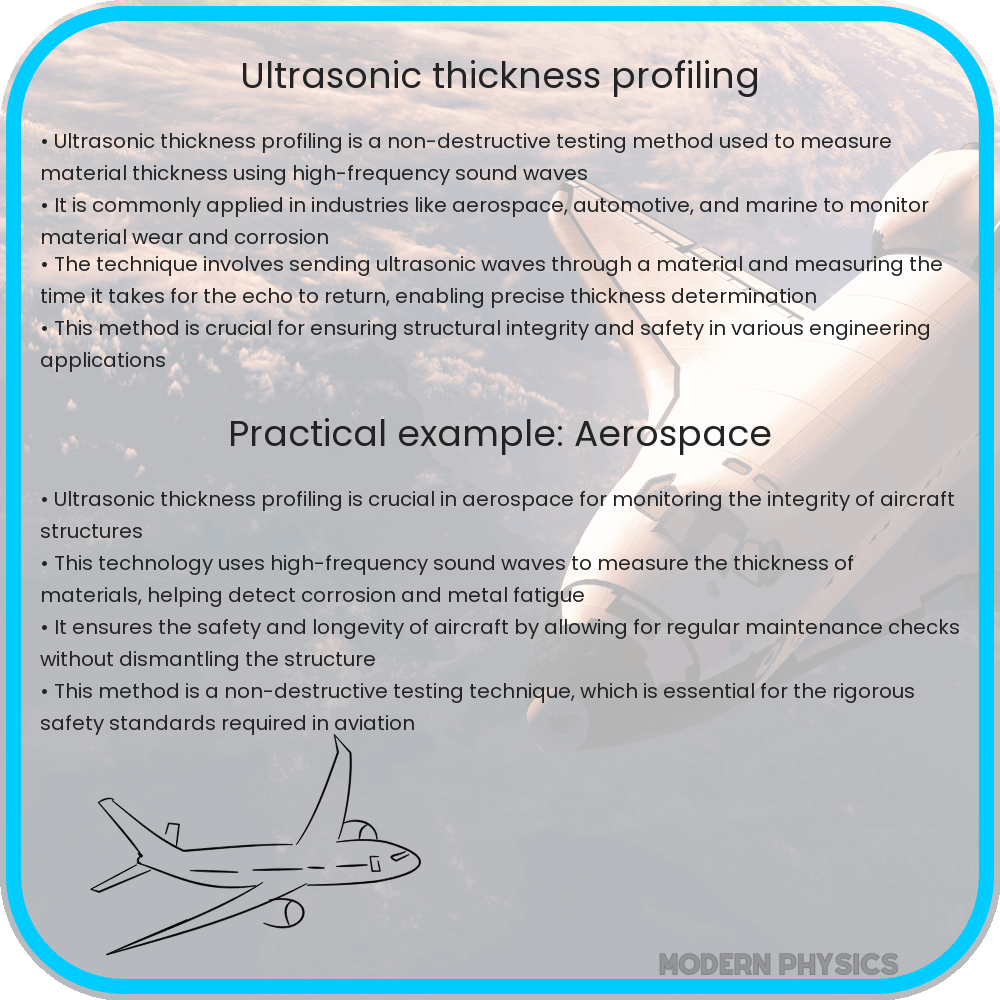
Understanding Ultrasonic Thickness Profiling
Ultrasonic thickness profiling is a highly effective, non-destructive testing technique that engineers and technicians use to measure the thickness of a material from one side. This method is predominantly used in fields where pipe corrosion or the wear and tear of critical structures can lead to catastrophic failures. Understanding how ultrasonic thickness profiling works, its accuracy, and efficiency is key to appreciating its use in various industries.
How Ultrasonic Thickness Profiling Works
Ultrasonic thickness measurements are carried out using a device known as an ultrasonic thickness gauge. This tool functions by emitting a high-frequency sound wave, typically in the range of 0.5 to 20 MHz, through the material whose thickness is to be measured. Once the ultrasonic wave is sent into the material, it travels until it hits the back wall and then reflects back to the sensor.
The thickness of the material is calculated based on the time taken for the sound waves to return to the gauge. The formula used to determine the thickness is given by:
Thickness (T) = (Velocity (V) * Time (t) ) / 2
Here, Velocity (V) is the speed of sound in the material, and Time (t) is the time taken for the ultrasound to travel to the back of the material and back to the sensor. The division by 2 is necessary because the ultrasound travels the distance twice: going to the back of the material and returning.
Accuracy of Ultrasonic Thickness Profiling
The accuracy of ultrasonic thickness profiling largely depends on the uniformity of the material’s acoustic properties and the precision of the device used. Generally, modern ultrasonic thickness gauges can achieve accuracies as high as ±0.1 mm or better. However, several factors affect accuracy, such as:
- Material properties: Variations in the material’s composition and internal structure can affect how uniformly the sound travels through it.
- Surface condition: Rough or uneven surfaces can scatter the ultrasonic waves and affect the accuracy of the readings.
- Calibration: The equipment must be properly calibrated with reference blocks that closely resemble the test material’s acoustic characteristics.
- Skill of the operator: The technique is somewhat sensitive to the skills and experience of the person performing the test, particularly in setting up the gauge and interpreting the results.
Non-Destructive Nature and Efficiency
One of the standout features of ultrasonic thickness profiling is its non-destructive nature. The method does not cause any damage to the material being inspected, making it an ideal choice for ongoing monitoring of critical infrastructure like pipelines, hulls of ships, or bridges. This attribute results in substantial cost savings over methods that require cutting or sectioning of the material for measurement.
Further, ultrasonic thickness gauges are highly efficient. They provide immediate results, which is crucial for industries where downtime equals significant financial loss. This immediacy allows for rapid decision-making, whether it is routine maintenance or emergency interventions.
Lastly, ultrasonic thickness profiling is versatile and can be used on a variety of materials, including metals, plastics, ceramics, glass, and various composites. This versatility, combined with its accuracy and non-destructive nature, makes ultrasonic thickness profiling an indispensable tool in the maintenance and safety of industrial and structural assets.
Applications of Ultrasonic Thickness Profiling
The applications of ultrasonic thickness profiling are widespread and impact multiple sectors. Common uses include:
- Corrosion monitoring: Regularly assessing the thickness of pipes and tanks in chemical plants or oil rigs to predict the replacement or repair needs.
- Boiler tubes: Measuring the thickness of tubes in boilers to prevent failures from thinning due to corrosion or erosion.
- Aerospace: Checking the integrity of aircraft parts, which are subject to significant wear and tear.
- Marine industry: Monitoring the hull’s thickness to ensure it meets safety standards and prevent failures at sea.
Each of these applications highlights the critical role that ultrasonic thickness profiling plays in not only maintaining operational efficiency but also ensuring safety in various industrial activities.
Challenges and Limitations
Despite the significant advantages of ultrasonic thickness profiling, there are challenges and limitations that need consideration. These include:
- Material Limitations: Certain materials that have coarse grain structures, like cast iron, may diffuse the ultrasonic wave, making it difficult to obtain accurate measurements.
- Complex Geometries: Components with complex shapes or small radii can pose difficulties for the ultrasonic sensor to maintain contact and deliver reliable results.
- Temperature Extremes: Extremely high or low temperatures can affect the performance of ultrasound equipment and the propagation of sound waves, impacting measurement accuracy.
- Thickness Range: There are limitations on measuring very thin or excessively thick materials, which may require alternative methods or more advanced ultrasonic techniques.
Nevertheless, advancements in ultrasonic technology and calibration techniques continue to mitigate many of these challenges, broadening the applicability of this crucial diagnostic tool.
Conclusion
Ultrasonic thickness profiling stands out as a critical tool in the monitoring and maintenance of various industrial components. From ensuring the integrity of aerospace parts to preventing catastrophic failures in pipelines and structures, its role cannot be overstated. Though there are challenges related to material properties and environmental conditions, continual improvements in technology and skill enhancement of operators are making ultrasonic measurements more reliable and accurate. This non-destructive technique not only saves costs by preventing unforeseen failures but also enhances safety by allowing for timely maintenance and repairs. With its broad range of applications and ongoing advancements, ultrasonic thickness profiling remains a cornerstone technology in industrial safety and efficiency.
Understanding and incorporating ultrasonic thickness profiling into regular maintenance routines can dramatically extend the life of essential components and structures, offering peace of mind and substantial economic benefits to industries around the globe.