
Explore the advanced features of TMR sensors, their enhanced sensitivity, stability, and precision, and their diverse applications in technology.
Understanding TMR Sensors: Enhanced Sensitivity, Stability, and Precision
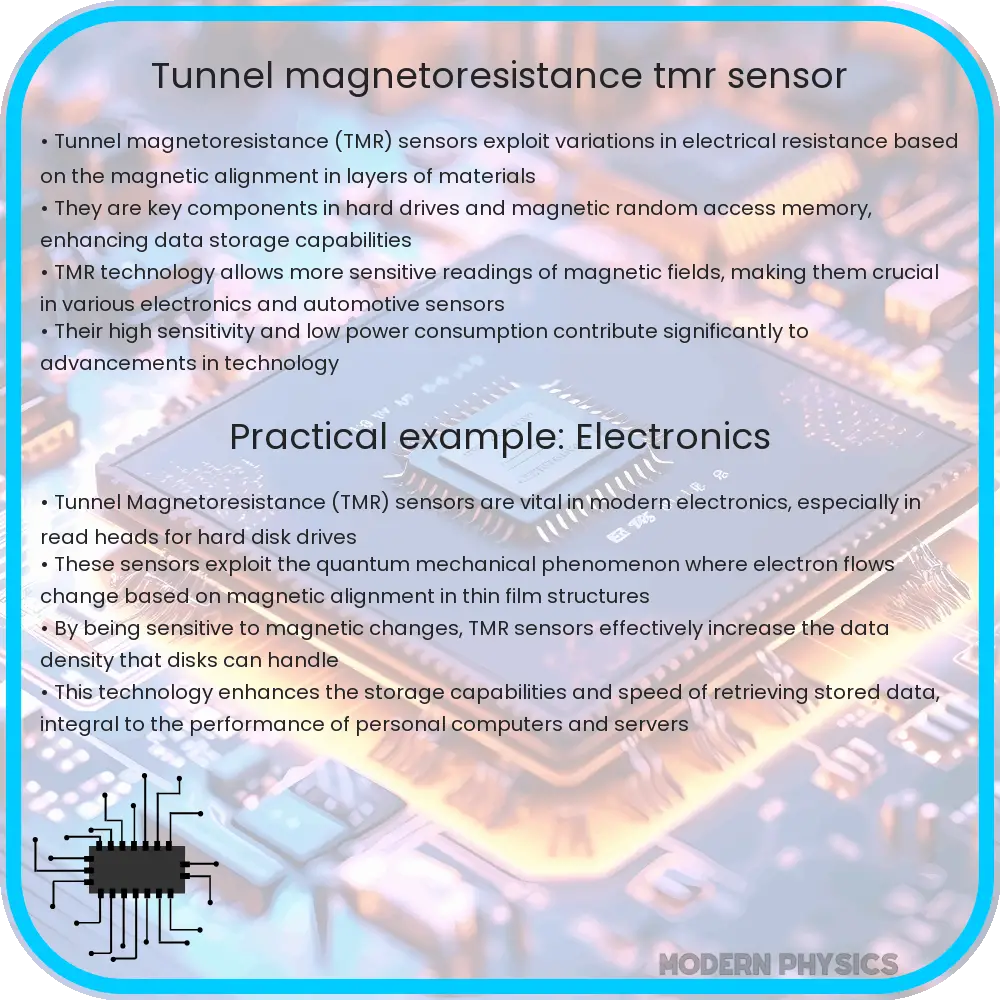
Tunnel Magnetoresistance (TMR) sensors represent a significant advancement in magnetic field detection technology. These sensors are renowned for their enhanced sensitivity, stability, and precision, making them highly sought-after in various applications, from automotive to medical diagnostics. This article delves into the fundamentals of TMR sensors and their superior characteristics.
Principles of TMR Sensor Operation
At the core of TMR sensor technology lies the principle of tunnel magnetoresistance. This phenomenon occurs in a magnetic tunnel junction (MTJ), which consists of two ferromagnetic layers separated by a thin insulating layer. When a magnetic field is applied, the relative orientation of the magnetizations in these layers changes, altering the resistance of the junction. This change in resistance is used to measure magnetic fields with high precision.
Enhanced Sensitivity and Precision
TMR sensors stand out for their exceptional sensitivity. They are capable of detecting minute changes in magnetic fields, which is crucial in applications requiring high precision, such as in magnetic encoders or biomedical imaging. The sensitivity of TMR sensors is typically an order of magnitude greater than traditional Hall Effect sensors, allowing for more accurate and detailed measurements.
Improved Stability
Another key advantage of TMR sensors is their stability. They exhibit minimal drift in their measurements over time, maintaining consistent performance even under varying environmental conditions. This reliability is essential for applications where long-term stability and repeatability are critical, such as in aerospace and industrial automation.
Applications of TMR Sensors
The unique attributes of TMR sensors make them ideal for a wide range of applications. In the automotive industry, they are used for position sensing in electric power steering systems, enhancing vehicle safety and performance. In the medical field, their high sensitivity enables advanced diagnostic techniques, such as magnetic resonance imaging (MRI). Additionally, their precision and stability are beneficial in robotics and automation, where accurate sensing is paramount.
In summary, TMR sensors offer enhanced sensitivity, stability, and precision over traditional magnetic field sensors. These characteristics have broadened their application scope, contributing significantly to advancements in various fields. In the following section, we will explore the technological advancements behind TMR sensors and their future potential.
Technological Advancements in TMR Sensors
Recent developments in TMR sensor technology have focused on enhancing their performance and reducing size. Advancements in nanofabrication techniques have enabled the production of smaller, more efficient sensors. This miniaturization allows for integration into compact devices, expanding their usability in space-constrained applications like wearable technology and mobile devices.
Material Innovations
Material science plays a crucial role in the advancement of TMR sensors. The use of novel materials like Heusler alloys has improved the magnetoresistive effect, leading to even higher sensitivity. Moreover, developments in insulating layers, such as the use of high-quality MgO (Magnesium Oxide), have significantly increased the TMR effect, enhancing the sensor’s performance.
Addressing Environmental Challenges
One of the challenges in TMR sensor technology is environmental robustness. Researchers are addressing this by developing sensors that can operate effectively in extreme temperatures and under electromagnetic interference. These improvements are vital for applications in harsh environments, such as deep-space exploration and industrial processes involving high temperatures or strong electromagnetic fields.
Future Potential and Emerging Applications
The future of TMR sensors is promising, with potential applications in quantum computing and spintronics. Their ability to detect minute magnetic fields can be pivotal in developing new computing technologies that rely on spin states. Additionally, their precision makes them ideal for security applications, such as tamper-proofing in banking and identification systems.
Conclusion
TMR sensors represent a paradigm shift in magnetic field detection, offering unmatched sensitivity, stability, and precision. Their evolution, driven by advancements in material science and nanotechnology, has broadened their application spectrum. From enhancing vehicle safety to pushing the boundaries of medical imaging and computing, TMR sensors continue to be at the forefront of technological innovation. As research progresses, we can expect these sensors to play an increasingly vital role in various industries, contributing significantly to technological advancements and societal benefits.