
Explore the impact of wind tunnel testing in kinematics for aerospace, automotive, sports, and architecture, enhancing design efficiency and precision.
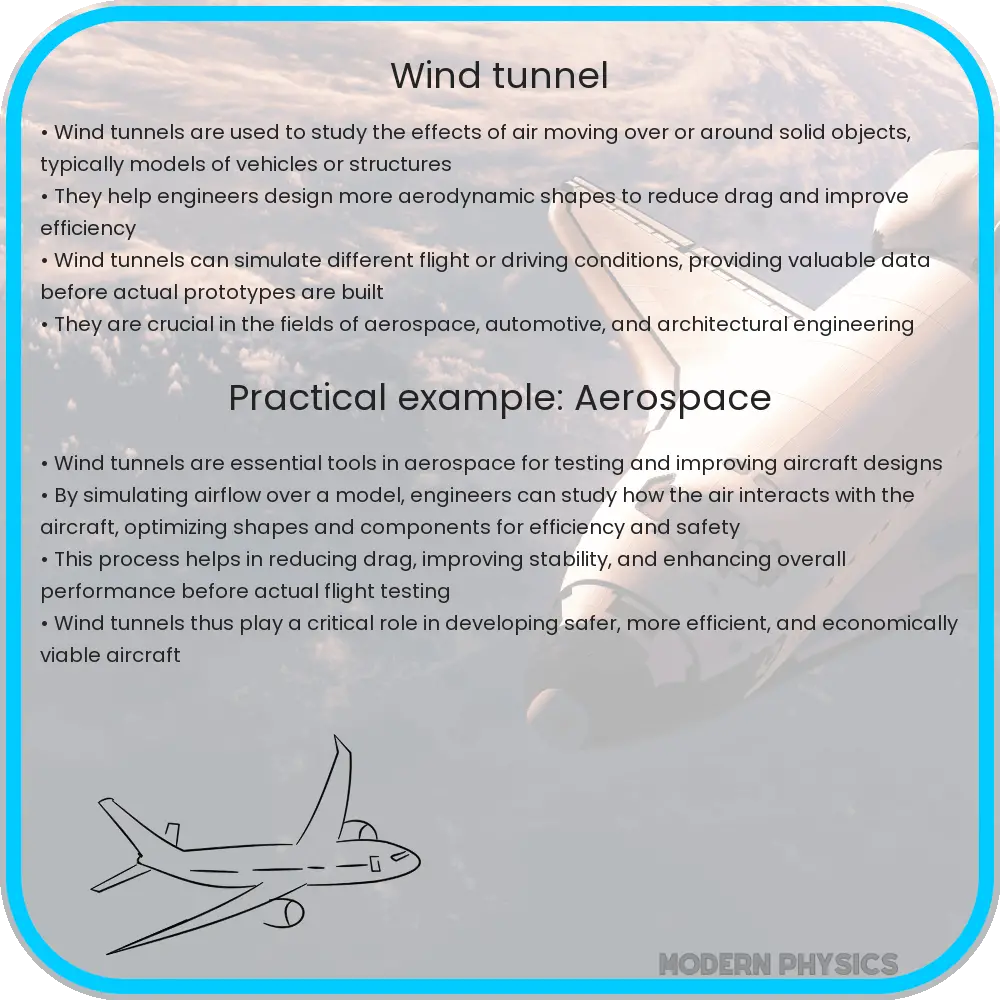
Understanding Wind Tunnel Testing in Kinematics
Wind tunnel testing stands as a pivotal method in the exploration and advancement of kinematics, particularly in the fields of aerospace, automotive, and architectural engineering. This technique offers invaluable insights into the aerodynamic properties of various structures and vehicles, enhancing efficiency and precision in design and performance.
Key Principles of Wind Tunnel Testing
The core principle of wind tunnel testing lies in simulating real-world air flow conditions in a controlled environment. This simulation allows engineers to study the effects of air movement around a physical model, typically a scaled-down version of the actual structure or vehicle. By observing the interaction between air flow and the model, engineers can glean crucial data on aerodynamic forces such as lift, drag, and pressure distribution.
Types of Wind Tunnels
Wind tunnels vary in size and complexity, ranging from small, low-speed tunnels for basic research to large, high-speed tunnels used for testing full-scale models. Two primary types are subsonic tunnels, which operate below the speed of sound, and supersonic tunnels, designed for speeds greater than Mach 1.
Enhancing Efficiency with Wind Tunnel Testing
One of the significant advantages of wind tunnel testing in kinematics is its ability to optimize efficiency. By understanding how air flows around a structure, engineers can design shapes that reduce drag and turbulence, leading to more energy-efficient designs. This is especially critical in the automotive and aerospace industries, where fuel efficiency is a paramount concern.
Advancing Precision in Kinematic Design
Wind tunnel testing also plays a crucial role in enhancing the precision of kinematic designs. Through detailed analysis of aerodynamic forces, engineers can fine-tune designs to achieve desired performance characteristics. This precision is essential in high-stakes applications like aircraft design, where even minor improvements can have significant impacts on safety and performance.
Incorporating advanced technologies like computational fluid dynamics (CFD) alongside traditional wind tunnel testing further elevates the potential for precision. CFD allows for the simulation of air flow in a virtual environment, complementing physical tests with detailed, predictive models.
Applications in Various Fields
While most commonly associated with aerospace and automotive industries, wind tunnel testing finds applications in several other areas. For instance, in architectural engineering, it helps in designing buildings that can withstand high winds and minimize wind-induced vibrations. In sports, athletes and equipment manufacturers use wind tunnel data to improve performance and reduce drag in disciplines like cycling and skiing.
The upcoming section will delve into specific examples and case studies, showcasing the transformative impact of wind tunnel testing in enhancing efficiency and precision across various industries.
Case Studies in Wind Tunnel Testing
Examining specific case studies illuminates the profound impact of wind tunnel testing in various sectors. In the aerospace industry, for example, wind tunnel experiments have been instrumental in refining the aerodynamic designs of aircraft. These studies have led to the development of winglets and streamlined fuselages, significantly improving fuel efficiency and reducing emissions. Similarly, in the automotive sector, manufacturers rely on wind tunnel data to sculpt vehicle exteriors that minimize drag, boosting fuel efficiency and enhancing stability at high speeds.
Wind Tunnel Testing in Sports
In the realm of sports, wind tunnel testing has revolutionized equipment design and athletic training. Cyclists, for instance, use wind tunnel data to optimize their riding position and helmet design, seeking the ideal balance between aerodynamics and comfort. This testing extends to winter sports as well, where ski jumpers and bobsledders utilize wind tunnel insights to minimize air resistance and maximize speed.
Architectural Applications
Architecturally, wind tunnel testing is critical in skyscraper design. By analyzing wind patterns around scale models, engineers can predict wind loads and mitigate sway, ensuring structural integrity and occupant comfort in tall buildings. This approach has paved the way for innovative designs in cities prone to high winds and typhoons.
Challenges and Future Directions
Despite its numerous benefits, wind tunnel testing faces challenges, including high costs and the complexity of simulating real-world conditions accurately. The future of wind tunnel testing lies in the integration of more advanced computational methods, which promise to reduce costs and increase the fidelity of simulations. This evolution will likely see a greater synergy between physical testing and virtual simulations, offering a more comprehensive approach to understanding aerodynamics.
Conclusion
Wind tunnel testing has emerged as a cornerstone technique in kinematics, driving advancements in efficiency and precision across multiple industries. From improving the fuel efficiency of vehicles to ensuring the safety of skyscrapers, the contributions of wind tunnel testing are both far-reaching and profound. As technology advances, the integration of computational simulations with traditional testing methods is set to further enhance our understanding of aerodynamics, paving the way for even more innovative and efficient designs in the future.