
Explore the eco-friendly and efficient world of Magnetic Refrigeration, a sustainable alternative to traditional cooling systems.
Magnetic Refrigeration: A Leap Towards Sustainable Cooling
The realm of refrigeration is witnessing a revolutionary change with the advent of magnetic refrigeration. This cutting-edge technology, not only promises enhanced efficiency but also strides towards eco-friendliness, making it a beacon of hope in the quest for sustainable cooling solutions.
Understanding Magnetic Refrigeration
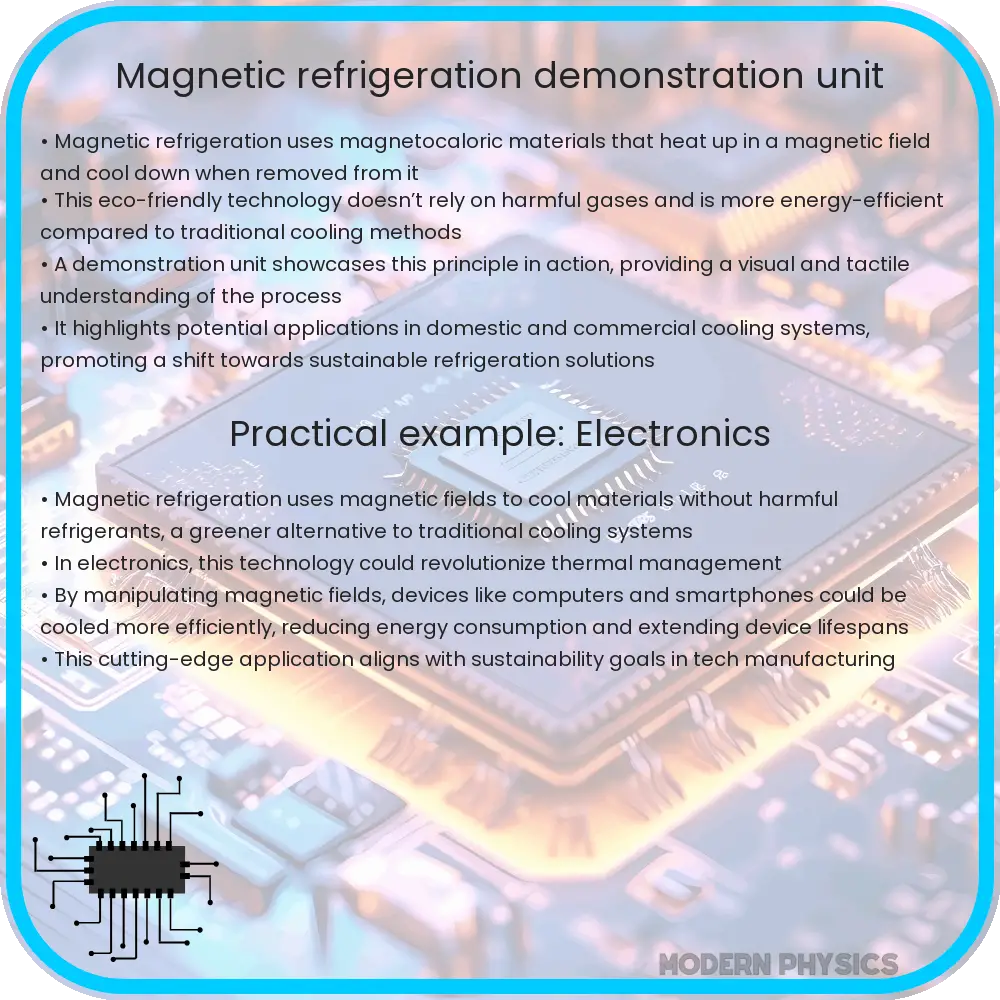
Magnetic refrigeration operates on the Magnetocaloric Effect (MCE). The core principle lies in the heating and cooling of a magnetocaloric material (MCM) under varying magnetic fields. When a magnetic field is applied, these materials heat up, and when the field is removed, they cool down. The cycle of applying and removing the magnetic field creates a refrigeration effect, without the need for traditional refrigerants.
Advantages Over Conventional Refrigeration
- Eco-friendly: Unlike traditional refrigerators that rely on harmful gases like Chlorofluorocarbons (CFCs) and Hydrofluorocarbons (HFCs), magnetic refrigeration uses solid state materials, significantly reducing environmental impact.
- Energy Efficiency: Studies suggest that magnetic refrigerators can be up to 20-30% more energy-efficient than their conventional counterparts.
- Noise Reduction: As it lacks compressors and other moving parts common in standard refrigerators, magnetic refrigeration operates silently.
Key Components and Mechanism
The primary component of a magnetic refrigeration system is the magnetocaloric material. Gadolinium (64Gd157) is often used due to its high MCE near room temperature. The system also includes a magnetic field source, usually a superconducting magnet, and a heat transfer fluid.
The refrigeration cycle involves four stages:
- Magnetization: The MCM is exposed to a magnetic field, causing it to heat up.
- Heat Transfer: The excess heat is removed by the heat transfer fluid.
- Demagnetization: The magnetic field is removed, causing the MCM to cool.
- Cooling the Target: The cool MCM absorbs heat from the refrigerated space.
This innovative approach opens new avenues in refrigeration technology, paving the way for more sustainable and efficient cooling systems. Magnetic refrigeration stands as a testament to the relentless pursuit of innovation and environmental stewardship in modern technology.
Challenges and Future Prospects
Despite its numerous advantages, magnetic refrigeration faces several challenges in widespread adoption. The cost and availability of high-quality magnetocaloric materials, like Gadolinium, are primary concerns. Additionally, the requirement for strong magnetic fields necessitates advanced, often expensive, magnet technology.
Moreover, integrating magnetic refrigeration into existing systems poses design challenges. It requires a rethinking of conventional refrigeration layouts to accommodate the new technology effectively.
Research and Development Efforts
Significant research is underway to overcome these obstacles. Efforts focus on finding more abundant, less expensive materials with similar magnetocaloric properties to Gadolinium. Advances in superconducting magnets and magnetic field generation technologies also promise to enhance the feasibility and efficiency of magnetic refrigeration systems.
Furthermore, researchers are exploring hybrid systems that combine magnetic refrigeration with traditional methods to optimize performance and cost-effectiveness.
Environmental Impact and Regulatory Compliance
Magnetic refrigeration aligns well with global efforts to reduce greenhouse gas emissions and ozone-depleting substances. It is in compliance with international environmental agreements, such as the Montreal Protocol and the Kigali Amendment to the Montreal Protocol, which aim to phase out harmful refrigerants.
Conclusion: A Paradigm Shift in Cooling Technology
Magnetic refrigeration represents a paradigm shift in cooling technology. Its potential to offer efficient, silent, and eco-friendly refrigeration is unparalleled. While challenges in material science and engineering persist, ongoing research and development are rapidly addressing these issues, bringing this innovative technology closer to practical, widespread use.
As the world moves towards sustainable solutions, magnetic refrigeration stands out as a beacon of innovation, demonstrating a commitment to environmental stewardship without compromising efficiency. It holds the promise of revolutionizing the way we approach cooling and refrigeration in the near future, making it an exciting field to watch in the realm of green technology.