
Explore the intricate world of tuning forks, their precision mechanics, applications in sound therapy, and significant role in acoustics research.
Understanding Tuning Forks: Precision, Sound Therapy, and Acoustics
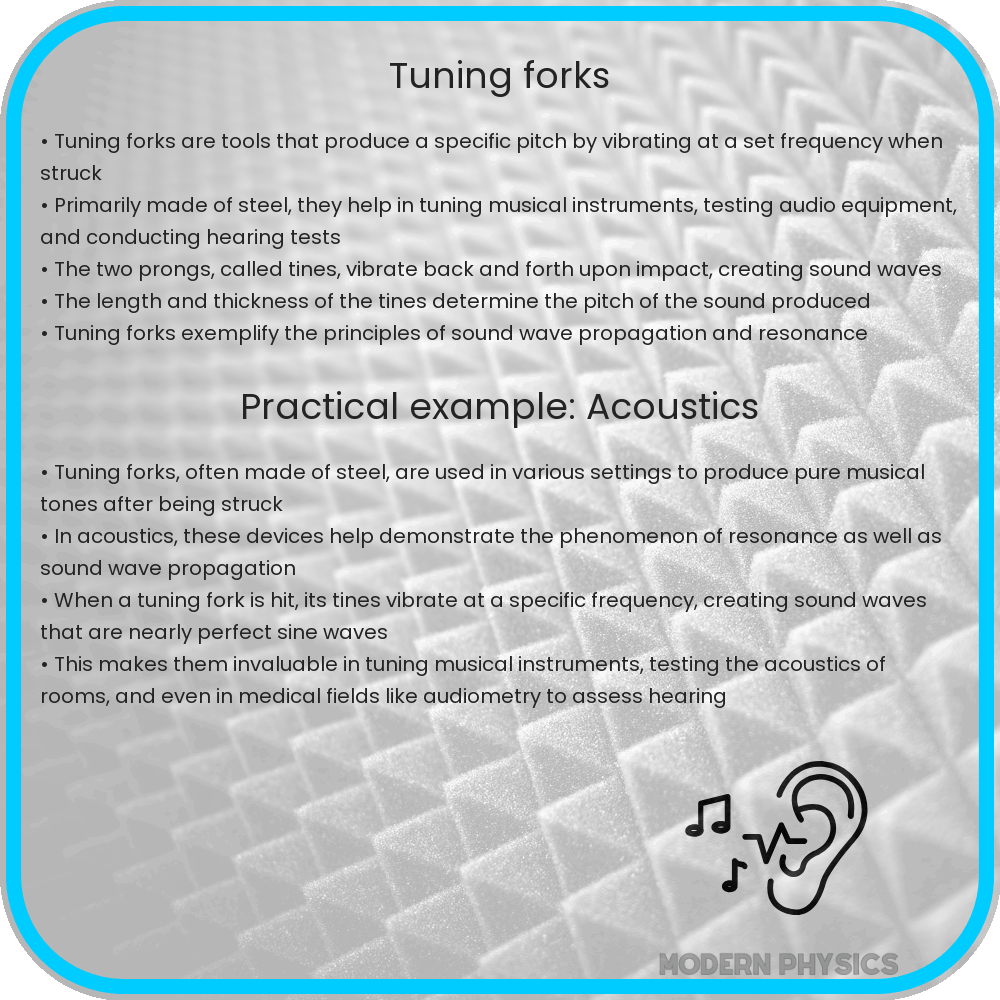
Tuning forks are not just simple tools; they are intricately linked to several fascinating aspects of physics and have applications that range from musical tuning to the realms of medical therapy. A tuning fork is essentially an acoustic resonator in the form of a two-pronged fork with the prongs formed from a U-shaped bar of elastic metal. When struck, it resonates at a specific constant pitch and emits sound waves that are musical in nature. In this article, we will explore the precision mechanics of tuning forks, how they are used in sound therapy, and their relevance in acoustics.
Precision in the Design and Use of Tuning Forks
The precision of a tuning fork’s pitch depends on several key factors, including its size, material, and shape. For a standard tuning fork, the frequency at which it vibrates is primarily determined by the length of its prongs. The pitch produced can be represented by the equation:
f = (1/2L) * √(E/I)
Where f is the frequency, L is the length of the prongs, E is the modulus of elasticity of the material, and I is the moment of inertia. The standard tuning fork used for musical tuning typically resonates at 440 Hz, which corresponds to the musical note A4, often used as a reference pitch for tuning musical instruments.
The material used in manufacturing a tuning fork also plays a crucial role. Most are made from an alloy of steel, which provides a good balance of elasticity and density, essential for long-lasting vibrations. Stainless steel or aluminum can be used as well, each bringing slight variances in tone and decay time of the sound produced.
Tuning Forks in Sound Therapy
Interestingly, beyond the realms of music, tuning forks have found a significant place in sound therapy, where they are used to promote healing and relaxation. This practice is based on the idea that the pure, resonating sound of a tuning fork can help reduce stress and increase the flow of energy in the body. Therapists strike the tuning fork and place its base on various parts of the patient’s body. The vibration patterns are thought to facilitate healing processes and boost psychological wellness by aligning the body’s energy fields or chakras.
Sound therapists utilize forks with different frequencies depending on the therapy goals. These frequencies might correspond to specific energy centers or chakras in the body, each purportedly responding to different sound frequencies. For example, a fork tuned to 528 Hz is commonly used for “DNA repair” and stress reduction due to its soothing tonal qualities.
The Role of Tuning Forks in Acoustics Research
Acoustics, the branch of physics dealing with sound, relies heavily on devices like tuning forks to calibrate and test sound equipment. In educational settings, tuning forks can demonstrate how sound waves travel through the air and other mediums, serving as a practical teaching aid that simplifies complex theories. The straightforward operation and consistent output of a tuning fork help students and researchers alike visualize and understand sound waves and their properties.
In laboratory settings, precise tuning forks are used for various measurements and experiments that require exact sound frequencies. For example, an acoustical resonance experiment might use a tuning fork to measure the speed of sound in different gases.
- Understanding gathering frequencies and their implications.
- Visual demonstration of wave interference and beat frequencies.
- Calibrating musical and scientific equipment.
Conclusion
In conclusion, tuning forks exemplify a unique blend of simplicity and scientific utility. From their crucial role in setting musical pitch to their therapeutic applications and significant contributions to acoustic research, tuning forks serve multiple functions across various disciplines. By precisely resonating at given frequencies, these tools not only aid in the calibration of musical and scientific instruments but also enhance our understanding of sound and its effects on both physical and mental health.
Whether it’s providing a clear tone for a musician, aligning someone’s chakras in a sound therapy session, or demonstrating acoustic principles in a classroom, the tuning fork’s versatility and precision make it an invaluable tool in both arts and sciences. Its enduring design and effectiveness underscore its importance and continue to invite curiosity and exploration into the fascinating world of acoustics and beyond.
As we further explore and develop new applications for tuning forks, we might find even more innovative uses for this simple yet powerful device, expanding our boundaries of knowledge and enhancing various therapeutic and scientific practices. Therefore, tuning forks not only resonate with sound but also with the boundless potential of human ingenuity in understanding and manipulating the world around us.