
Explore acoustic vortex generators, devices using sound wave manipulation for noise control, sound enhancement, and potentially medical imaging.
Understanding Acoustic Vortex Generators
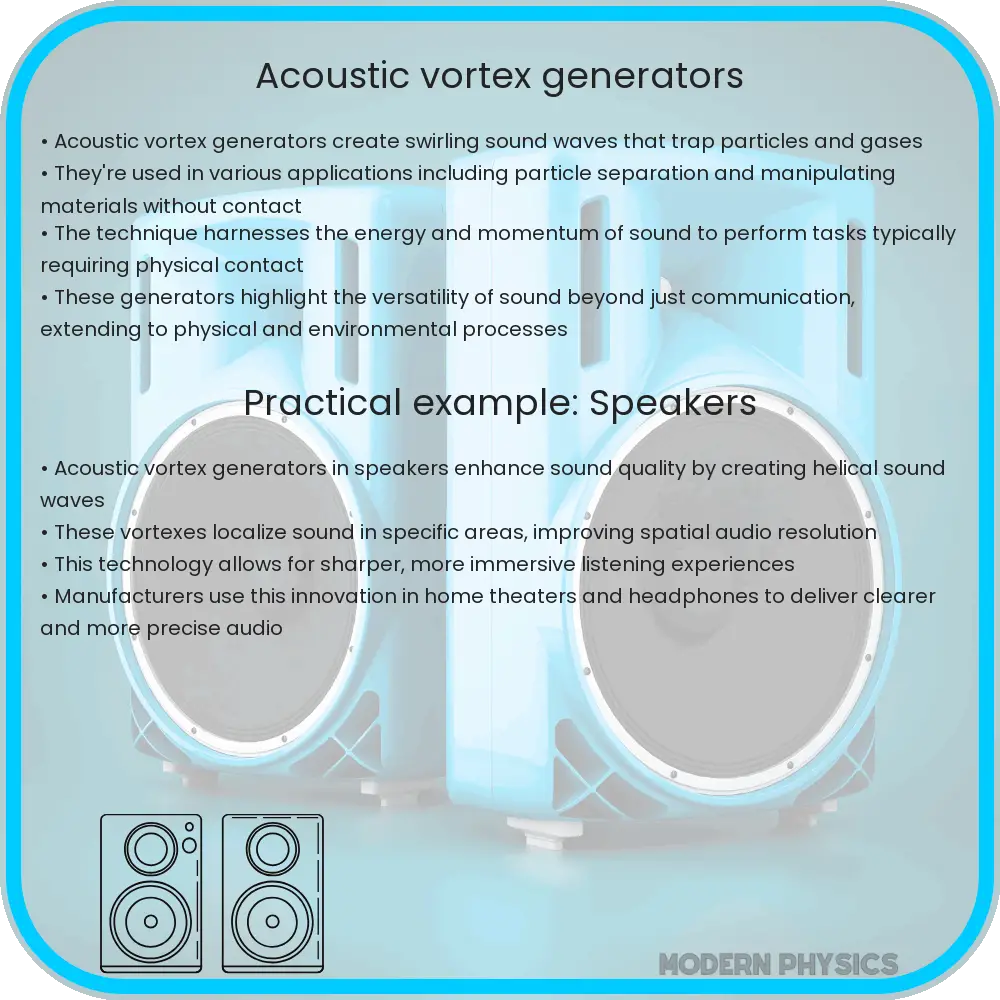
Acoustic vortex generators are innovative devices in the field of acoustic engineering, primarily focused on manipulating how sound moves in an environment. These devices, through the use of sound waves, create what is known as an “acoustic vortex. An acoustic vortex can be described as a mini whirlwind of sound, structured in such a way that it travels in a spiraling pattern, resembling the physical attributes of a tornado, but on a far smaller scale.
Principles Behind Acoustic Vortex Generators
The core idea behind acoustic vortex generators relies on the physics of wave interference and sound propagation. Sound waves are longitudinal waves that consist of compressions and rarefactions moving through a medium. Acoustic vortex generators manipulate these waves to form a helical wavefront, effectively turning the linear sound propagation into a twisting, rotating motion.
To generate an acoustic vortex, these devices utilize multiple speakers or sound sources, arranged in a specific geometrical pattern. Each sound source emits sound waves that are finely controlled in terms of phase and amplitude. When these sound waves intersect, they superpose and interfere with each other, producing a dynamic and complex sound field characterized by a central core that remains silent – the eye of the acoustic storm, so to speak.
Applications of Acoustic Vortex Generators
- Noise Control: By generating phased array interactions among sound waves, these devices can effectively cancel out noise or redirect its flow. This proves invaluable in environments like urban areas, industrial sites, or studios where controlling sound can significantly impact overall ambiance and functionality.
- Sound Manipulation and Enhancement: In auditoriums, theaters, and concert halls, acoustic vortex generators can sculpt the sound landscape, enhancing clarity and ensuring sound reaches all parts of the venue evenly without the traditional need for higher volume levels or strategic speaker placements.
- Medical and Industrial Imaging: Although less conventional, the precise control over sound waves can also aid in noninvasive medical imaging techniques, similar to how ultrasound is used but potentially with greater resolution or in different modalities.
Despite the clear benefits and innovative potential of acoustic vortex generators, there are challenges and limitations, particularly concerning their implementation and the physical environments in which they are most effective. The generation and control of acoustic vortices require not only precise technology but also an environment where these controlled sound waves can propagate effectively without too many distortions or interruptions.
The Technology Behind Acoustic Vortex Generators
To understand the technology, it’s necessary to delve a little deeper into the physics of sound waves and their manipulation. Acoustic vortices are generated through the use of phase arrays, which are essentially groups of individual sound sources. By controlling the phase (i.e., the relative position in the wave cycle) and amplitude (the size of the wave) of each source, engineers can create interference patterns that craft the acoustic vortex.
The control system for these phase arrays is crucial, requiring sophisticated software and calibration to ensure that the interaction of waves produces the desired effect. This software typically involves algorithms that calculate the necessary adjustments in real time, adapting to both environmental changes and the specific requirements of the space being modified.
The effectiveness of an acoustic vortex generator depends significantly on its design and the precision with which each sound source in the array is manipulated. As this technology evolves, it promises to open new doors in both the fields of acoustic engineering and broader industrial and technological applications.
Potential for Future Development
Looking ahead, the potential for further development in acoustic vortex technology is vast. Research is ongoing to advance the software algorithms that manage these devices, making them more adaptive and efficient. Moreover, improvements in materials and sound emission technology could allow for smaller, more powerful acoustic vortex generators suitable for personal use in consumer electronics, vehicles, or personal audio systems.
Innovations might also extend to creating immersive audio experiences, where listeners can feel as though sound surrounds them in a three-dimensional space. Such advancements could revolutionize home entertainment systems, virtual reality platforms, and even aid in more effective auditory alerts in vehicles or public settings.
Educational and Environmental Impact
Acoustic vortex generators also have a unique role to play in educational settings, where they could be used to demonstrate complex physics concepts, such as wave interference and sound propagation, in a more interactive and palpable manner. Additionally, by reducing noise pollution in sensitive environments, these generators can contribute positively to environmental conservation efforts, such as protecting wildlife from the harmful effects of human-generated noise.
Furthermore, these devices might also find applications in architectural design to enhance acoustics more naturally in buildings without needing extensive modifications. This could be beneficial for constructing more sustainable and comfortable living and working spaces.
Conclusion
Acoustic vortex generators embody a fascinating synergy of physics and engineering, with a multitude of practical applications that just scratch the surface of their potential. From enhancing the quality of life through noise control and auditory experience enhancements to supporting high-tech industries and healthcare, the footsteps of this technology are imprinting a significant mark on the modern world. As we continue to delve deeper and improve the technology behind acoustic vortices, the horizons too keep expanding, promising an exciting future for acoustic engineering and its role in our daily lives.
Understanding the intricacies and potentials of acoustic vortex generators not only invites us to appreciate the complexities of acoustic engineering but also encourages us to think creatively about the new possibilities for manipulating sound in our environment—a true testament to the continuous evolution of technology.