
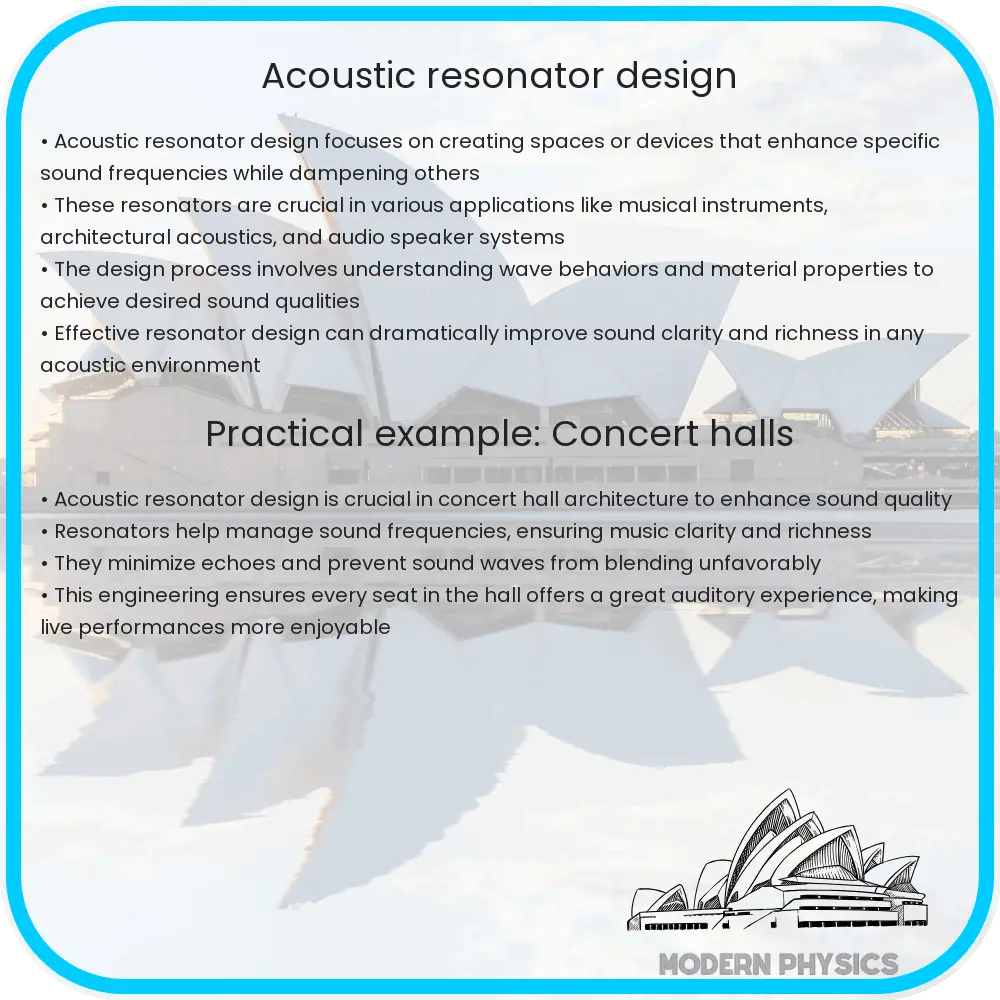
Delve into the fundamentals of acoustic resonator design, focusing on amplifying specific frequencies for applications in music, architecture, and more.
Introduction to Acoustic Resonator Design
Acoustic resonators are structures that are capable of amplifying sounds or vibrations at specific frequencies, a concept that is fundamental in various engineering and design applications such as musical instruments, loudspeakers, and even architectural acoustics. The design of acoustic resonators focuses on efficiency, precision, and innovative use of materials and technology to achieve desired resonance characteristics. This article delves into the basic principles of acoustic resonator design and explores how advancements in this field can lead to improvements in sound quality and energy efficiency.
Understanding the Basics of Resonance
At the heart of acoustic resonator design is the concept of resonance, the physical phenomenon where an object vibrates at maximum amplitude at certain frequencies. These frequencies are known as the resonant frequencies and depend on the properties of the object, including its size, shape, and material. The basic equation governing the resonant frequency of a simple harmonic oscillator is:
fn = (1/2π) * √(k/m)
where fn represents the nth resonant frequency, k is the stiffness of the system, and m is the mass. For more complex shapes and materials, the resonant frequency calculations involve detailed analysis of the vibrational modes and structural dynamics.
Design Principles of Acoustic Resonators
- Material Selection: The choice of material significantly affects the resonator’s performance. Materials like wood, metal, and composites each have different sound amplifying qualities. Designers must choose materials that not only provide desired acoustic properties but also align with aesthetic and structural requirements.
- Geometrical Design: Shape and size are crucial in resonator design. The dimensions of the resonator determine the wavelengths it can effectively amplify. Common shapes include cylindrical, spherical, and rectangular, each having its unique set of resonant frequencies.
- Precision in Construction: High precision in construction ensures that the resonator performs as designed. Small deviations from the intended dimensions or imperfections in the material can significantly alter the sound being amplified.
Technologies Enhancing Acoustic Resonator Efficiency
Innovation in materials science and manufacturing techniques continues to push the boundaries of acoustic resonator design. The use of advanced materials like shape memory alloys and engineered composites has allowed for the development of resonators that are not only more efficient but also more durable and lighter. Additionally, computational modeling and simulation play a critical role in designing resonators by predicting how they will perform before they are physically built, saving time and resources in the design process.
Another emerging technology in resonator design is the use of metamaterials. These engineered materials have properties not found in naturally occurring materials, allowing for the creation of resonators with tailored acoustic properties that can control sound in ways previously thought impossible.
Applications of Acoustic Resonators
Acoustic resonators have a wide range of applications across various industries. In musical instruments like guitars and violins, resonators enhance the quality of sound by amplifying specific frequencies that contribute to the instrument’s unique tone. In architectural acoustics, resonators are used to improve sound quality in buildings like concert halls and theaters, ensuring that sound is evenly distributed throughout the space without echoes or dead spots.
In the automotive industry, acoustic resonators are employed to reduce unwanted noise, enhancing the comfort of passengers. Similarly, in industrial settings, these resonators help in controlling noise pollution. This showcases the importance of resonators not just in enhancing sound quality but also in managing and mitigating unwanted sounds in the environment.
Future Trends and Innovations
The future of acoustic resonator design holds promising advances, with ongoing research focused on integrating new materials and technologies to further refine efficiency and functionality. Smart materials that respond to environmental changes and offer adjustable resonant frequencies are currently being explored. These innovations could lead to the development of more adaptable and efficient resonators suitable for dynamic real-world applications.
Furthermore, the integration of artificial intelligence (AI) and machine learning into resonator design processes could revolutionize how resonators are developed. By utilizing AI, designers can predict more accurately how alterations in design affect performance, leading to faster and more efficient development cycles.
Conclusion
The field of acoustic resonator design bridges the gap between scientific understanding and practical application, reflecting the incredible potential of physics and engineering to enhance our daily lives. Whether it’s making musical performances more enriching or keeping our environments comfortably quiet, the applications of acoustic resonators are both broad and profoundly impactful.
Advancements in material science, precision manufacturing, and computational modeling are not just academic exercises; they represent tangible enhancements that resonate with us, quite literally, every day. By continuing to push the envelope in acoustic resonator design, future developments promise even greater integration into diverse fields, ensuring that the harmony of form and function remains central to technological progress.