
Learn about thermoresponsive polymers, smart materials that change properties in response to temperature variations.
Understanding Thermoresponsive Polymers: The Smart Materials of Tomorrow
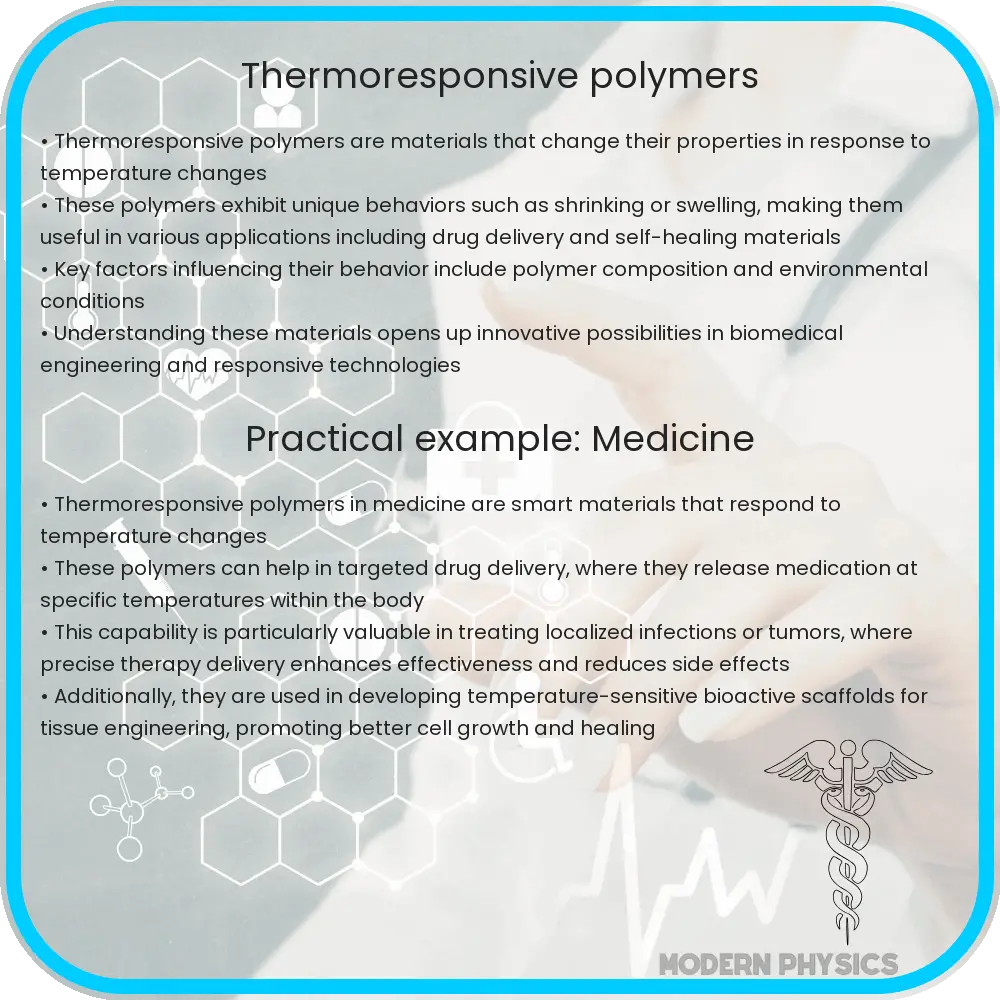
Thermoresponsive polymers, a fascinating subset of smart materials, have captured the interest of scientists and engineers alike due to their ability to react to changes in temperature. These materials have the unique capability to alter their physical properties in response to thermal stimuli, paving the way for numerous innovative applications in various fields including biomedicine, textiles, and environmental technology.
What are Thermoresponsive Polymers?
Thermoresponsive polymers are polymers that undergo physical changes when exposed to different temperatures. These changes can include alterations in solubility, shape, and mechanical properties. The responsiveness of these polymers is primarily due to their molecular structure, which is designed to be sensitive to temperature fluctuations.
- Lower Critical Solution Temperature (LCST): Polymers with LCST become soluble in water below a specific temperature and insoluble above that temperature.
- Upper Critical Solution Temperature (UCST): Polymers with UCST behave in the opposite manner, where they are insoluble in water below a certain temperature and soluble above it.
How Do Thermoresponsive Polymers Work?
The key mechanism behind the responsiveness of these polymers lies in their molecular interactions. In polymers with LCST, an increase in temperature leads to a decrease in hydrogen bonding between the polymer and water molecules. This results in the polymer becoming less soluble, causing it to precipitate out of solution. Conversely, polymers with UCST experience an increase in hydrogen bonding with higher temperatures, making them more soluble.
Applications of Thermoresponsive Polymers
- Drug Delivery Systems: Thermoresponsive polymers can be engineered to form gels that respond to the human body’s temperature, making them ideal carriers for drugs that need to be released at specific sites within the body.
- Smart Textiles: Incorporating these polymers into fabrics can lead to the development of clothing that adapts its insulation properties based on ambient temperature, enhancing comfort and energy efficiency.
- Environmental Applications: These polymers can be utilized in environmental cleanup operations, such as the collection and removal of pollutants from water. Their solubility can be adjusted to absorb contaminants and then precipitate for easy collection.
The adaptability and sensitivity of thermoresponsive polymers to temperature changes not only make them highly effective in practical applications but also open new pathways for innovation in material science. As we explore further into their capabilities, the potential for new and improved technologies seems almost limitless.
Future Perspectives and Challenges
While thermoresponsive polymers hold great promise, their widespread adoption faces several challenges. One major issue is the fine-tuning of their transition temperatures to match specific applications, which requires precise control over polymer synthesis. Additionally, the long-term stability and biocompatibility of these materials need to be thoroughly assessed, especially for medical applications where prolonged exposure to the human body could pose health risks.
Research is also focused on developing eco-friendly production methods that reduce potential environmental impacts. Sustainable sourcing of raw materials and improvements in recyclability or biodegradability of these polymers are critical considerations for future studies.
Innovative Research in Thermoresponsive Polymers
The ongoing research into thermoresponsive polymers is vibrant and continuously evolving. Scientists are increasingly using nanotechnology to enhance the properties of these materials. For instance, the incorporation of nanoparticles can further refine the thermal sensitivity of polymers, opening up applications in areas like nano-medicine and intelligent sensor technology.
Another exciting development is the integration of thermoresponsive polymers with electronics to create responsive surfaces that change their properties in real-time. Such advancements could lead to revolutionary changes in how devices interface with their environment and respond to human needs.
Conclusion
Thermoresponsive polymers represent a dynamic and promising field within material science. As researchers tackle the challenges associated with these smart materials, their potential applications continue to grow. From revolutionizing drug delivery systems and creating smarter textiles to playing a crucial role in environmental sustainability, thermoresponsive polymers are paving the way towards a more interactive and responsive future.
Understanding and harnessing these properties not only enhances our current technology but also inspires further innovations that might one day transform our approach to healthcare, environmental management, and everyday materials. The journey of exploring and applying thermoresponsive polymers is just beginning, and it holds a bright future for those ready to engage with the next generation of smart materials.