
Learn about thermally conductive polymers, innovative materials combining traditional plastic benefits with enhanced heat management capabilities.
Understanding Thermally Conductive Polymers
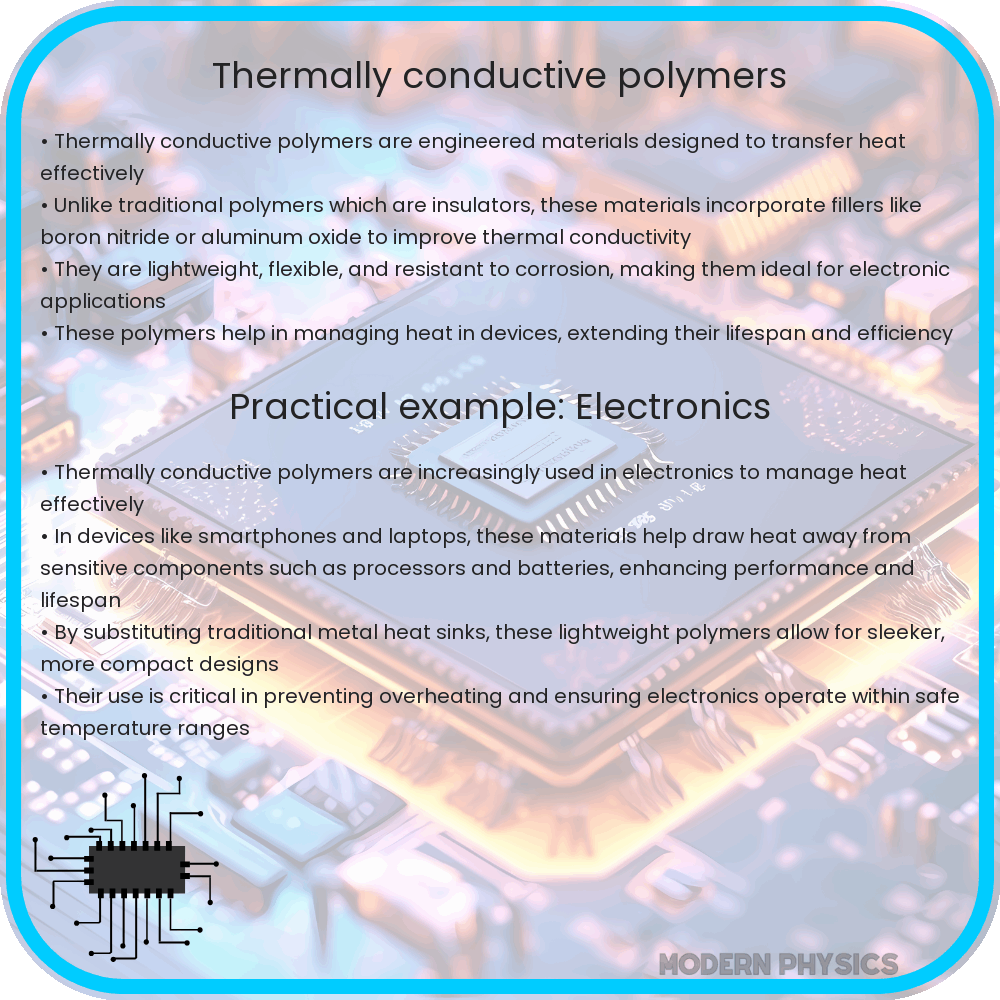
Thermally conductive polymers represent a groundbreaking advancement in materials science, combining the versatility of traditional plastic polymers with enhanced thermal conductivity. These materials are specifically designed to effectively manage heat in various applications, from electronics to automotive components. By doing so, they help in improving efficiency, reliability, and performance of devices and systems.
What Makes Polymers Thermally Conductive?
Conventionally, polymers are poor conductors of heat due to their molecular structure, which limits the transfer of kinetic energy across the polymer chains. To transform these inherently insulating materials into conductive ones, engineers incorporate thermally conductive fillers. These fillers can include materials like graphite, boron nitride, or aluminum oxide, known for their ability to facilitate heat flow. The fillers are distributed throughout the polymer matrix, creating pathways that allow heat to bypass the insulating nature of the polymer itself.
Applications of Thermally Conductive Polymers
The unique properties of thermally conductive polymers make them suitable for a host of applications. Below are some key areas where these polymers are making a difference:
- Electronics Cooling: As devices shrink in size but increase in power, managing heat becomes crucial. Thermally conductive polymers are used in heat sinks, cooling fans, and thermal interface materials to dissipate heat efficiently from electronic components and extend their lifespan.
- Automotive Industry: Under the hood, components are subjected to extreme heat. Thermally conductive plastics are employed in parts like LED headlamp housings and battery cooling systems to prevent overheating, thereby ensuring safety and performance.
- Energy Systems: In renewable energy systems, such as solar panels or wind turbines, these polymers help manage thermal stresses that can affect performance and durability.
Benefits Over Traditional Materials
Thermally conductive polymers offer several advantages over more traditional heat management materials such as metals or ceramics:
- Weight Reduction: These polymers are significantly lighter than metals, which is a critical advantage in automotive and aerospace applications where weight reduction is essential for fuel efficiency.
- Corrosion Resistance: Unlike metals, thermally conductive polymers do not corrode, which extends the life of components and reduces maintenance costs.
- Processing Flexibility: Polymers can be molded into complex shapes which are difficult or expensive to achieve with metals, allowing more design freedom in engineering.
Through the addition of thermal conductive fillers, these polymers not only maintain their inherent benefits such as corrosion resistance and flexibility but also gain the crucial ability to conduct heat. This combination makes them an increasingly preferred choice in many industries where effective heat management is paramount.
Challenges in Developing Thermally Conductive Polymers
While thermally conductive polymers hold significant advantages, their development and use come with distinct challenges:
- Cost of Materials: High-quality thermal fillers like boron nitride or aluminum oxide are expensive, and the process of integrating these fillers into polymers can be cost-intensive.
- Even Distribution of Fillers: Achieving a homogenous dispersion of conductive fillers within the polymer matrix is critical for consistent thermal conductivity. However, this can be difficult to control during manufacturing.
- Balancing Properties: Increasing the filler content can enhance thermal conductivity, but it may also adversely affect the mechanical properties of the polymer, such as flexibility and strength.
Future Prospects
The future of thermally conductive polymers looks promising with ongoing research aimed at overcoming existing challenges and improving performance. Innovations such as nanocomposites and hybrid materials are being explored to enhance thermal conductivity without compromising other desired properties. Furthermore, advancements in manufacturing processes are expected to reduce costs and improve the scalability of these high-performance materials.
Conclusion
Thermally conductive polymers are revolutionizing the field of materials science, providing an effective solution for heat management across multiple industries. From boosting the efficiency of electronic devices to enhancing the durability of automotive and aerospace components, these polymers blend the best features of plastics and thermal conductivity. Despite facing challenges such as cost and material distribution, the ongoing research and development promise to address these issues, paving the way for broader applications and improved materials. As technology continues to push the boundaries of what’s possible, thermally conductive polymers stand out as a key material in the development of lighter, more efficient, and more reliable products.