
Polymer nanocomposites (PNCs) are materials combining polymers with nanoparticles, enhancing physical, thermal, and electrical properties.
Introduction to Polymer Nanocomposites
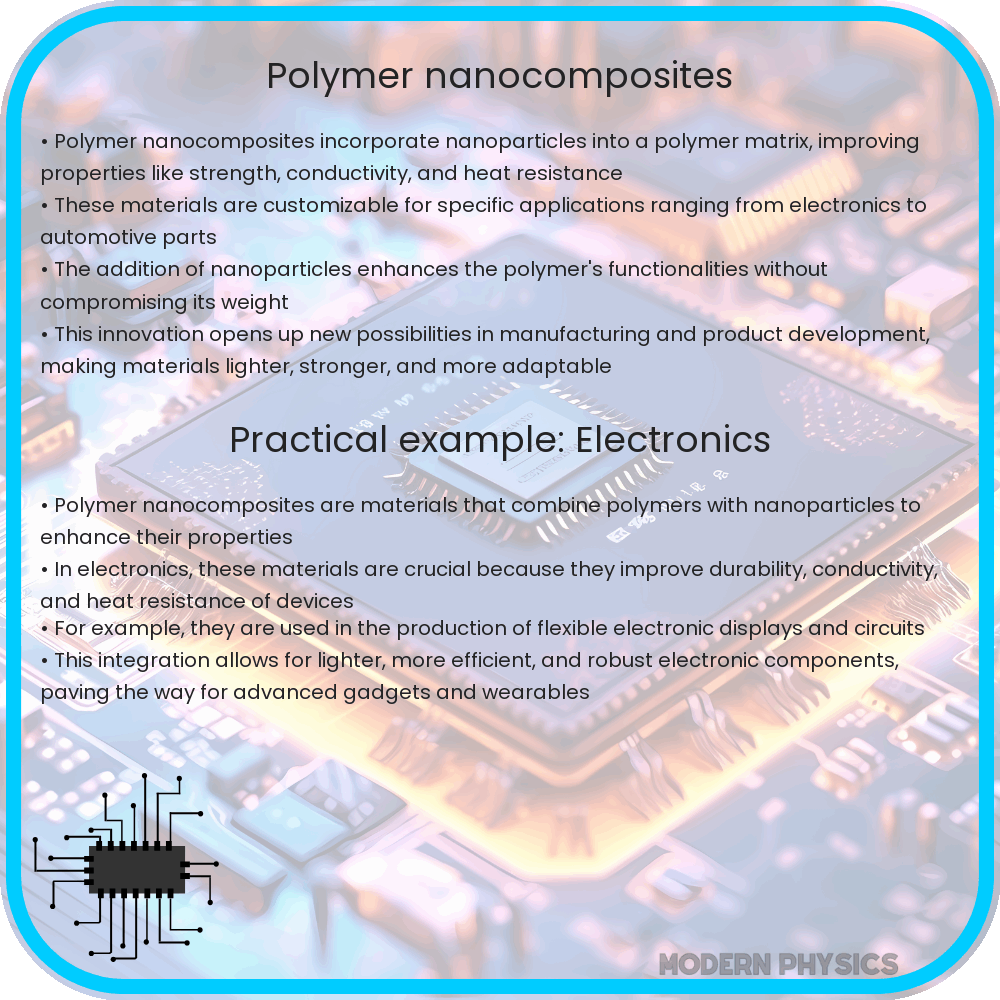
Polymer nanocomposites (PNCs) are materials made from a polymer or copolymer having nanoparticles or nanofillers dispersed in the polymer matrix. These nanoscale fillers can significantly enhance the physical, thermal, and electrical properties of the base polymer, thus providing superior characteristics compared to conventional composite materials. Common types of nanoparticles used include clay, carbon nanotubes, graphene, and metal oxides. The integration of these nanoparticles into the polymer matrix can improve strength, durability, conductivity, and various other functional properties.
Enhancing Strength and Durability
The incorporation of nanoparticles into a polymer matrix results in a significant improvement in mechanical strength and durability. When nanoparticles are added, they can interact with the polymer at the molecular level, creating a more robust linkage that contributes to higher tensile strength and elasticity. The size and shape of the nanoparticles, along with their distribution and concentration within the polymer matrix, play crucial roles in determining the final characteristics of the nanocomposite.
- Tensile Strength: Tensile strength is enhanced due to the uniform dispersion of nanoparticles, which act as load-bearing constituents. The stress transfer from the polymer to the nanoparticles results in improved resistance to deformation under tension.
- Impact Resistance: Nanoparticles like clay and carbon nanotubes are particularly effective at enhancing impact resistance, absorbing and dissipating the energy from impacts more efficiently than the neat polymer.
- Wear Resistance: The incorporation of hard nanoparticles like silica or titanium dioxide can significantly enhance wear resistance, making PNCs ideal for use in applications where material degradation due to friction is a concern.
Improved Conductivity
The inclusion of conductive nanoparticles, such as carbon nanotubes or graphene, into polymers can transform an insulating material into a conductive composite. These conductive pathways allow for applications in electronics and electromagnetic shielding where conductivity is crucial. The level of conductivity achieved is highly dependent on the type, amount, and distribution of the conductive nanoparticles within the polymer matrix.
- Electrical Conductivity: By adding a sufficient concentration of conductive nanoparticles, PNCs can exhibit a percolation threshold, where they transition from insulative to conductive properties. This change occurs when there is a continuous path of conductive particles that spans across the material, allowing for electron flow.
- Thermal Conductivity: Similar to electrical conductivity, thermal conductivity in PNCs can be significantly enhanced through the incorporation of thermally conductive nanoparticles. This allows the nanocomposite to efficiently transfer heat, useful in thermal management applications.
Applications
Due to their enhanced properties, polymer nanocomposites have found wide-ranging applications in various fields. In the automotive industry, they are used to make lighter, more durable parts that contribute to overall vehicle efficiency. In electronics, their conductive properties allow for the development of flexible electronic components and improved electromagnetic shielding materials. Additionally, their high strength-to-weight ratio makes them excellent candidates for aerospace applications, where weight reduction is crucial without compromising material strength and durability.
Exploring further into the microscopic interactions between nanoparticles and the polymer matrix reveals the critical role of surface modification of the nanoparticles. This modification helps in achieving an even distribution throughout the matrix, which is vital for the consistent performance of the resulting nanocomposite.
Surface Modification and Dispersion Techniques
Improving the dispersion and interaction of nanoparticles within a polymer matrix is central to optimizing the performance of polymer nanocomposites. Surface modification techniques involve altering the surface chemistry of the nanoparticles to enhance compatibility with the polymer, which helps in achieving a more uniform distribution. Common methods include silanization, which attaches silane groups to the nanoparticles, and grafting, where polymer chains are directly bonded to the nanoparticle surfaces. These modifications can significantly reduce the tendency of nanoparticles to clump together, ensuring better mechanical properties and durability.
- Silanization: This technique involves treating nanoparticles with silane compounds that form a bridge between the nanoparticle surface and the polymer matrix, promoting better bonding and stability.
- Polymer Grafting: Polymer molecules are grafted onto the surface of nanoparticles to improve compatibility and interaction with the polymer matrix, leading to enhanced material properties.
- Ultrasonication: Used during the mixing process, ultrasonication applies high-frequency vibrations to disperse nanoparticles evenly throughout the polymer matrix.
Environmental Impact and Sustainability
While polymer nanocomposites offer improved performance in many applications, it is also essential to consider their environmental impact. The use of nanoparticles can raise concerns regarding sustainability and recyclability. Efforts are ongoing to develop biodegradable polymer nanocomposites and methods for recycling materials embedded with nanoparticles. Such initiatives aim to maintain the beneficial properties of PNCs while reducing their environmental footprint.
- Biodegradable Nanocomposites: These are designed to decompose naturally, minimizing environmental pollution, particularly in single-use applications like packaging.
- Recycling Techniques: Research is focusing on recovering and reusing nanoparticles from decommissioned nanocomposite products, which could help in reducing waste and energy consumption involved in producing new nanoparticles.
Conclusion
Polymer nanocomposites represent a significant advancement in the field of materials science, offering remarkable improvements in strength, durability, and conductivity. Thanks to the versatile nature of nanotechnology, these materials are ideally suited for a wide range of applications, from automotive to aerospace and beyond. The continuous development in nanoparticle integration and surface modification techniques will likely unlock even more potential uses and properties in the future. Moreover, addressing environmental concerns related to PNCs is essential for sustainable progress in this innovative area. As technology evolves, polymer nanocomposites have the potential not only to improve product performance but also to contribute positively to environmental conservation efforts.