
Explore the physics of ruler bending, delving into measurement, force application, stress analysis, material properties, and fatigue effects.
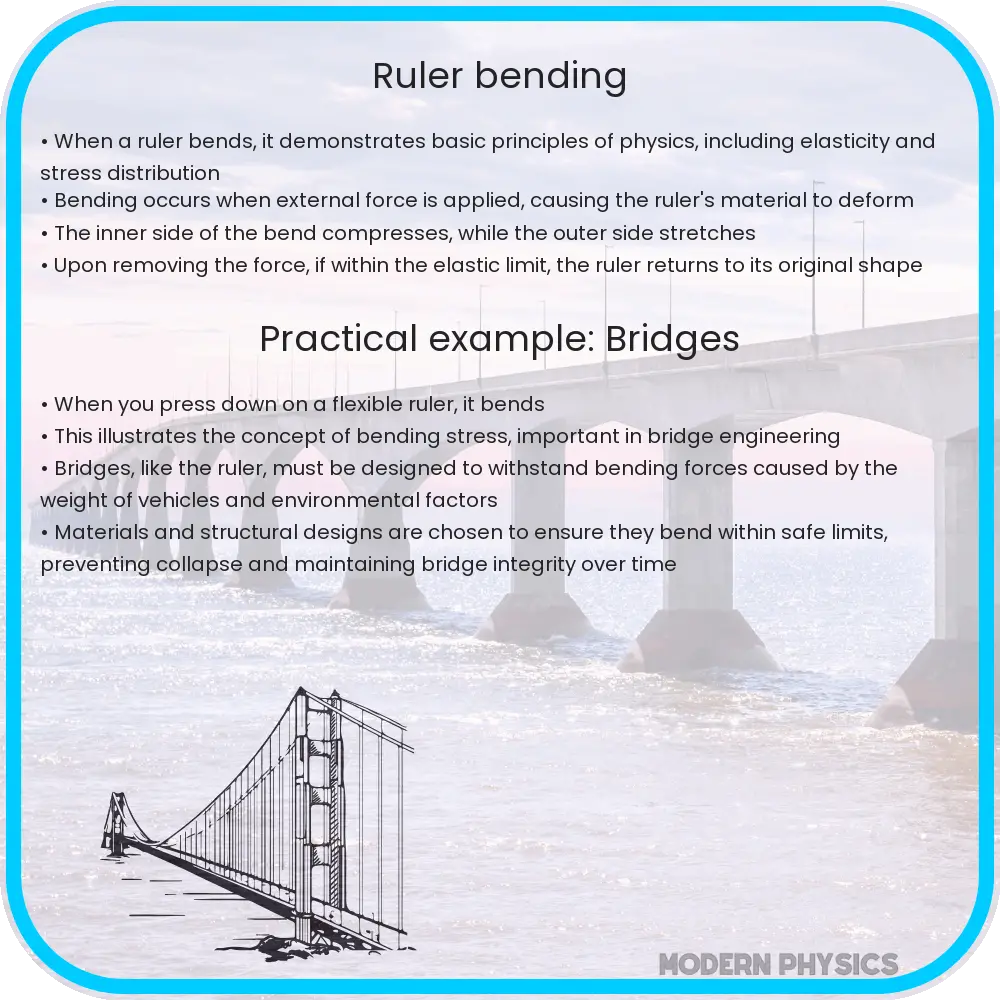
Ruler Bending: Understanding the Basics
Bending a ruler is a simple yet intriguing demonstration of basic physics principles such as measurement, force application, and stress analysis. This article delves into the fundamentals of these concepts, offering insights into how they interact in the seemingly straightforward act of bending a ruler.
Measurement: The Foundation of Observation
Measurement is the first critical step in understanding the bending of a ruler. It involves quantifying the ruler’s dimensions, material properties, and the degree of bend. The length, width, and thickness of the ruler are essential measurements, as they directly influence its bending characteristics. Additionally, material properties such as Young’s modulus, a measure of the stiffness of an elastic material, play a pivotal role in determining how the ruler will react to applied forces.
Force Application: The Catalyst of Deformation
When a force is applied to a ruler, it causes the material to deform. The nature of this deformation depends on the type and magnitude of the force. In bending a ruler, the forces are typically applied at the edges, creating a bending moment at the center. This moment is the product of the force applied and the distance from the point of force application to the ruler’s center. Understanding the relationship between the applied force, the bending moment, and the resulting deformation is crucial in stress analysis.
Stress Analysis: Assessing Material Response
Stress analysis in the context of bending a ruler involves examining how the material of the ruler withstands the applied forces. Stress, defined as force per unit area, is a key parameter in determining whether a material will return to its original shape (elastic deformation) or undergo permanent deformation (plastic deformation). The stress distribution across the ruler’s length is not uniform, with the maximum stress typically occurring at the surface furthest from the neutral axis, where the material is stretched or compressed the most.
Using the formula for bending stress, \( \sigma = \frac{My}{I} \), where \( \sigma \) is the stress, \( M \) is the bending moment, \( y \) is the distance from the neutral axis, and \( I \) is the moment of inertia of the ruler’s cross-section, one can calculate the stress at any point in the ruler during bending. This formula encapsulates the interplay of force, material properties, and geometry in the bending process.
Understanding these fundamental concepts sets the stage for exploring more complex aspects of ruler bending, including the effects of different materials, cross-sectional shapes, and force variations.
Advanced Aspects of Ruler Bending
Moving beyond the basics, we encounter several factors that significantly impact the ruler bending process. These include material anisotropy, temperature effects, and fatigue under repeated bending.
Material Anisotropy and Its Effects
Many rulers are made from anisotropic materials, meaning their mechanical properties vary with direction. In such materials, the bending response can differ significantly based on the orientation of the ruler relative to its material structure. This anisotropy can lead to uneven stress distribution and unexpected bending behavior, especially in composite or layered materials.
Temperature Effects on Bending
Temperature can also play a crucial role in ruler bending. As temperature changes, so do the material properties of the ruler. Higher temperatures typically decrease the Young’s modulus of a material, making it more flexible and less prone to breaking. Conversely, lower temperatures can increase brittleness, leading to a higher risk of fracture under bending stress.
Fatigue and Repeated Bending
Repeated bending, or fatigue, is another critical factor in the life of a bent ruler. Each bend can cause microscopic damage to the material, which accumulates over time. This damage can lead to failure even if the stress during each bending cycle is below the material’s yield strength. Understanding fatigue behavior is essential for predicting the lifespan of a ruler subjected to repeated bending.
Conclusion: The Complexities of a Simple Act
In conclusion, the act of bending a ruler, while simple in appearance, encapsulates a complex interplay of physics and materials science principles. From the initial measurement of the ruler’s properties to the application of forces and the resultant stress analysis, each step offers insight into the material’s behavior under stress. Advanced considerations like material anisotropy, temperature effects, and fatigue add layers of complexity to this seemingly straightforward experiment.
The study of ruler bending provides a valuable educational tool for understanding fundamental concepts in physics and engineering. It highlights the importance of considering various factors such as material properties, environmental conditions, and usage patterns in the design and analysis of everyday objects. Ultimately, the humble act of bending a ruler opens a window into the intricate world of force, material response, and structural integrity, offering lessons that extend far beyond the classroom.