
Explore the revolutionary Terahertz Quantum Cascade Lasers, their precision, speed, and diverse applications in technology and science.
Understanding Terahertz Quantum Cascade Lasers
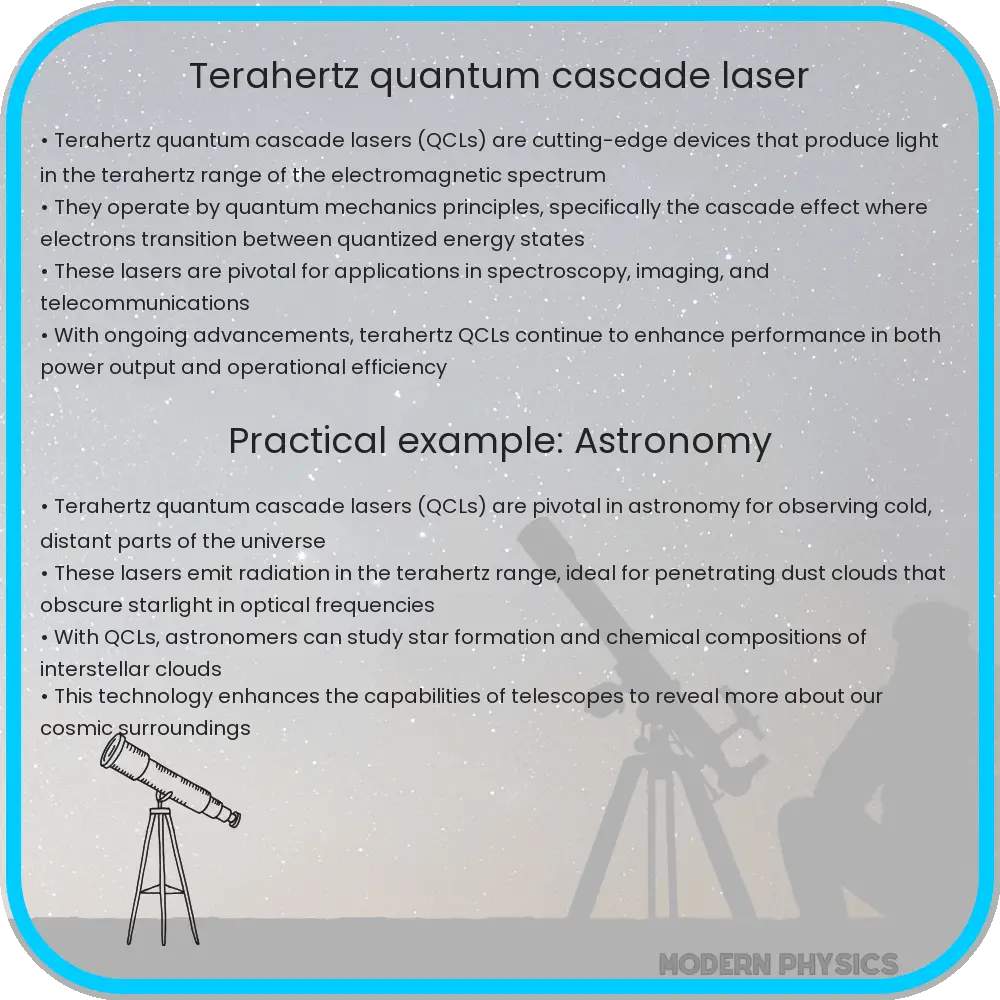
Terahertz Quantum Cascade Lasers (QCLs) represent a significant breakthrough in laser technology, offering unprecedented precision, speed, and control in various applications. These lasers operate in the terahertz (THz) range of the electromagnetic spectrum, which spans from 0.1 to 10 terahertz. This unique capability enables a wide range of applications in spectroscopy, medical imaging, and wireless communication.
Principles of Operation
Quantum Cascade Lasers differ fundamentally from traditional lasers. While conventional lasers rely on electronic transitions between energy bands in a material, QCLs exploit transitions between quantized energy levels within the conduction band of semiconductor heterostructures. This design allows for precise control over the emitted wavelength, which is essential for applications requiring specific radiation characteristics.
Key Features and Advantages
- Precision: The ability to fine-tune the emission wavelength of QCLs enables high-precision spectroscopy. This is particularly useful in chemical and environmental sensing, where detecting specific molecular signatures is crucial.
- Speed: Terahertz QCLs can operate at extremely high frequencies. This speed makes them ideal for fast data transmission in wireless communication, significantly enhancing bandwidth and data rates.
- Control: The engineering of the semiconductor layers in QCLs allows for tailored emission properties. This level of control is beneficial in applications like medical imaging, where specific frequencies can penetrate different materials.
Applications of Terahertz QCLs
Terahertz QCLs have found their place in a variety of fields. In medical diagnostics, they are used for non-invasive imaging techniques, offering safer alternatives to X-rays. In security, they enable the detection of concealed weapons and explosives. Furthermore, in the field of telecommunications, they are paving the way for the next generation of high-speed wireless networks.
Their unique properties also make them suitable for environmental monitoring, as they can detect trace gases and pollutants. This capability is vital for studying atmospheric chemistry and addressing climate change challenges.
In summary, Terahertz Quantum Cascade Lasers are revolutionizing the way we interact with the electromagnetic spectrum. Their precision, speed, and control open new avenues in scientific research and practical applications, making them a critical component of modern technology.
Challenges and Future Directions
Despite their numerous advantages, Terahertz QCLs also face some challenges. One of the main issues is their need for cryogenic cooling, which complicates their deployment in portable devices. Researchers are actively working on developing QCLs that can operate at higher temperatures, aiming to make them more practical for everyday applications. Additionally, improving the power efficiency of these lasers remains a key area of focus.
Innovations in Terahertz QCL Technology
Recent advancements in semiconductor materials and fabrication techniques have led to significant improvements in QCL performance. The use of new materials like graphene and advanced quantum well structures has resulted in lasers that are more efficient, reliable, and capable of operating at higher temperatures. Furthermore, innovations in laser design, such as distributed feedback mechanisms, have enhanced the spectral purity and beam quality of QCL emissions.
Integrating Terahertz QCLs with Other Technologies
Integrating Terahertz QCLs with other technologies like silicon photonics and nanotechnology is a growing research area. Such integration could lead to compact, highly efficient, and multifunctional devices, opening up new possibilities in various sectors, including healthcare, environmental monitoring, and telecommunications.
Conclusion
Terahertz Quantum Cascade Lasers are at the forefront of laser technology, offering unparalleled precision, speed, and control. Their ability to operate in the terahertz range has unlocked new possibilities in spectroscopy, imaging, and communication. While challenges like the need for cryogenic
cooling and power efficiency persist, ongoing research and technological advancements are continually addressing these issues. The integration of QCLs with other cutting-edge technologies is anticipated to further expand their applications, making them an increasingly vital tool in scientific and industrial fields. As we continue to explore and harness the capabilities of Terahertz QCLs, their impact on technology and society is poised to grow, leading to breakthroughs across a broad spectrum of applications. In conclusion, Terahertz Quantum Cascade Lasers not only represent a remarkable scientific achievement but also signify a stepping stone towards the future of high-precision, high-speed, and controlled laser applications.