
Explore the transformative power of Quantum Cascade Lasers in precision, innovation, and diverse applications from healthcare to telecommunications.
Quantum Cascade Lasers: Revolutionizing Precision and Power in Quantum Innovation
The realm of quantum technology has witnessed a significant leap forward with the advent of Quantum Cascade Lasers (QCLs). These highly specialized lasers have transformed various scientific and industrial applications, thanks to their precision, power, and unique quantum mechanical operations. Unlike conventional lasers that rely on electronic transitions in atoms or semiconductors, QCLs operate on quantum mechanics principles, making them a cornerstone in modern photonic technology.
Understanding the Mechanics of Quantum Cascade Lasers
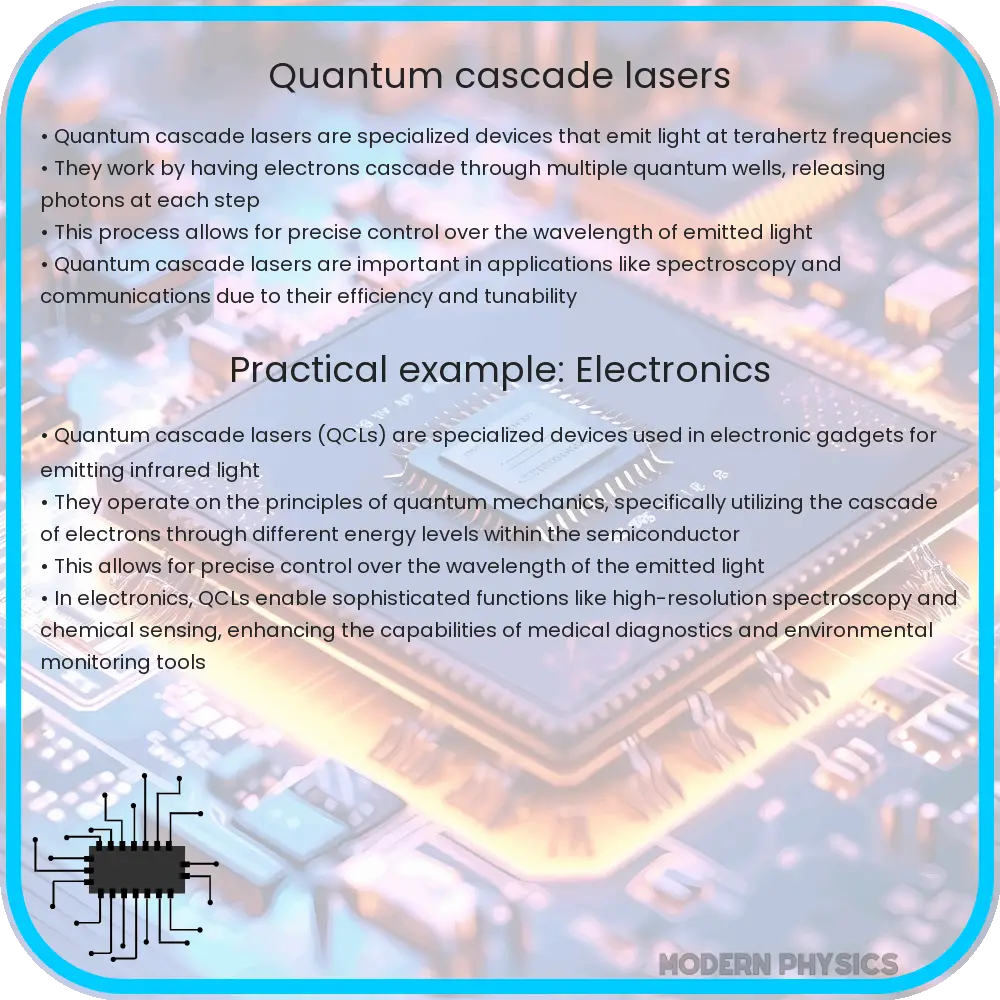
At the heart of a Quantum Cascade Laser’s functionality is its unique structure. QCLs are composed of multiple quantum wells and barriers, creating a series of discrete energy states. Electrons transit through these states, emitting photons at each step. This cascade effect is pivotal in QCLs, as it allows for the generation of coherent light over a range of mid-infrared to terahertz frequencies. This attribute makes QCLs highly adaptable for various applications, ranging from environmental sensing to medical diagnostics.
Advantages of Quantum Cascade Lasers
One of the standout features of QCLs is their ability to operate at room temperature, a significant advancement over other types of infrared lasers. Moreover, the wavelength of QCLs can be precisely tailored by altering the thickness of the quantum wells. This level of control is unmatched in other laser technologies, offering immense benefits in fields requiring high precision and specificity.
- High Power Output: QCLs are renowned for their high-power output, making them ideal for applications needing intense light sources.
- Wide Wavelength Range: The ability to cover a broad spectrum of wavelengths, particularly in the mid-infrared range, opens up new possibilities in spectroscopy and chemical analysis.
- Compact and Efficient: Their compact size coupled with high efficiency makes QCLs suitable for portable and space-constrained applications.
Furthermore, QCLs have a robust design, making them less susceptible to external disturbances and fluctuations. This durability ensures consistent performance, critical in precision-demanding tasks like hazardous material detection or astronomical observations.
Applications of Quantum Cascade Lasers
Quantum Cascade Lasers have found a myriad of applications across diverse fields. In environmental monitoring, they play a crucial role in detecting trace gases and pollutants. In healthcare, QCLs are used in breath analysis and tissue spectroscopy, providing non-invasive diagnostic techniques. Additionally, their high-resolution capabilities make them invaluable in military and security applications for surveillance and targeting.
Moreover, QCLs are at the forefront of scientific research, aiding in the exploration of new materials and quantum computing components. Their ability to generate terahertz radiation is particularly promising for imaging and spectroscopy in physics and material science.
In conclusion, Quantum Cascade Lasers exemplify the fusion of quantum mechanics and photonic technology, offering unparalleled precision and versatility. Their continued development and integration into various fields signify a new era of innovation and discovery.
The Future Prospects and Challenges of Quantum Cascade Lasers
As the technology behind Quantum Cascade Lasers (QCLs) continues to evolve, the potential applications and impact on various sectors seem limitless. Advanced research is underway to enhance the power efficiency and output of QCLs, aiming to make them more sustainable and accessible for widespread use. Future iterations of these lasers may see them becoming smaller, more energy-efficient, and capable of operating over an even broader range of frequencies.
However, there are challenges to be addressed. The high cost of producing QCLs, primarily due to their complex manufacturing process and the need for specialized materials, remains a significant hurdle. Furthermore, integrating these advanced lasers into existing systems and technologies requires careful consideration and design, ensuring compatibility and maximizing their unique advantages.
Integrating Quantum Cascade Lasers into Industry and Research
Industries are keenly observing the development of QCLs, anticipating their integration into commercial products. The telecommunication sector, for example, sees potential in using QCLs for high-speed, secure data transmission. In manufacturing, QCLs can be employed for precise material processing and quality control, thanks to their accuracy and power.
In academic and research circles, QCLs are proving to be invaluable tools. Their precise wavelength control and high spectral purity are advantageous for studying molecular structures and dynamics. This precision opens new frontiers in understanding chemical reactions, biological processes, and novel materials at a molecular level.
Conclusion: Embracing the Quantum Leap
Quantum Cascade Lasers represent a monumental step in laser technology and quantum physics. Their unique operating principles, based on quantum mechanics, allow for unprecedented precision and versatility in generating laser light. As QCLs continue to evolve, they promise to revolutionize fields ranging from environmental monitoring to healthcare, telecommunications, and beyond.
The challenges in cost and integration notwithstanding, the future of QCLs is bright. Their potential to drive innovation and discovery in numerous disciplines cannot be overstated. As technology advances, we can expect Quantum Cascade Lasers to become more integral in various applications, heralding a new era of scientific and industrial breakthroughs driven by quantum innovation.