
Explore the applications, safety, and emerging trends of Terahertz Radiation Technology, a breakthrough in imaging and communication.
Understanding Terahertz Radiation Technology
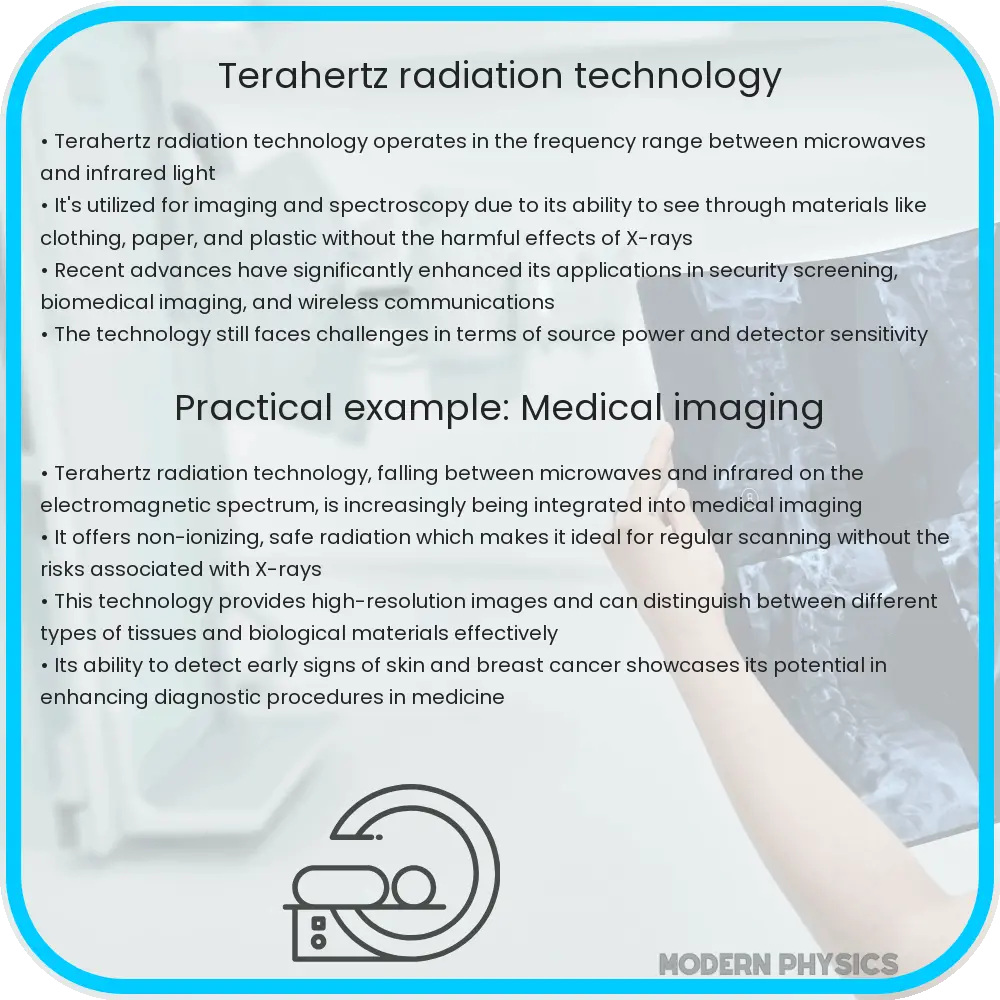
Terahertz (THz) radiation technology, situated in the electromagnetic spectrum between microwaves and infrared light, has emerged as a potent tool in various scientific and industrial applications. Terahertz waves, typically defined within the frequency range of 0.1 to 10 THz, offer unique advantages due to their non-ionizing nature and ability to penetrate a wide range of non-conducting materials.
Applications of Terahertz Radiation
- Medical Imaging: THz waves are employed in advanced imaging techniques, offering safer alternatives to X-rays. Their non-ionizing radiation poses less risk to biological tissues, making them ideal for soft tissue imaging.
- Pharmaceutical Quality Control: In pharmaceuticals, THz spectroscopy is used to analyze the crystalline structure of drugs, ensuring quality and efficacy.
- Security Screening: THz imaging is increasingly used in security checkpoints for detecting concealed weapons and explosives, as it can penetrate clothing and packaging materials without harmful effects.
- Wireless Communications: Terahertz technology promises to revolutionize wireless communication, offering ultra-high-speed data transmission, crucial for the development of 6G networks.
Safety of Terahertz Radiation
One of the primary concerns with any radiation technology is safety. Terahertz radiation, being non-ionizing, does not possess enough energy to ionize atoms or molecules and hence is generally considered safe. Unlike X-rays, THz waves do not damage DNA or living tissues, reducing concerns about long-term exposure effects. However, ongoing research is necessary to fully understand any potential health impacts, especially with increasing use in various sectors.
Emerging Trends in Terahertz Technology
Terahertz technology is rapidly evolving, with new applications and improvements constantly emerging. One notable trend is the miniaturization of THz devices, making them more portable and accessible for various uses. Advances in THz quantum cascade lasers have enhanced the power and efficiency of THz sources, broadening their applicability. Furthermore, integration with artificial intelligence and machine learning is opening new frontiers in data analysis and interpretation of THz imaging and spectroscopy results.
The potential of terahertz radiation technology is vast, and its impact on industries ranging from healthcare to telecommunications is just beginning to be realized. As research continues, we can expect to see further innovations and applications of this transformative technology.
Challenges and Future Directions in Terahertz Radiation Technology
Despite its promising applications, terahertz radiation technology faces several challenges. One of the primary hurdles is the efficient generation and detection of THz waves. Current THz sources and detectors are often bulky, expensive, and energy-intensive, limiting their widespread adoption. Additionally, the atmospheric absorption of THz waves, particularly in humid conditions, poses significant challenges for outdoor applications, such as long-range communications and remote sensing.
Interdisciplinary Collaboration in THz Research
Advancements in terahertz technology are often the result of interdisciplinary efforts, combining insights from physics, materials science, engineering, and computer science. This collaborative approach is essential for overcoming technical challenges and developing innovative applications. For instance, new materials like graphene and advanced semiconductors are being explored for more efficient THz wave generation and detection.
Regulatory and Ethical Considerations
As THz technology becomes more prevalent, regulatory frameworks need to be established to ensure safe and ethical usage. Issues such as privacy in THz imaging and data security in THz communications require careful consideration. Standardization of THz equipment and protocols is also crucial for ensuring compatibility and safety across different applications and industries.
Conclusion
Terahertz radiation technology stands at the forefront of scientific and technological innovation, offering transformative possibilities across various fields. Its unique properties, such as the ability to penetrate non-conducting materials and non-ionizing nature, make it a versatile and safe tool. While challenges like efficient wave generation and atmospheric absorption persist, ongoing research and interdisciplinary collaboration continue to drive advancements in this field. As we navigate the ethical and regulatory landscapes, the potential of THz technology to impact areas like medical imaging, pharmaceuticals, security, and wireless communications is immense. The future of terahertz radiation technology is bright, with its influence expected to grow significantly in the coming years, shaping the way we approach diagnostics, security, communication, and beyond.