
Explore the origins, evolution, and significance of supernova progenitors, uncovering the explosive events that shape our universe and influence cosmic evolution.
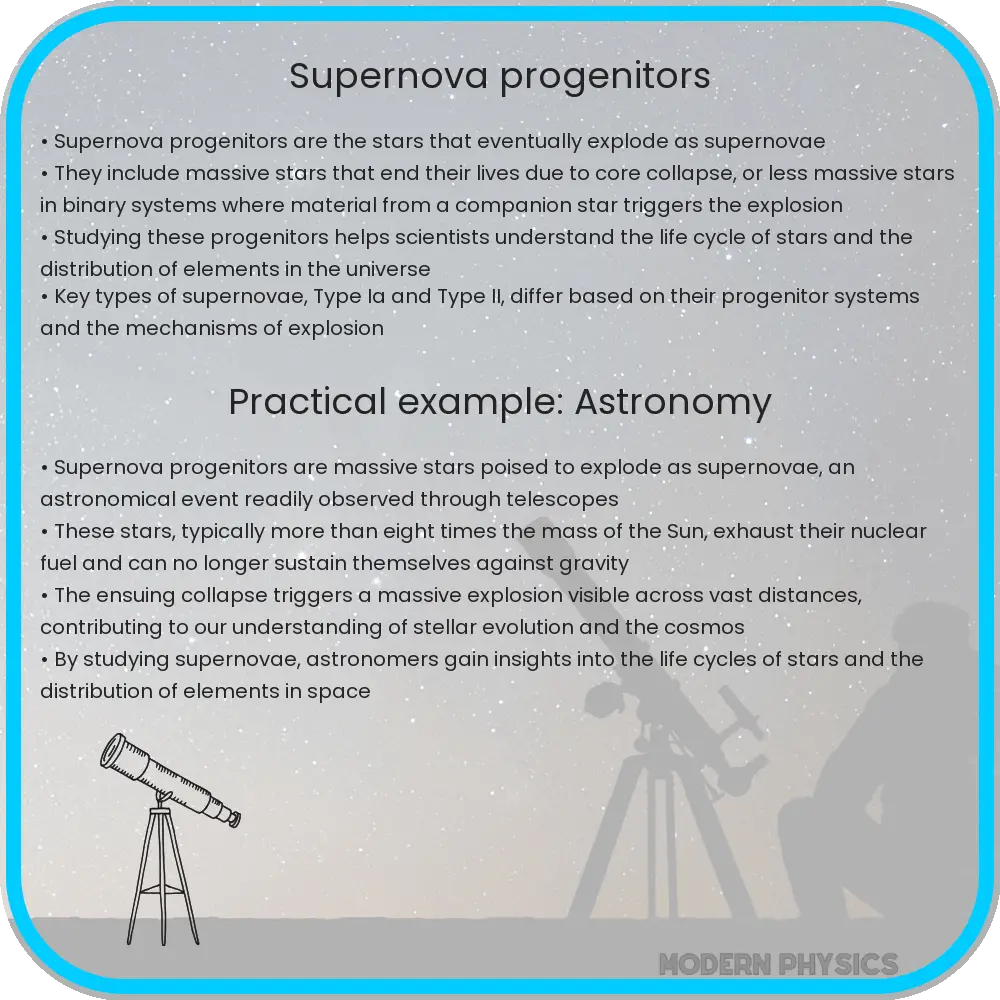
Understanding Supernova Progenitors
Supernovae, the most explosive events in the universe, have intrigued astronomers and astrophysicists for centuries. These cosmic events signify the explosive death of a star, leading to the release of immense amounts of energy and the formation of new elements. The precursors to these spectacular explosions, known as supernova progenitors, play a crucial role in the life cycle of stars and the evolution of galaxies.
Origins and Evolution of Supernova Progenitors
The journey to becoming a supernova progenitor begins with the star’s birth in dense molecular clouds. These progenitors can be broadly classified into two main types based on their mass and evolutionary pathways: Type I and Type II supernovae progenitors.
- Type I Supernova Progenitors: These are typically white dwarf stars in binary systems. A white dwarf accumulates matter from its companion star, increasing in mass until it approaches the Chandrasekhar limit, approximately 1.4 times the mass of the Sun. This critical mass triggers a thermonuclear explosion, resulting in a Type I supernova.
- Type II Supernova Progenitors: These stars are massive, solitary stars with at least 8 times the mass of the Sun. They undergo a series of nuclear fusion reactions, creating elements up to iron (Fe). Once the core is primarily iron, further fusion is not energetically favorable, leading to core collapse and the subsequent supernova explosion.
The evolution of these progenitors is dictated by factors such as mass, age, chemical composition, and presence in binary systems. As they evolve, these stars undergo various changes in their core and outer layers, setting the stage for their ultimate fate as supernovae.
Forecasts and Significance
Understanding the origins and evolution of supernova progenitors is crucial for astrophysics, providing insights into stellar evolution, galactic chemical evolution, and the universe’s expansion. By studying these progenitors, scientists can predict potential supernova events and gain a deeper understanding of the cosmos.
Forecasting Supernova Events
Predicting when and where a supernova will occur is an area of ongoing research. While it is challenging to forecast an exact time, certain indicators, such as increased brightness or changes in the emission spectrum, can signal a star’s imminent demise. Astronomers utilize sophisticated telescopes and instruments to monitor stars that exhibit these characteristics, hoping to catch a supernova in its early stages.
Technological Advancements and Observational Strategies
Advancements in technology and observational techniques have significantly improved our ability to detect and study supernova progenitors. Instruments like the Hubble Space Telescope, the Very Large Telescope (VLT), and the upcoming James Webb Space Telescope (JWST) allow for detailed observations of distant stars. Additionally, networks of telescopes and automated survey programs, such as the Panoramic Survey Telescope and Rapid Response System (Pan-STARRS), are designed to detect transient astronomical events like supernovae.
These technological advancements, combined with theoretical models, enable scientists to piece together the life cycles of stars and the mechanics of supernova explosions. They also help in identifying potential supernova candidates and understanding the distribution of elements throughout the universe, a process known as nucleosynthesis.
Implications for Astrophysics and Beyond
The study of supernova progenitors extends beyond the realm of astrophysics, influencing cosmology, particle physics, and even biology. Supernovae are responsible for the creation and distribution of heavy elements, such as carbon and iron, which are essential for life as we know it. Furthermore, the energy and particles released by supernovae can trigger the formation of new stars, contributing to the cyclical nature of cosmic evolution.
Moreover, supernovae play a pivotal role in measuring cosmic distances. Type Ia supernovae, in particular, are known as “standard candles” due to their consistent peak brightness. This characteristic allows astronomers to calculate distances to galaxies, thereby aiding in the determination of the universe’s expansion rate.
Conclusion
Supernova progenitors are fundamental to our understanding of the universe. Their study sheds light on the life and death of stars, the chemical makeup of the cosmos, and the expansion of the universe. As technology and observational methods continue to evolve, our grasp of these celestial phenomena will grow, leading to more accurate forecasts and deeper insights into the fabric of the cosmos. Through the lens of supernova progenitors, we gain a clearer picture of our place in the universe and the cosmic processes that shape it.