
Explore the fascinating world of stellar chromospheres, their features like spicules and flares, and their impact on star-planet interactions and habitability.
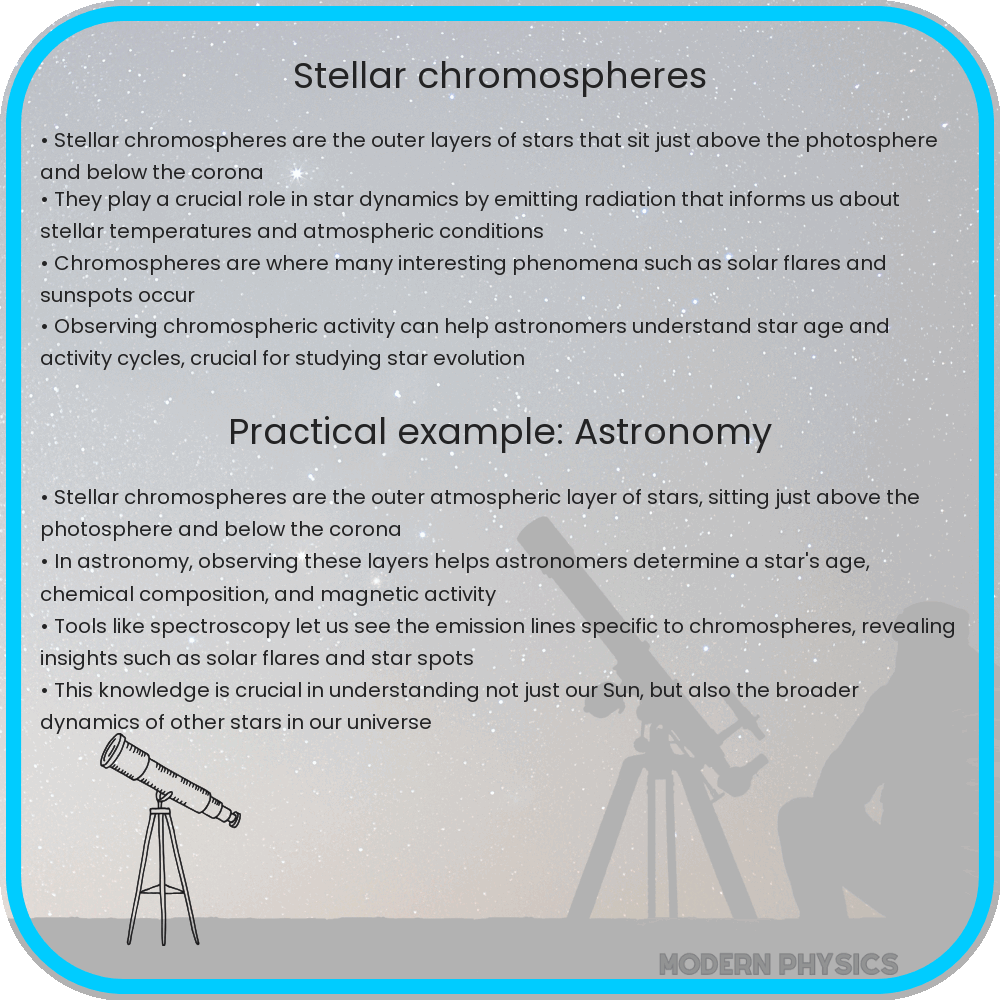
Understanding Stellar Chromospheres
The chromosphere is an essential layer in the atmosphere of stars, including our Sun. It sits above the photosphere and beneath the corona, playing a critical role in stellar dynamics. Understanding the chromosphere’s properties, features, and impacts not only enhances our comprehension of stellar processes but also helps in the study of stellar evolution and space weather phenomena.
Key Features of Stellar Chromospheres
Stellar chromospheres are characterized by their unique spectral lines, most notably the H-alpha line at 6562.8 Ångströms, which is a specific kind of light emitted by hydrogen atoms. This emission is a hallmark of the chromospheric activity and provides crucial information about the star’s magnetic field, temperature, and gas motions. Another notable feature is the presence of spicules and filaments, which are dynamic jet-like structures that contribute to the mass and energy transfer between the chromosphere and the corona.
- Temperature Gradient: Unlike the cooler photosphere, the chromosphere experiences a temperature increase with altitude, ranging from about 4,500K to upwards of 25,000K. This temperature inversion is a result of the complex interactions between magnetic fields and plasma.
- Magnetic Activity: Stellar chromospheres exhibit varied levels of magnetic activity, influencing the formation of sunspots, flares, and other solar phenomena. The activity level is often correlated with the star’s age and rotational speed.
Impact of Chromospheric Activity
The activity within a star’s chromosphere has profound implications both on the star itself and its surrounding environment. Energetic events like solar flares and coronal mass ejections originate from this region, impacting space weather and potentially affecting planetary atmospheres and technology on Earth. Furthermore, the study of chromospheric activity aids in the understanding of stellar lifecycles and the behavior of exoplanets orbiting other stars.
By analyzing the light from stellar chromospheres, astronomers can deduce vital information regarding the star’s magnetic field strength, surface temperature variations, and overall activity levels. This analysis is crucial for predicting solar activity cycles and understanding the fundamental processes driving stellar evolution.
Understanding Stellar Chromospheres
The stellar chromosphere is a layer of a star’s atmosphere situated above the photosphere and beneath the corona. Characterized by its complex magnetic fields and dynamic activity, the chromosphere is vital for understanding stellar behavior and evolution. This layer showcases a diverse range of features, including spicules, filaments, and flares, significantly impacting stellar and planetary systems.
Key Features of Stellar Chromospheres
- Spicules: These are narrow, jet-like features that eject material from the photosphere into the chromosphere, contributing to the heating of the upper layers.
- Filaments: These are large, dark structures observed against the brighter background of the chromosphere, formed by cool plasma suspended by magnetic fields.
- Flares: Sudden, intense bursts of radiation stemming from the release of magnetic energy, flares can significantly influence space weather and planetary atmospheres.
Impact of Chromospheric Activity
Stellar chromospheric activity plays a critical role in star-planet interactions and the habitability of surrounding exoplanets. Flares and other chromospheric phenomena can affect planetary atmospheres, potentially stripping away essential elements and affecting climate stability. Additionally, the study of chromospheric activity helps in understanding the magnetic field structure and dynamics of stars, which is crucial for comprehensively modeling stellar and galactic evolution.
Conclusion
The study of stellar chromospheres bridges the gap between stellar interiors and the interstellar environment, offering insights into the magnetic activities and energetic phenomena shaping our universe. By analyzing the features and impacts of chromospheric activity, astronomers can better understand the life cycles of stars and the conditions necessary for supporting life on surrounding planets. As observational techniques improve, our knowledge of these fascinating stellar layers continues to expand, highlighting the intricate connections between stars and their cosmic surroundings.