
Explore the vibrant world of starburst galaxies: their formation, evolution, and impact on astrophysics, including star formation rates and galactic interactions.
Understanding Starburst Galaxies
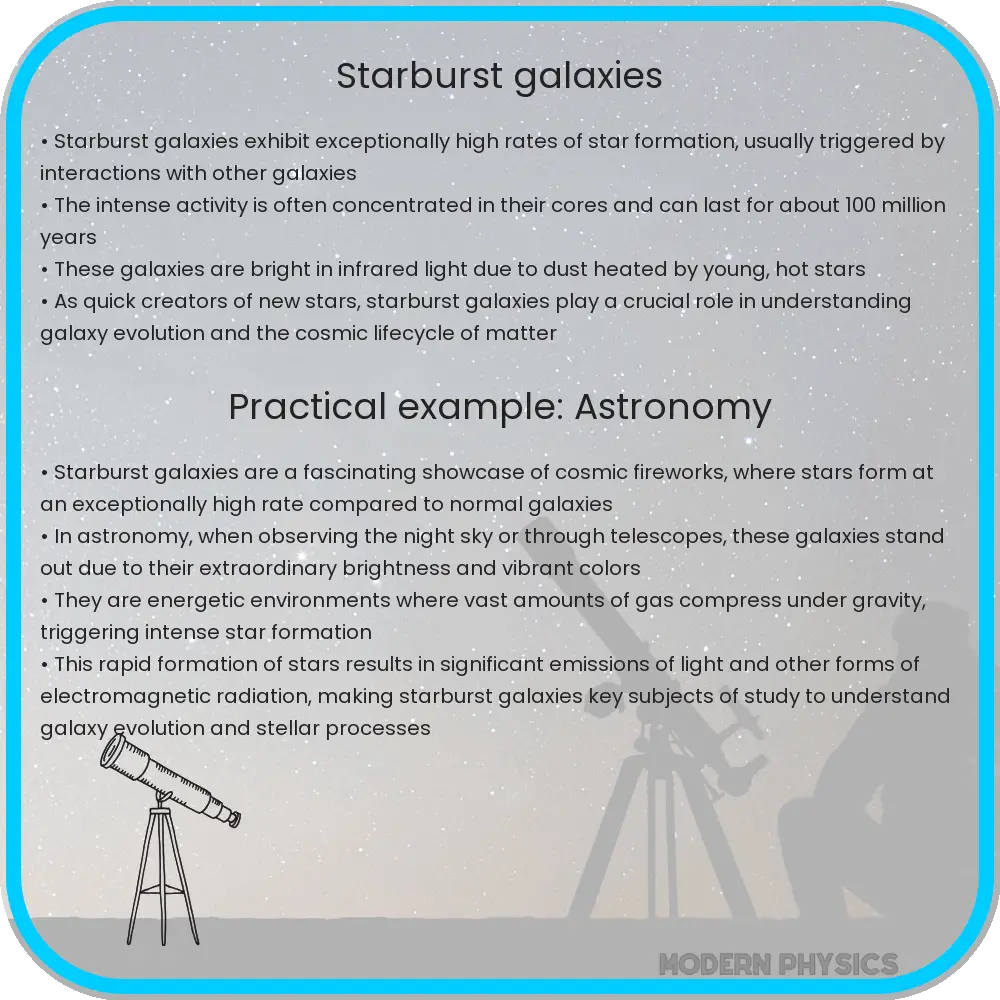
Starburst galaxies represent some of the most vibrant and dynamic systems in the universe. These galaxies experience an exceptionally high rate of star formation, significantly higher than the average rates seen in typical spiral or elliptical galaxies. The term ‘starburst’ itself denotes the explosive and rapid creation of stars, often resulting in intense luminosity and significant galactic evolution.
Formation of Starburst Galaxies
The formation of starburst galaxies is often triggered by specific astrophysical conditions and events. One of the primary catalysts is the collision or interaction between two or more galaxies. Such interactions disturb the gas clouds within the galaxies, leading to gravitational instabilities and subsequently triggering intense star formation. Additionally, the accumulation of gas in certain regions of a galaxy, often caused by internal processes or external accretion, can also initiate a starburst phase.
Evolution and Characteristics
During the starburst phase, a galaxy can undergo significant changes. The intense star formation leads to the rapid consumption of the interstellar medium, the gas and dust from which new stars are born. This phase is characterized by the presence of numerous young, massive stars, which contribute to the galaxy’s high luminosity. These massive stars, however, have short lifespans. They quickly exhaust their nuclear fuel and end their lives as supernovae, releasing vast amounts of energy and heavier elements into the surrounding medium.
This explosive end to massive stars plays a crucial role in the evolution of starburst galaxies. The supernovae inject energy into the surrounding gas, which can lead to the formation of new stars while also heating and dispersing the gas, potentially quenching further star formation. This process, known as feedback, is essential in regulating the starburst activity and shaping the future of the galaxy.
Impact in Astrophysics
Starburst galaxies have a significant impact on the field of astrophysics. They serve as natural laboratories for studying the processes of star formation and galaxy evolution. Furthermore, the phenomena associated with starbursts, such as supernovae and the creation of heavy elements (elements heavier than hydrogen and helium), are critical to understanding the chemical evolution of the universe. By examining starburst galaxies, astronomers can gain insights into the lifecycle of galaxies and the cosmic web of matter in the universe.
Observational Challenges and Techniques
Observing and studying starburst galaxies presents unique challenges. Due to their vast distances and the obscuring effects of interstellar dust, specialized observational techniques are essential. Infrared and radio telescopes are particularly valuable, as they can penetrate dust clouds and reveal the intense star-forming regions hidden within. Additionally, space-based observatories equipped with ultraviolet and X-ray detectors provide crucial data on the high-energy processes occurring in these galaxies.
Spectroscopic analysis is another critical tool, allowing astronomers to decipher the chemical compositions, temperatures, and velocities within starburst regions. This data is vital for understanding the lifecycle of massive stars and the dynamics of galactic nuclei, often prevalent in starburst environments.
The Role of Starburst Galaxies in Cosmic Evolution
Starburst galaxies play a pivotal role in the broader context of cosmic evolution. The processes within these galaxies, such as massive star formation and supernova explosions, contribute significantly to the chemical enrichment of the intergalactic medium. Elements synthesized in the cores of massive stars and distributed by supernovae are essential for the formation of planets and life as we know it.
Furthermore, the intense radiation and stellar winds from young, massive stars can influence the formation and evolution of nearby galaxies, contributing to the complex interplay of forces that shape the universe. The study of starburst galaxies thus provides insights not only into the mechanics of galaxies themselves but also into the processes that drive the evolution of the cosmos.
Conclusion
Starburst galaxies are essential keys to unlocking the mysteries of the universe. Their unique properties and dynamic behaviors offer insights into the processes of star formation, galaxy evolution, and cosmic chemical enrichment. Despite the observational challenges they present, advances in technology and methodology continue to unveil the secrets of these luminous phenomena. As our understanding of starburst galaxies expands, so too does our knowledge of the vast, intricate tapestry of the cosmos. Through the study of these extraordinary systems, we inch closer to answering fundamental questions about the origin and evolution of the universe and our place within it.