
Explore the Strong CP Problem in quantum mechanics, its impact on particle physics, and theories like Peccei-Quinn and supersymmetry as solutions.
Understanding the Strong CP Problem in Quantum Mechanics
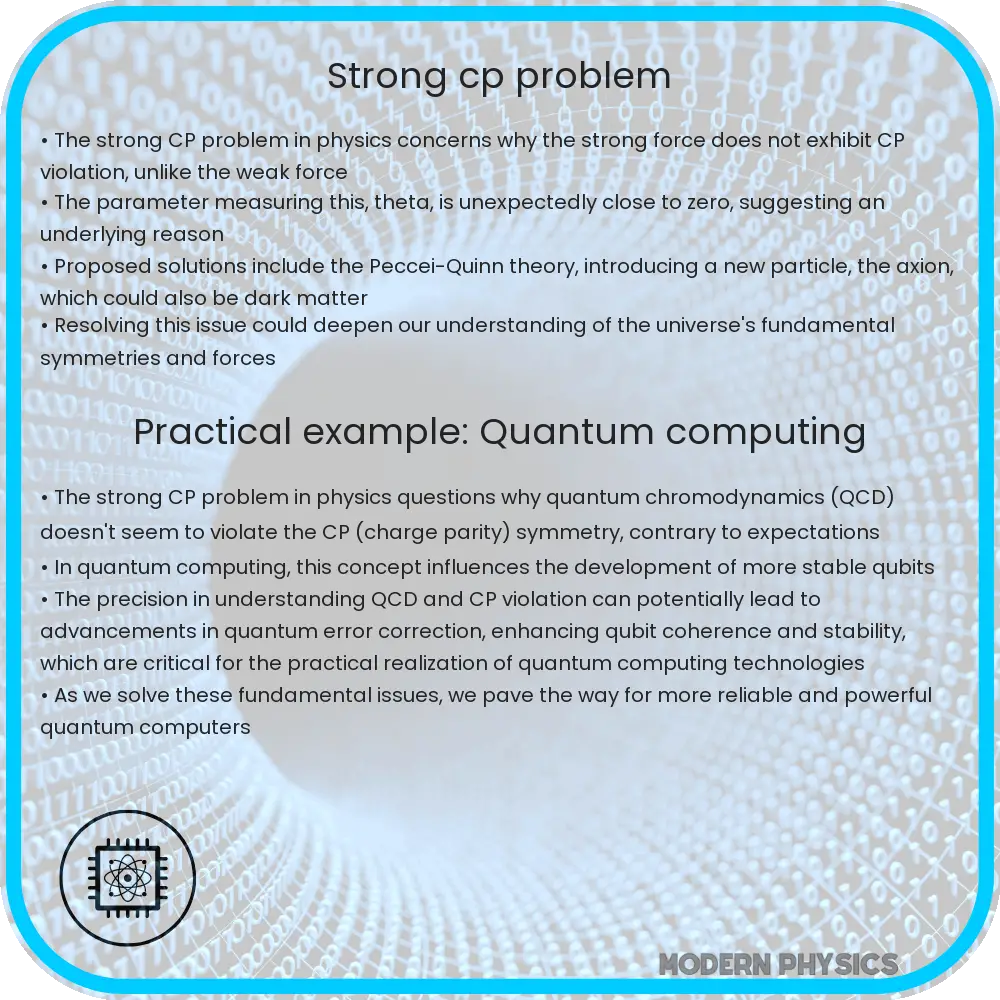
The Strong CP Problem is a fundamental puzzle in the realm of quantum physics, particularly within the framework of the Standard Model of particle physics. This issue arises from the intersection of quantum chromodynamics (QCD) – the theory that describes the strong nuclear force – and CP (Charge Parity) symmetry, a key concept in particle physics. The problem highlights an unexpected absence of CP violation in strong interactions, which contradicts theoretical expectations.
In the Standard Model, CP symmetry relates to the interchangeability of particles with their antiparticles, accompanied by a mirror inversion of their spatial coordinates. While CP violation is observed in weak nuclear forces, it is mysteriously absent in strong interactions. This absence is quantified by the so-called Theta (θ) angle in QCD, a theoretical parameter expected to influence the degree of CP violation. The enigma lies in the fact that experimental observations suggest that θ is extremely close to zero, an unanticipated scenario leading to the Strong CP Problem.
To delve deeper, let’s consider the concept of symmetry in physics. Symmetry is a cornerstone in our understanding of physical laws, indicating that certain properties of systems remain invariant under specific transformations. In the case of the Strong CP Problem, the relevant symmetry is CP symmetry. The Standard Model predicts that if CP symmetry were violated in strong interactions, it would lead to observable effects like a measurable electric dipole moment in the neutron. However, experiments have repeatedly shown that the neutron’s electric dipole moment is too small to measure, suggesting an almost perfect CP symmetry in strong interactions.
This contradiction between theory and experiment poses a significant challenge to physicists. Several theoretical solutions have been proposed to resolve the Strong CP Problem. One of the most prominent among these is the introduction of a new hypothetical particle called the axion. The axion model not only proposes a mechanism to neutralize CP violation in the strong force but also provides a potential candidate for dark matter. However, despite extensive searches, axions remain elusive, and their existence is yet to be confirmed.
Other theoretical approaches include the possibility of additional symmetries or new physics beyond the Standard Model. For instance, some theories suggest that the θ angle might be naturally small due to an underlying symmetry of the universe, a concept known as CP conservation.
Exploring Solutions to the Strong CP Problem
The pursuit of a resolution to the Strong CP Problem has led to numerous intriguing theories and proposals. One prominent approach is the Peccei-Quinn (PQ) theory, which extends the Standard Model to include a new global symmetry. This symmetry, when spontaneously broken, predicts the existence of axions, offering a natural solution to the Strong CP Problem. The PQ theory elegantly adjusts the θ angle to zero dynamically, thus explaining the absence of CP violation in strong interactions.
Another approach involves speculating about the role of supersymmetry, a theoretical framework that posits a symmetric relationship between the fundamental particles of matter (fermions) and force-carrying particles (bosons). Some supersymmetric models naturally incorporate mechanisms that could explain the smallness of the θ angle, potentially offering a solution to the Strong CP Problem. However, like the axion hypothesis, supersymmetry has yet to be experimentally verified, remaining a theoretical construct.
Besides these, there are other less mainstream theories that attempt to tackle the problem. These include models suggesting mirror particles or proposing new dimensions of space-time. Each of these theories brings its unique perspective, but they all share a common goal: to reconcile the apparent contradiction between the theoretical prediction of CP violation in strong interactions and the empirical evidence to the contrary.
The quest to solve the Strong CP Problem is not just an academic exercise. It carries profound implications for our understanding of the universe. Resolving this puzzle could lead to a deeper comprehension of the fundamental forces that govern the cosmos and might even provide insights into the nature of dark matter and other unsolved mysteries in physics.
Conclusion
The Strong CP Problem remains one of the most intriguing and unresolved issues in theoretical physics. It stands at the crossroads of quantum mechanics, cosmology, and particle physics, challenging our understanding of fundamental symmetries in the universe. The search for a solution has led to innovative theories, like the Peccei-Quinn theory and concepts of supersymmetry, each opening new avenues of inquiry in the quest to comprehend the fabric of the universe.
As physicists continue to probe the depths of this problem, the potential discoveries could revolutionize our understanding of the natural world. Whether it leads to the confirmation of new particles like axions, the validation of supersymmetry, or an entirely unexpected breakthrough, the resolution of the Strong CP Problem promises to be a pivotal moment in the history of modern physics. It epitomizes the relentless human pursuit of knowledge, reminding us that at the heart of every scientific endeavor lies a fundamental curiosity about the universe we inhabit.