
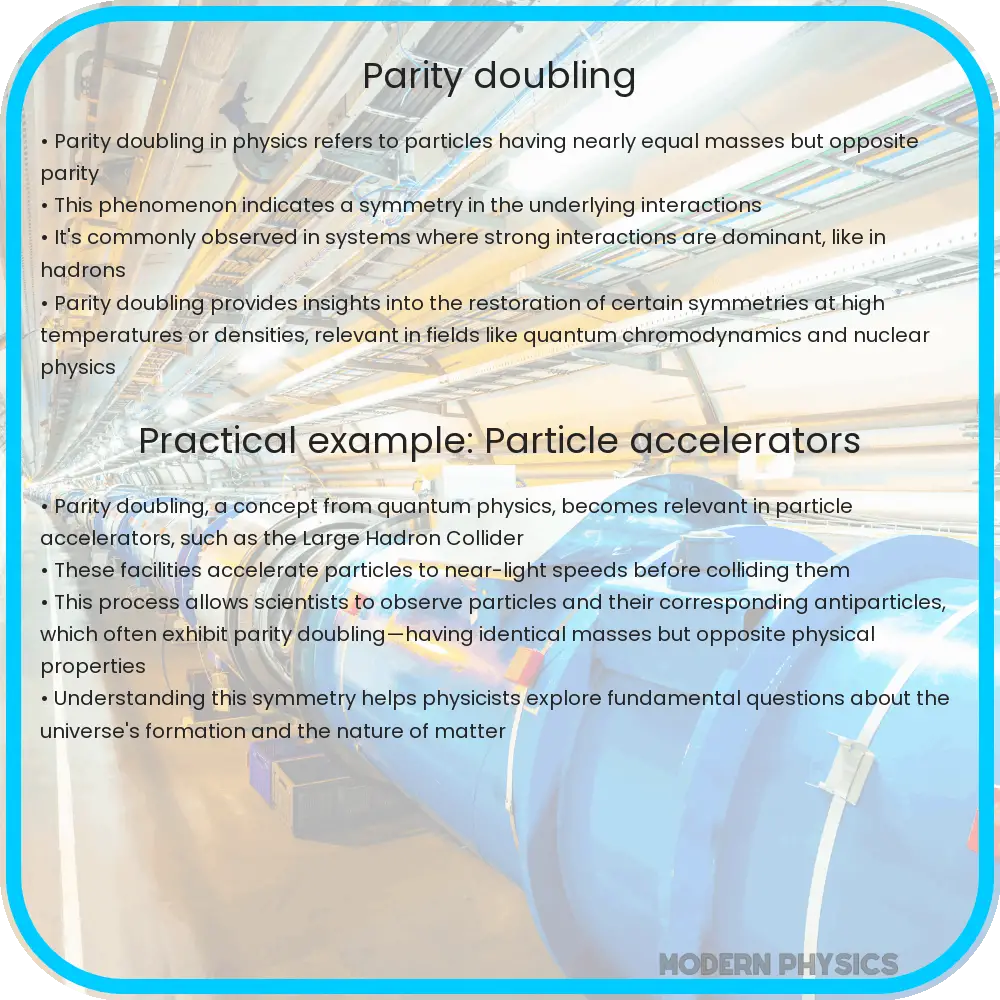
Parity doubling in physics refers to pairs of particles with nearly identical mass but opposite parity, offering insights into symmetrical properties and interactions in quantum systems.
Parity Doubling: Exploring Symmetry in Physics
Parity doubling is a fascinating concept in physics that demonstrates the symmetrical properties of certain quantum mechanical systems. This principle is particularly significant in the realm of particle physics, offering insights into the interactions and intrinsic properties of elementary particles.
In physics, ‘parity’ refers to the symmetry of a system when its spatial coordinates are inverted. Parity transformation essentially involves changing the sign of the spatial coordinates, from (x, y, z) to (-x, -y, -z). The concept of parity helps physicists understand how physical processes are affected when spatial orientations change.
The principle of parity doubling occurs when pairs of particles, or states, have nearly the same mass but opposite parity. These particles are known as parity doublets. The existence of such doublets can be indicative of underlying symmetrical relationships in the forces governing these particles, particularly in strong interaction scenarios, commonly known in the context of quantum chromodynamics (QCD).
Basic Understanding of QCD and Parity
Quantum Chromodynamics (QCD) is the theory of strong interaction—a fundamental force described by the standard model of particle physics that affects quarks and gluons. QCD posits that these particles are held together by gluons, transmitting forces by exchanging these particles amongst quarks.
In the framework of QCD, parity doubling suggests that for every particle with a specific set of quantum numbers and parity, there exists a corresponding particle (or antiparticle) with nearly the same mass but opposite parity. This near mass degeneracy is a hint at a larger symmetry of the QCD vacuum, potentially pointing to aspects of its structure and interactions that are not yet fully understood.
Examples of Parity Doubling
The most clear illustrations of parity doubling can be found in the spectrum of baryons (particles made of three quarks). For example, in the nucleon family of particles, which includes protons and neutrons, observations have suggested states where parity is doubled. These observations are crucial for testing theoretical models of particle interactions based on QCD.
Exploring parity doubling also extends into mesons (particles composed of one quark and one antiquark). Theoretical models predict that mesonic states should exhibit parity doubling, especially at high energies where the effects of the quark masses are minimized, reflecting a symmetrical nature dictated by the strong force.
Importance in Modern Physics
Understanding parity doubling is essential for several reasons. Firstly, it offers a window into the symmetrical properties of the QCD vacuum and the potential existence of new symmetrical principles in nature. Secondly, it helps physicists test and refine models of particle interactions, providing a clearer picture of how fundamental forces operate at a subatomic level. Lastly, studying parity doubled states can also have implications for understanding the early universe and conditions during high energy phenomena like neutron stars or in the aftermath of particle collisions.
In summary, parity doubling serves as a critical concept in advancing our understanding of particle physics, highlighting the intricate symmetries and interactions that define the universe at its most fundamental level. In the next part of this article, we will delve deeper into the theoretical implications and the challenges faced in studying parity doubled states in greater detail.
Challenges and Theoretical Implications
Studying parity doubling involves significant challenges, primarily due to the difficulty in distinguishing between parity doubled states and other similar particle states. The experimental identification requires precise measurements of particle properties such as mass, decay modes, and production rates. The complexity increases as these measurements must be done under conditions that simulate the high energy environments where parity doubling is expected to be more apparent.
From a theoretical standpoint, understanding parity doubling can lead to enhanced models of quantum chromodynamics. Scientists use advanced computational techniques like lattice QCD, where QCD is simulated on a discrete space-time lattice, allowing for approximation of how quarks and gluons behave. Analyzing the results can provide insights into the symmetry properties of the QCD vacuum, which might be otherwise impossible to discern through conventional experimental methods alone.
Future Directions
The future of studying parity doubling looks promising with advancements in particle accelerator technologies and computational methods. Improvements in accelerator capabilities will allow physicists to produce higher energy collisions, which are crucial for generating and observing parity doubled states. On the computational side, developments in quantum computing and machine learning could revolutionize simulations, making them more accurate and less resource-intensive.
Moreover, interdisciplinary approaches involving field theorists and experimental physicists can foster deeper understandings and potentially unearth new phenomena related to parity doubling. Researchers are also exploring the implications of parity doubling in cosmology, particularly how it influences theories about the evolution of the universe and the behavior of matter under extreme conditions.
Conclusion
Parity doubling is more than just an abstract concept in particle physics; it’s a gateway to understanding the fundamental symmetries that govern our universe. The study of these symmetrical properties not only enriches our knowledge of quantum mechanics and particle interactions but also bridges the gap to potential new physics. As theoretical predictions continue to be tested against experimental data, the exploration of parity doubled states holds the promise of unveiling deeper truths about the very fabric of reality. Whether it’s probing the early universe or predicting the properties of exotic states of matter, the implications of parity doubling are profound and far-reaching, showcasing the ever-evolving landscape of modern physics.