
Explore the impact of QCD-inspired models in quantum physics, their theoretical depth, applications in various fields, and future prospects.
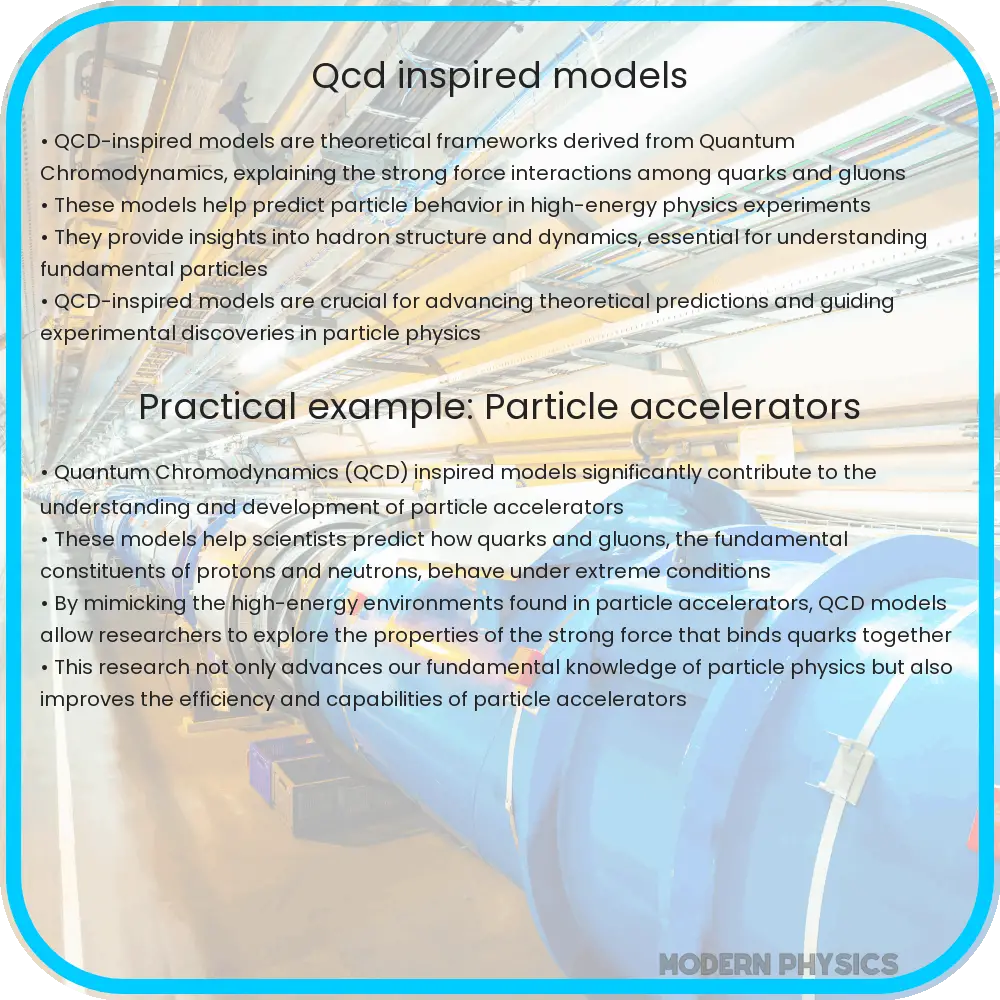
Exploring QCD-Inspired Models in Quantum Physics
Quantum Chromodynamics (QCD), the cornerstone of modern particle physics, profoundly impacts our understanding of the fundamental forces of nature. This theory, central to the Standard Model of particle physics, describes how quarks and gluons interact through the strong force. In recent years, QCD-inspired models have emerged as powerful tools in theoretical physics, offering insights into complex quantum phenomena and potential applications in various fields.
Theoretical Foundations of QCD
QCD is based on the concept of color charge, analogous to electric charge in electromagnetism but with three types: red, green, and blue. Quarks, the building blocks of protons and neutrons, carry these color charges and interact via gluons, the mediators of the strong force. This interaction is characterized by two key properties: asymptotic freedom and confinement. Asymptotic freedom, a unique feature of QCD, explains why quarks behave almost freely at high energies or short distances. In contrast, confinement describes how quarks are perpetually bound within hadrons, like protons and neutrons, and cannot exist in isolation.
QCD-Inspired Models and Theoretical Depth
QCD-inspired models delve into areas where direct calculations from QCD are challenging due to its non-perturbative nature. These models, such as the Nambu–Jona-Lasinio model and the chiral perturbation theory, approximate QCD in various regimes. For instance, the lattice QCD approach discretizes space-time to compute properties of hadrons, providing insights into the mass and structure of these particles. These models serve as a bridge, connecting abstract theoretical concepts with observable phenomena in particle physics.
Applications Across Physics
The applications of QCD-inspired models extend beyond particle physics. In cosmology, they assist in understanding the early universe’s conditions and the evolution of cosmic structures. In condensed matter physics, concepts from QCD help explain phenomena like superconductivity and the behavior of exotic materials under extreme conditions. Furthermore, these models contribute to advancements in computational physics, with algorithms developed for QCD calculations finding applications in other scientific domains.
In summary, QCD-inspired models not only enhance our grasp of quantum mechanics and particle interactions but also pave the way for interdisciplinary applications. Their role in bridging theoretical concepts with practical observations exemplifies the dynamic nature of modern physics.
Challenges and Future Prospects in QCD-Inspired Models
Despite the significant strides made in QCD-inspired models, challenges remain. A primary issue is the complexity of calculations, especially in the non-perturbative regime. Advanced computational techniques, such as lattice QCD, demand immense computational resources. Additionally, translating the insights gained from these models to experimental verification is a daunting task, given the extreme conditions required to study quarks and gluons directly.
Interdisciplinary Impacts of QCD-Inspired Models
The influence of QCD-inspired models extends to various scientific fields. In nuclear physics, they provide a framework for understanding the behavior of nuclear matter under extreme conditions, such as those found in neutron stars. In the field of materials science, insights from QCD help in exploring the quantum properties of novel materials. Moreover, the mathematical techniques developed in QCD research are increasingly applied in areas like machine learning and data analysis, showcasing the broad impact of these models.
Technological Advancements and QCD
The progress in QCD-inspired models is closely tied to technological advancements. The development of powerful supercomputers has allowed for more accurate and detailed simulations. Innovations in detector and accelerator technologies are crucial for experiments that test QCD predictions. As technology evolves, it is expected that new avenues will open up for exploring and validating QCD-inspired models.
Conclusion
Quantum Chromodynamics, with its rich theoretical framework and broad implications, continues to be a pivotal area of study in physics. QCD-inspired models have significantly advanced our understanding of the quantum world and have found applications across a diverse range of scientific disciplines. Despite the challenges inherent in these complex models, their potential to unravel mysteries of the universe and contribute to technological innovation remains immense. As computational and experimental techniques evolve, we can anticipate further breakthroughs and a deeper comprehension of the fundamental forces that govern our universe. The journey of exploring QCD and its inspired models is not only a testament to human curiosity and ingenuity but also a promising path leading to new frontiers in science and technology.