
Explore the Intergalactic Medium (IGM): the vast, ionized hydrogen space between galaxies influencing cosmic evolution, light propagation, and star formation.
Understanding the Intergalactic Medium
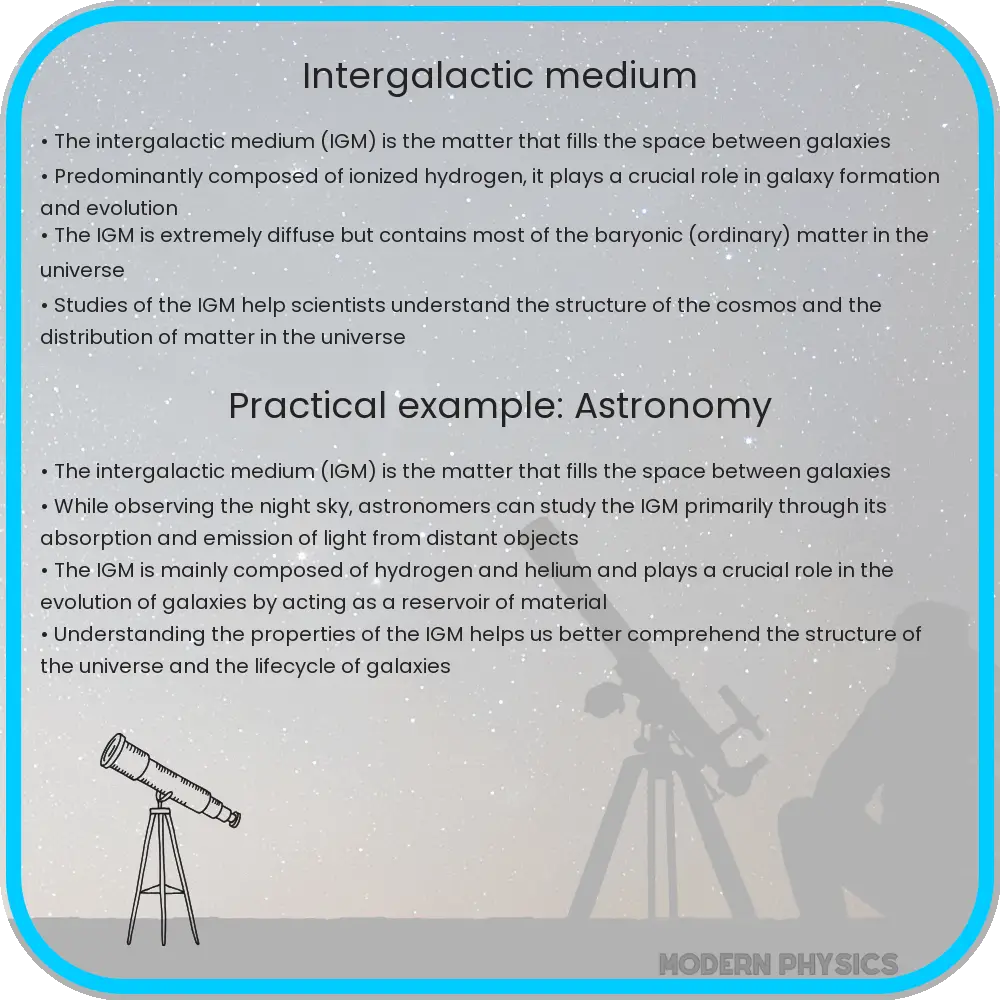
The Intergalactic Medium (IGM) constitutes the matter that exists in the vast spaces between galaxies. Predominantly composed of ionized hydrogen, it plays a crucial role in the structure and evolution of the universe. This near-invisible material influences the formation of galaxies, the propagation of light, and the distribution of elements across cosmic distances.
Composition of the Intergalactic Medium
The primary component of the IGM is ionized hydrogen, or HII. This state results from the stripping away of electrons from hydrogen atoms, a process that occurs under the extreme temperatures found in outer space. Apart from hydrogen, the IGM contains traces of helium (He), and lithium (Li), along with minute quantities of heavier elements like carbon (C), nitrogen (N), and oxygen (O). These elements are leftovers from the processes of stellar evolution and explosions, such as supernovae and the outflows from active galactic nuclei.
Effects of the Intergalactic Medium
The IGM is not a passive entity; it actively shapes the universe. Its ionized state allows it to interact with electromagnetic radiation, affecting the propagation of light through the cosmos. This interaction is evident in phenomena such as the Lyman-alpha forest, a series of absorption lines seen in the spectra of distant quasars, providing crucial information on the structure and density of the IGM. Additionally, the IGM serves as a reservoir for the gas that eventually coalesces to form stars and galaxies, thus playing a vital role in cosmic evolution.
Research and Exploration
Studying the IGM poses significant challenges due to its extremely low density and the vast distances involved. However, advances in astronomical techniques and instruments, such as spectroscopy and high-powered telescopes, have allowed scientists to probe this elusive medium. Research focuses on understanding the temperature, density, and composition of the IGM, as well as its influence on galaxy formation and the evolution of the universe. The ongoing study of the IGM is essential for unraveling the mysteries of cosmic web and the lifecycle of matter in the cosmos.
Techniques for Studying the Intergalactic Medium
Modern astronomers employ various techniques to study the IGM. One of the most effective methods is the use of quasar light spectra. Quasars, extremely bright and distant objects, serve as natural lighthouses, illuminating the intervening IGM. By analyzing the absorption lines in the spectra of quasar light (such as the aforementioned Lyman-alpha forest), researchers can deduce the distribution, density, and composition of the IGM between quasars and Earth. Another method involves studying the Cosmic Microwave Background Radiation, which provides insights into the early universe and helps in mapping the distribution of matter, including the IGM.
Challenges and Future Directions
Despite significant advancements, studying the IGM remains fraught with challenges. Its low density and the immense scales involved make detection and analysis difficult. Additionally, the IGM is dynamic; its properties change over cosmic time scales, adding complexity to its study. Future research will likely focus on improving detection methods, perhaps through the next generation of space telescopes and observatories. Scientists also aim to better understand the interactions between the IGM and galactic structures, shedding light on the continuous cycle of matter in the universe.
Conclusion
The Intergalactic Medium is a critical component of the cosmos, acting as the backdrop to the dramatic play of galaxy formation and evolution. Its study, while challenging, is essential for a comprehensive understanding of the universe’s structure, history, and future. Through the IGM, we can trace the intricate web of matter that connects the cosmos, offering insights into the past and present processes shaping our universe. As research techniques evolve, our understanding of the IGM will continue to deepen, revealing the secrets of the vast, intergalactic expanse and its role in the cosmic lifecycle.